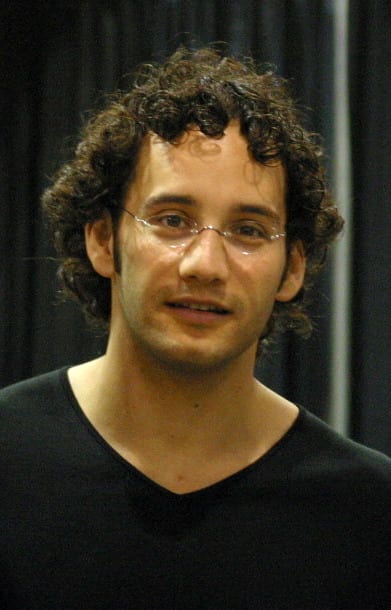
Photo: johnnyscars / Wikimedia Commons (CC BY 2.0)
When Josh Waitzkin was six, he was walking with his mother through Washington Square Park in New York City. People were playing chess on the stone tables there, and he stopped to watch. That was how it started.
His childhood became famous. The 1993 film Searching for Bobby Fischer is based on Josh's early life. Here is his story, the game that shows his attacking style at ten, and five more of his early games you can study.
The Park and the Teacher
At seven, Josh began studying with his first real teacher, Bruce Pandolfini, a well-known New York chess coach. At his school in New York, he helped the chess team win seven national team championships between third and ninth grade, and he won eight national titles of his own.
At 13 he earned the title of National Master. At 16 he became an International Master. In 1993 and 1994 he won the US Junior Championship.
The Game: Josh Waitzkin vs. Edward Frumkin, New York 1987
Josh Waitzkin 1-0 Edward Frumkin New York, 1987 White: Josh Waitzkin, age 10 · Black: Edward Frumkin
This is the game that shows why people talked about Josh's attacking chess. He gives up a rook, then his queen, and checkmates six moves later.
1.e4 c5 2.Nf3 e6 3.d4 cxd4 4.Nxd4 Nf6 5.Nc3 Nc6 6.Be3 Bb4 7.f3 d5 8.Bb5 Bd7 9.Bxc6 bxc6 10.e5 Ng8
Josh's pawn on e5 pushes Black's knight all the way back to g8. That pawn will matter a lot at the end.
11.a3 Ba5 12.b4 Bc7 13.f4 Ne7 14.Na4 O-O 15.Nc5 a5 16.c3 Nc8 17.O-O Nb6 18.Qg4 Nc4 19.Bf2 Qe8 20.Rfe1 Bc8 21.Bh4 Kh8
Look at where Josh's pieces are pointing: the queen on g4, the bishop on h4 and the pawns on e5 and f4 all aim at the squares around the black king.
22.a4 Bb6 23.Rad1 Bxc5 24.bxc5 Nb2 25.Re3
The black knight on b2 attacks the white rook on d1. Josh does not save it. Instead he brings his other rook toward the king with 25.Re3. Our Stockfish 16 check rates White clearly better here.
 8
8


 5
5 4
4


 d
d g
gAfter 25.Re3, Black to move. The black knight on b2 can take the rook on d1. Should it? Look at the white queen, bishop and rook near the black king first.
25...Nxd1
Black takes the rook. Josh is now a rook behind. And now comes the queen.
854dgAfter 25...Nxd1, White to move. White is a rook behind. Our engine finds a forced checkmate. It starts with the most surprising move on the board.
26.Qxg7+
The queen takes the pawn on g7, with check. Black has only one legal reply: the king must take the queen.
26...Kxg7 27.Bf6+
Now the bishop gives check. Notice the pawn on e5: it guards f6, so the black king cannot take the bishop.
27...Kg6 28.Rg3+ Kh6 29.Bg7+ Kh5 30.Rg5+ Kh4
Every white move is a check. The rook and bishop take turns, and the black king is pushed up the board, all the way to h4.
31.Nf3#
854dgFinal position after 31.Nf3, checkmate. The knight gives check. The rook on g5 covers g4, h5 and g3, the pawn on g2 covers h3, and the rook itself is guarded by the knight and the pawn on f4, so the king cannot take it.
Checkmate. At the end, Josh had given up a rook and a queen. By the usual point count he was 13 points behind, and it did not matter at all.
Five More Waitzkin Games to Study
These five games are from when Josh was 9 to 13, the years his story was becoming famous. Set each one up on a board, or play through it on your computer, and look for the idea in the note. The engine numbers come from our own Stockfish 16, searching to depth 16 to 20.
- Jeff Sarwer vs. Josh Waitzkin, US Primary Championship, 1986 (½-½). Jeff Sarwer was another famous young player of that time, and he had beaten Josh at the same event the year before. In this game our engine rates Sarwer clearly better for long stretches. Josh keeps defending, and the game ends with only the two kings left on the board. Never give up a worse position without a fight.
- Garry Kasparov vs. Josh Waitzkin, New York, 1988 (½-½). A simultaneous exhibition, where the world champion played 59 young players at once. Josh, 11, was one of only two to draw. For a moment our engine even preferred Josh, after Kasparov's 19.Bxe5+. Kasparov was better again after 20...Qg5, and the game was drawn in a level position after 28...Bd7.
- Mikhail Zlotnikov vs. Josh Waitzkin, New York, 1988 (0-1). Our engine has White about a pawn better until 26.b3. Then the game turns, and Josh's pieces start working against the white king. Watch his queen and knight: the game ends with 48...Nxf2, the knight landing right beside the white king.
- Josh Waitzkin vs. Tal Shaked, National Elementary Championship, Tempe, 1989 (1-0). A short one, and Josh included it in his own book, Attacking Chess. After 9...g6, which our engine rates as a mistake, 11.Nc7+ is a fork: the knight checks the king on e8 and attacks the rook on a8 at the same time. Black's only legal move is 11...Kf8, and 12.Nxa8 wins the rook. See the diagram below.
- Josh Waitzkin vs. Judit Polgar, World Under-14 Championship, Fond du Lac, 1990 (½-½). A meeting of two famous prodigies. Our engine rates it close to level throughout. It is a good game for seeing how two strong young players keep the balance.
87421acefhWaitzkin vs. Shaked, 1989, after 11.Nc7+, Black to move. The knight checks the king on e8 and attacks the rook on a8. The only legal reply is 11...Kf8, and then the knight takes the rook.
After Chess
Josh stopped playing tournament chess around 1999. In an interview he explained it like this: "When people ask me why I stopped playing chess ... I tend to say that I lost the love." He said the need to win all the time had pushed out the freedom to explore the game.
He wrote two books, Attacking Chess (1995) and The Art of Learning (2008), about how he learned chess and, later, martial arts. Later his focus shifted to the martial art tai chi, and he earned a black belt in Brazilian jiu-jitsu.
What Josh Waitzkin Can Teach You
- Point your pieces at the enemy king before you attack. Against Frumkin, the queen, bishop, rook and e-pawn were all aimed at it first.
- Count checks, not pieces. Every move of the final attack was a check, so Black never had time to use his extra material.
- Look for knight forks. Against Shaked, one knight move attacked the king and a rook.
- Keep fighting in worse positions. Against Sarwer, a lost-looking game ended in a draw.
- Play people stronger than you. Josh sat down against Kasparov at 11.
- Keep the love of the game. Josh said losing it was why he stopped.
A Habit to Practice
Set up the position after 25...Nxd1 and try to find the checkmate yourself. Here is a hint: every move is a check. Then, in your own games, whenever you have several pieces near the enemy king, stop and look for checks first.
Related Stories
legends • 2026-10-13
The $64,000 Prize Nobody Has Ever Won
legends • 2026-10-05
The Bishop in the Corner: How Anatoly Karpov Squeezed a Grandmaster
legends • 2026-10-05
Black's King Takes a Long Walk: Wei Yi's Famous Attack at 16
legends • 2026-10-04