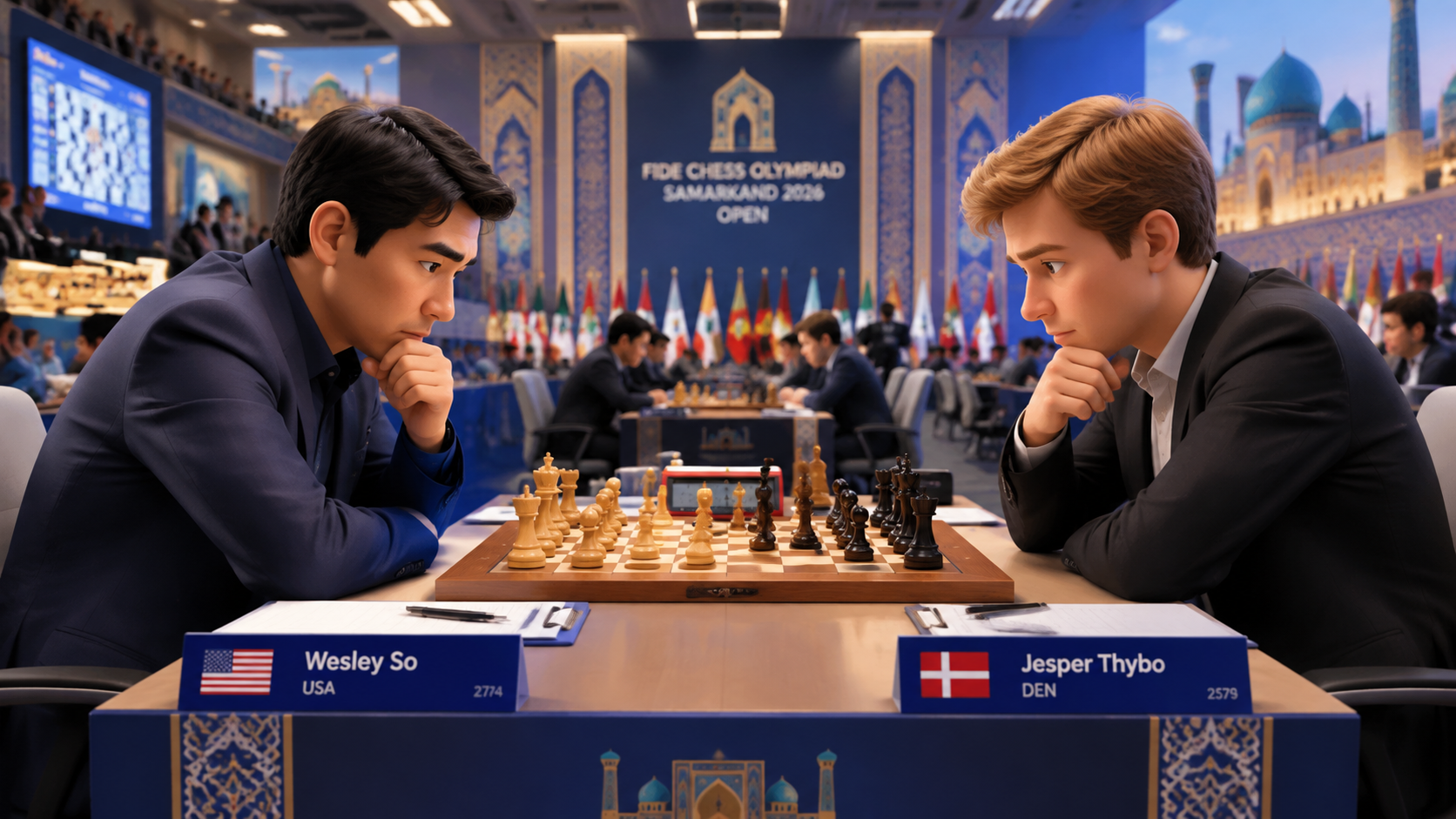
Illustration. The board shown is not a position from this game.
There is a moment in this game where Wesley So put his queen on a square where his opponent could simply take it.
Move 26. The queen goes to e6, right next to the black king's corner, and Black's queen is sitting on e7, guarding e6 and able to capture. A free queen, the most valuable piece on the board, offered to a grandmaster.
Jesper Søndergaard Thybo looked at it and moved his king instead.
He was right to. But the interesting question is not why he declined. It is why So could offer it at all. And the answer starts fourteen moves earlier, with a rook that begins one of the slowest, strangest journeys you will see in a top game.
Wesley So 1-0 Jesper Søndergaard Thybo 46th FIDE Chess Olympiad, Samarkand 2026 · Open Section, Round 3 · 18 September 2026 White: So (2774) · Black: Thybo (2579) · Opening: Italian Game
A quiet opening that is not really quiet
The game opens with one of the oldest sequences in chess:
1.e4 e5 2.Nf3 Nc6 3.Bc4 Bc5
This is the Italian Game, and people have been playing it for roughly five hundred years. Both sides put a bishop on an active diagonal and aim at the weakest square in the other camp: f7 for White, f2 for Black.
Then So does something that surprises beginners: nothing dramatic at all.
4.O-O Nf6 5.d3 h6 6.c3 d6 7.Re1 O-O 8.Nbd2 Bb6 9.h3 Ne7
No captures. No threats. Nine moves of simply putting every piece on a sensible square. This is what strong players mean by building a position. You are not trying to win yet. You are trying to reach a position where winning becomes possible.
Keep an eye on one small detail: Black played 5...h6. It is a useful little move that stops a white piece landing on g5. It also, very slightly, loosens the squares around the black king. Nobody could call it a mistake. Twenty moves later, So's bishop lands on exactly that square.
Move 10: taking away the other side of the board
10.a4 a5
This looks like it belongs to a different game. So is attacking on the kingside eventually, so why spend a move on the far queenside?
Because before you attack, you take away the other player's counter-attack. The move a4 stops Black from playing b5 and getting active on the queenside. Black answers a5 to stop a5 by White, and now that whole side of the board is frozen.
Here is the principle, and it is worth writing down:
An attack is not only about the squares you are attacking. It is about making sure your opponent has nothing better to do than defend.
11.d4 Nc6
Now the centre opens. Open positions favour whoever has the more active pieces, and So has been quietly arranging active pieces for ten moves.
Move 12: the rook goes for a walk
12.Ra3
A rook on a3. It looks wrong. Rooks belong on open files, and a3 is not an open file.
But the rook is not staying. It is travelling, and it is using the third rank as a road. Most of the time a rook gets into an attack by going up a file. Here there is no open file to use, so So sends it sideways instead. This idea has a name, the rook lift, and once you have seen it, you will see it everywhere in grandmaster games.
The draft version of this story that circulates online says the rook went a3 to g3. That is not quite what happened, and the real route is better:
12...Re8 13.Ba2 exd4 14.cxd4 Nxd4 15.Nxd4 Bxd4 16.Rd3
16.Rd3. The rook stops halfway, on d3, and attacks the black bishop sitting on d4. Black has to move it, 16...Bc5, and So has gained a free move. The rook is not just walking to the kingside; it is collecting time on the way.
So the journey is three stages: a3 → d3 → g3. Each stage does a job.
Move 17: opening the door
17.e5
Now So refuses to go slowly. The pawn pushes forward, lines open, and suddenly Black's pieces have jobs to do.
17...Qe7 18.Nf3 dxe5 19.Rxe5 Be6 20.Bxe6 fxe6
Look at what just happened to Black's pawns. Before, the f-pawn was on f7, shielding the king. Now it has been dragged to e6. The king on g8 has lost part of its wall, and the pawn on e6 is stuck where a white piece can attack it.
21.Nh4
Remember this knight. It goes to the edge of the board, which usually makes a knight worse. This one is different. From h4 it watches g6 and f5, two squares right next to the black king. It will not move again until move 36, and it will decide the game twice without ever capturing anything.
21...b6 22.Qe2 Rad8 23.Rg3
The rook completes its journey. Queen, rook, knight and dark-squared bishop are now all pointing at the same small patch of board.
Black has made no obvious mistake. And Black is one move away from a lost position.
Move 23: the one mistake
Black played 23...Rd5, and this is the move that loses.
Chess.com's computer analysis of the game, using Stockfish 19 Lite searching to depth 90, marks 23...Rd5 as the blunder, and it is the only move in the whole game it marks that way. Over the full ninety minutes, the engine scored So at 99.4% accuracy and Thybo at 85.8%. That gap is not the difference between a good player and a bad one. Thybo is a grandmaster who played a nearly clean game. It is the difference between eighty defensive decisions that were fine and one that was not.
The clock says he could feel it coming. On move 22 he had one hour and thirteen minutes. Two moves later he had forty-three. He spent thirty minutes on two moves, and then eighteen more on the move after that.
This is worth sitting with, because it is the most useful thing in the game for your own chess. Thybo did not hang a piece. He did not miss a one-move threat. He reached a position where the good moves had quietly run out, and then picked the wrong one from what was left. That is what a well-built attack actually does to a strong opponent. It does not beat them with a trick. It hands them a problem with no clean answer, and lets the clock do the rest.
Move 24: giving away a bishop
24.Bxh6
The bishop takes the h-pawn, the one Black moved all the way back on move 5. And here is the moment that makes the whole rook journey worth it: Black cannot take the bishop.
Look down the g-file. The rook sits on g3. The black king sits on g8. The pawn on g7 is standing directly between them. That pawn is pinned. If it stepped aside to capture on h6, it would expose its own king to the rook, and that is not allowed. So gxh6 is not a bad move. It is an illegal one.
Count Black's legal ways to capture that bishop. There are none.
So has just won a pawn, parked a bishop next to the enemy king, and cannot be punished for either. That is what the rook on g3 was really for. It is not only pointing at the king. It has frozen the pawn that was supposed to protect him.
Black gives back the exchange instead:
24...Rxe5 25.Qxe5 Bd6
The bishop attacks White's queen. In most games, the queen moves away.
Move 26: the offer
26.Qxe6+
So does not move the queen away. He moves it closer, to a square where the black queen on e7 can capture it.
Why is this not just losing a queen?
Because if 26...Qxe6, then 27.Rxg7+!, and the rook that walked from a3 crashes into the square in front of the king. Black must take, or move to h8:
- 27...Kh8 28.Ng6#, the knight from move 21 delivering checkmate from the square it had been watching for six moves.
- Taking the rook loses the king just as fast.
That is the whole game in one line. The queen offer works because a rook is already on g3 and a knight is already on h4.
Chess.com's analysis marks 26.Qxe6+ as a brilliant move, and it deserves the label. But notice what "brilliant" actually means here. So did not invent something out of nothing on move 26. He built a position where a brilliant move existed, and then it was simply there to be played. The brilliance was finished before the board showed it.
Thybo saw it, of course, and declined:
26...Kh7 27.Qf5+ Kg8 28.Qe6+ Kh7 29.Qf5+ Kg8
Checks that repeat like this usually mean one of two things: a player is happy with a draw, or a player is gaining time on the clock while deciding how to finish. Here it is the second.
The finish: the same idea, twice
30.f4 Qe1+ 31.Kh2 Bf8
Black finally gets his own check in, and brings the bishop back to defend g7. He is defending the right square. It does not help.
32.Bxg7 Bxg7 33.Rxg7+ Kxg7 34.Qg6+
There it is again: Rxg7+. The same sacrifice on the same square that would have finished the game seven moves earlier. So simply removed the extra defender first, then played it anyway.
And once more the king cannot take the queen on g6, because the knight on h4 is guarding it.
34...Kf8 35.Qxf6+ Kg8 36.Nf5, and Thybo resigned.
The knight moves for the first time since move 21, and the threat is Qg7#. There is no defence, so Black stopped.
What this game teaches
1. Attacks are built, not found. The sacrifice on move 26 looks like inspiration. It was construction. Every piece that made it work had arrived earlier: the rook on move 23, the knight on move 21, the open lines on move 17, the frozen queenside on move 10.
2. A rook does not need an open file. It needs a road. a3 → d3 → g3, picking up a free move in the middle by attacking a bishop. If you only ever put rooks on open files, you will miss half the attacking ideas in chess.
3. A knight on the edge can still be your best piece. Nh4 never captured anything. It guarded g6 in the mating line, guarded g6 again in the game, and finally delivered the last blow. Ask what a piece controls, not where it stands.
4. A pin can do more than win material. It can switch off a defender. The bishop on move 24 was not brave, it was safe, and it was safe because the rook on g3 had pinned the pawn that would have taken it. Before you calculate a sacrifice, check whether the defender is even allowed to move.
5. Pieces you give up are paying for something. The rook on move 33 and the queen offered on move 26 both bought the same thing: the squares around the enemy king. Material is a resource, and resources are for spending.
The next time you look at a spectacular sacrifice and think I would never find that, try scrolling back fifteen moves. The move that wins the game is usually the easiest one in the sequence. The hard part happened while nothing seemed to be happening at all.