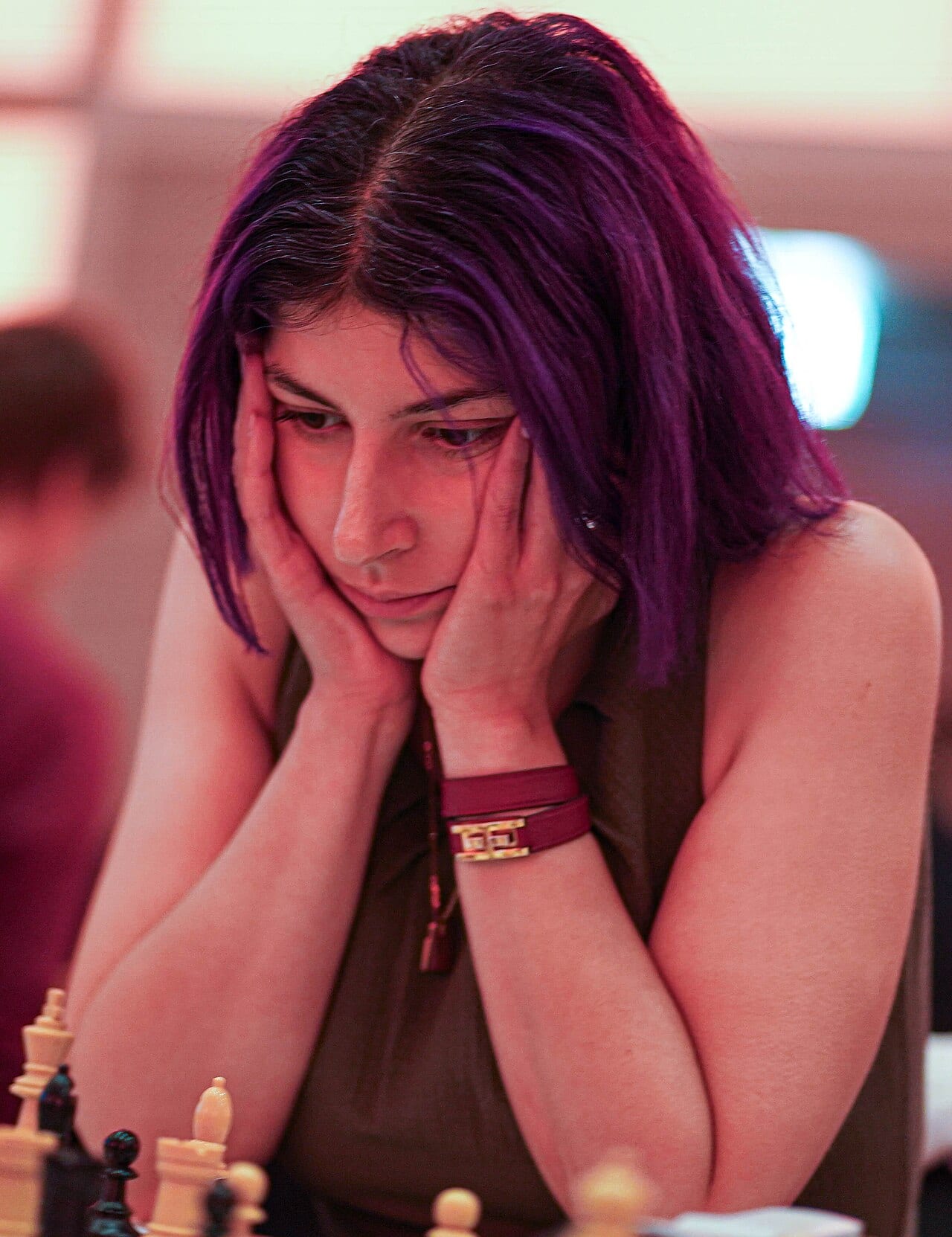
Photo: Paul Meyer-Dunker / Wikimedia Commons (CC BY-SA 4.0)
Let us start with a puzzle from the game. It is Black to move. White threatens checkmate in one move: the queen takes on h7. Black has 27 legal moves, and 23 of them lose to a forced checkmate. Can you find the best defence? The answer is in the article.
Black to move, after 31.Qh4. White threatens Qxh7, checkmate. Find the best defence.
Tatev Abrahamyan 1-0 Carissa Yip 2026 U.S. Women's Chess Championship, Saint Louis · Round 3 · 11 October 2026 White: IM Tatev Abrahamyan (2353) · Black: IM Carissa Yip (2484)
Round 3 in Saint Louis
The U.S. Women's Championship is a round robin at the Saint Louis Chess Club: 12 players, each meeting every other player once over 11 rounds. Each player gets 90 minutes for the first 40 moves, then 30 more minutes, plus 30 seconds for every move.
Carissa Yip has won the last three U.S. Women's Championships and came to Saint Louis trying for a fourth in a row. Tatev Abrahamyan earned her International Master title last year. Both played for the United States at the Olympiad this autumn. Before this game, Yip had drawn with Alice Lee and lost to Megan Paragua. Abrahamyan had lost her first two games.
This article follows the whole game. Its lesson is about attacking a king that waits too long to castle: a knight on f5, a pawn pushed all the way to e6, and a rook on the seventh rank can build a cage around it.
The Game: Abrahamyan v Yip
The opening: a Najdorf and a pawn storm
Yip chose the Sicilian Defence, , and the Najdorf system, . The little pawn move to a6 keeps White's pieces off b5.
Abrahamyan pushed her g-pawn two squares on move 7. The plan is simple: push the pawn to g5 and chase away the black knight on f6, the piece that guards Black's kingside.
After 7.g4. The white g-pawn is already on its way to g5, where it will attack the knight on f6.
The g-pawn reached g5 and the knight went back to d7. Black pushed on the other side of the board instead: the b-pawn to b4 chased the white knight from c3.
Moves 15 to 21: both kings wait
Our Stockfish 17.1 check at depth 20 rated Black a little better after . Then the black knight jumped to e5 and c4, and the white queen took the pawn on b4. White was a pawn ahead.
Black won the pawn back on g5. Material was level. But neither king had castled, and the centre was opening. Our engine now rated White more than one and a half pawns better.
Both players castled on move 21. Then the white knight jumped to f5, close to the black king. Abrahamyan had nine and a half minutes left after this move. Yip spent about 16 minutes on her reply and had 11 and a half left.
After 22.Nf5. The knight on f5 looks at g7 and h6, right next to the black king.
Moves 22 to 26: the pawn goes to e6
White pushed the e-pawn twice. chased the bishop from f6, and chased the knight from c4. Then put the pawn deep in Black's half of the board, where it attacked d7 and f7.
After 26.e6. The white pawn on e6 attacks d7 and f7. Together with the knight on f5 and the queen on g3, it cramps the black king.
Moves 26 to 30: a rook comes to the seventh rank
The knight traded itself for the bishop on e7. Then the white bishop came to d6 and attacked the black queen.
Black's queen took the e6 pawn, so Black was a pawn ahead. But White's rook came to e7, on the seventh rank. A rook on the seventh rank attacks along the row where the opponent's pawns and king live. Here it attacked the queen on d7 and the pawn on h7.
Now the white queen and the rook on e7 both aimed at h7. This is the puzzle position from the start of the article. White threatened 32.Qxh7, and the black king on g8 would have no square to go to. The f8 square is taken by its own rook. Abrahamyan had five minutes left, and Yip seven and a half.
Our engine checked all 27 of Black's legal moves. Twenty-three of them lose to a forced checkmate. The best defence was 31...Qxe7, taking the rook with the queen. After 32.Bxe7, Black would have given up her queen for a rook and would still be much worse, but there would be no checkmate on the board.
The finish
Yip put her rook on f7 to block the line from e7 to h7. It looked like it stopped the threat, but White could simply take it.
The white rook took the rook on f7, and after the king took back, the white queen took h7 with check. Now the black king had to walk into the open.
Every white piece joined the hunt. The bishop gave check from h3, and the queen took the pawn on g6 with check. Our engine finds a forced checkmate from here. The game ended there, 1-0.
The final position, after 36.Qxg6+. The black king on e6 is in check from the queen on g6, and our engine finds a forced checkmate for White.
After round 3, Megan Paragua, Thalia Cervantes and Alice Lee lead with 2.5 points out of 3. Abrahamyan has 1 point and Yip has half a point.
What to Learn
1. Castle before the centre opens. Black's king stayed on e8 until move 21, while pawns were being traded in the middle of the board. By then White's pieces were ready.
2. A pawn deep in enemy territory can be a monster. The pawn on e6 took squares away from Black's pieces and made room for White's attack. Even after Black won it, the attack it started kept going.
3. A rook on the seventh rank is worth a lot. From e7, the white rook attacked along the row where Black's king and pawns stood. With the queen behind it, it made the checkmate threat on h7.
4. When you block a threat, look one move further. blocked the line to h7, but the white rook simply took it. After the king took back, the queen took h7 with check anyway. Before you block, ask what happens if the blocker is taken.