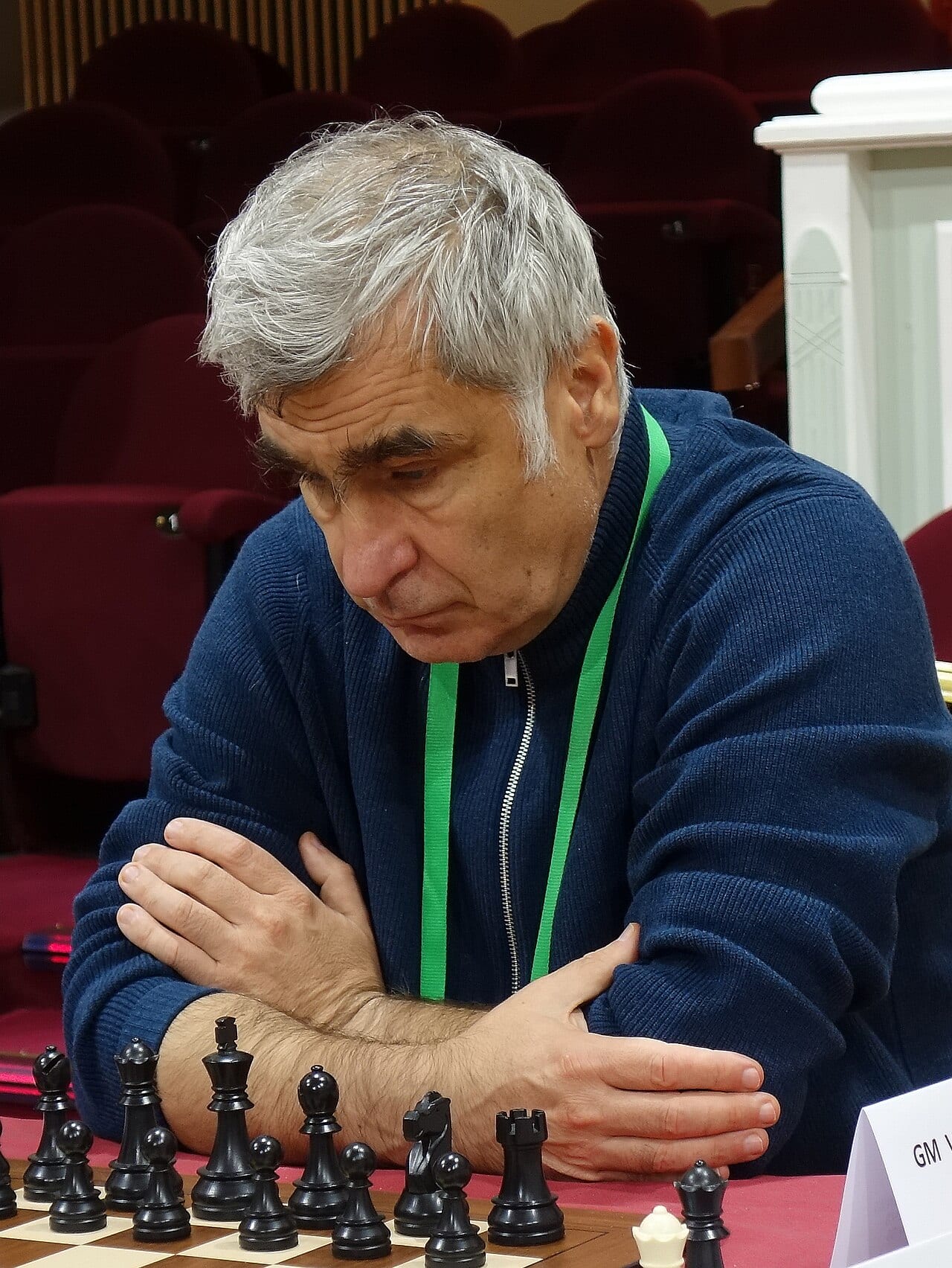
Photo: Stefan64 / Wikimedia Commons (CC BY-SA 3.0)
On move 10 of this game, Vasyl Ivanchuk stopped and thought for about 26 minutes. His opponent, Gawain Jones, had needed about six minutes for the move before. That gap in time is a good way to understand how Jones won in Round 2 of the 2026 XTX Markets London Chess Classic on Thursday 26 November.
Vasyl Ivanchuk 0-1 Gawain Jones London Chess Classic 2026, Masters, Round 2 · 26 November 2026 White: Vasyl Ivanchuk (2635) · Black: Gawain Jones (2630)
A quiet setup meets a loud answer
Ivanchuk began with the Queen's Pawn, and Jones chose the King's Indian Defense. The King's Indian is an opening where Black lets White build a big center, then attacks it later. After , White played , putting a knight on the kingside.
Jones answered with a pawn move on the edge of the board: .
That pawn has a plan. It wants to go to h4 and kick the knight. A pawn push that attacks an enemy piece is called a lever, and here it is aimed at the knight on g3.
After 7...h4. White to move. The pawn on h4 attacks the knight on g3. The squares f5 and h5 are guarded by Black's g6 pawn, so the only safe square for the knight is f1.
After , look at the knight on g3. Its two forward squares, f5 and h5, are both covered by the black pawn on g6. The knight has only one safe square left, f1, and White played . Our Stockfish 17.1 run at depth 20 agrees that this is White's best move, so Jones's idea was a real test and not a trick.
But the knight is now far from the action. Jones then opened a second front on the other side of the board: .
After 8...b5. White to move. The pawns on b5 and c4 attack each other. White's knight on f1 is on the edge of the board.
Twenty-six minutes on move 10
White took the pawn with . Here Ivanchuk spent almost 10 minutes on move 9 and then about 26 minutes on . Jones replied in about six minutes.
Think about what the clock shows. One player needed more than four times as long as the other to choose a move. We cannot know why, because neither player has said. What we can see is who was thinking and who was playing quickly.
The game continued . This is the third time Jones pushed the h-pawn, and the pawn on h3 now attacks White's pawn on g2.
After 12...h3. White to move. The pawn on h3 attacks the pawn on g2, and the knight that began on g3 is now on d2.
White took it with . This broke up the pawns near White's king. Our engine rates the position as level after and gives White a small edge of about four tenths of a pawn after , where it preferred 13...c5. So the opening was not a clean win for Jones. But White already had about 50 minutes left to Jones's 1 hour 17.
Time decides the middle of the game
The next eight moves were a tough fight. Black's bishop went to g4 and h5, Black's knight went to e5, and the pieces started to come off the board. After , White had five pawns against four. Our engine still saw the game as level, because the black bishop on e5 was active.
After 21...Bxe5. White to move. White has five pawns to Black's four, but Black's bishop on e5 is strong. Ivanchuk has about 15 minutes left and Jones has about 44.
Look at the clocks on that board. Ivanchuk had about 15 minutes for the rest of the game. Jones had about 44. A player with less time has to choose faster, and fast choices are where mistakes come from.
The moment it tipped
By move 27 the position was balanced again. Ivanchuk had about six minutes, and he took about four of them on .
After 27...Re6. White to move. Our engine finds several safe moves, including Kh2, Kg2 and Rg3. The game continuation 28.a3 let the black rook check on g6.
Our engine at depth 20 rates this position as level, and it prefers a king move such as 28.Kh2. After , it saw Black ahead by almost a full pawn. After that came , and by Ivanchuk had less than a minute left. Black's e-pawn jumped forward with and a pair of rooks came off. Jones won the game.
What to take from this game
- A pawn on the edge can start an attack. Jones moved his h-pawn three times, to h5, h4 and h3. Each push asked the white pieces a question, and the knight on g3 had to leave first.
- Know your ideas before the game starts. Our engine says the opening was fair for both sides. What changed the game was how long each player needed to think. When you understand your opening's plan, you save minutes, and you can spend them in the middle of the game.
- Time is a piece. Ivanchuk's slip on move 28 came with about two minutes on the clock. Strong players make mistakes when they are short of time too. A grandmaster who blunders was beaten, not foolish.
Next time you play a King's Indian or any opening, try this. Before the game, decide which pawn you want to push and which piece it will chase. Then see how much time you have left on move 20.
Also from London: how Abdusattorov turned one extra pawn into a win.