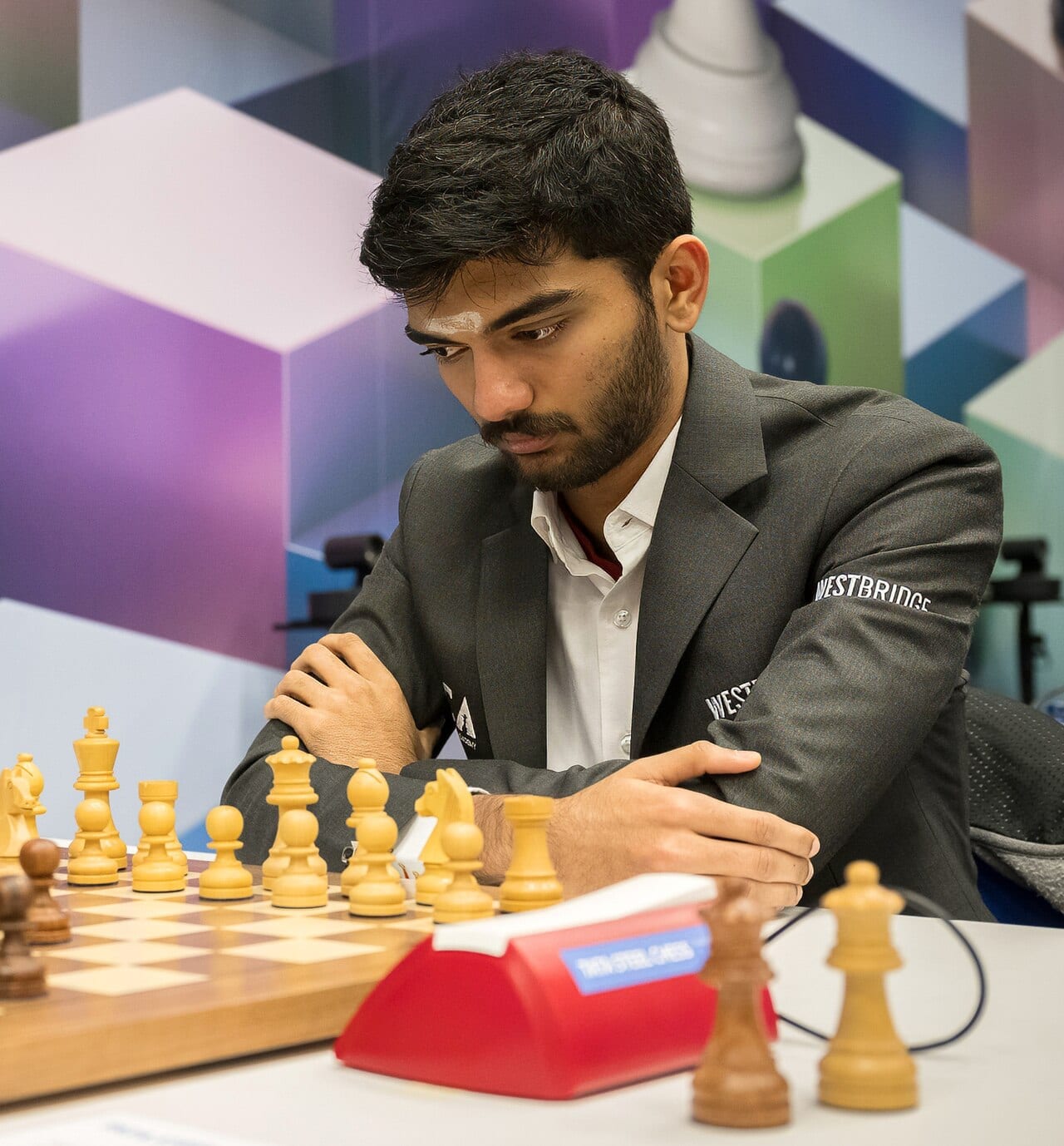
Photo: Frans Peeters / Wikimedia Commons (CC BY-SA 2.0)
Game 2 of the World Chess Championship in Geneva ended in a draw on Wednesday, 25 November. World champion Gukesh Dommaraju had White, Javokhir Sindarov had Black, and after only 20 moves the same position had appeared on the board three times. The match score is 1-1.
It was a much shorter day than Game 1, which lasted 38 moves. The Lichess broadcast's engine evaluation never showed either side ahead by more than 0.28 of a pawn, so the position stayed level from start to finish. As in Game 1, the story was the clock.
The opening: Gukesh picks the London System
Gukesh opened with and, after , played . That move makes the London System. In the London, White puts a bishop on f4 early, builds a solid pawn wall with e3 and c3, and plays the same set-up against almost anything.
Sindarov answered with , a calm set-up that attacks White's centre. Then Gukesh jumped his knight forward with , and Sindarov played the move that made the game interesting.
After 7...Qb6. The queen attacks the pawn on b2, and nothing on White's side protects it yet.
puts the queen on a square where it hits the pawn on b2. We checked the position with python-chess: at that moment no white piece guarded b2. Sindarov said after the game that was his own preparation. Gukesh said he knew the move too but could not fully remember the details. He thought for about six minutes and played , a rook move that protects the pawn, and said he was still inside his preparation at that point. Sindarov traded knights with and brought out his bishop with .
Preparation matters because the clocks are running. A player who knows the position can move quickly. A player who has to work it out at the board pays for every minute.
A surprising queen retreat
White played , Black castled with , and White developed with . Then Sindarov moved his queen back to its starting square with . The queen had gone to b6 to hit a pawn, and now it was heading home.
There was a plan behind it, though. Sindarov said after the game that the idea was ...Qd8, then ...Be8, ...Nd7 and ...f5, and that he played it at the best moment. Gukesh said he underestimated that plan, and that once ...f5 was on the board he did not see what he could do. The game went . Black's pieces found good squares for the pawn break ...f5, which gives Black space on the kingside. Sindarov took almost 8 minutes to retreat his knight with , and after Black was comfortable.
The 29-minute think
Gukesh then reached the point that decided the day.
After 16.f3. The pawn on f3 covers the e4 square. Gukesh had about 49 minutes left, and Sindarov had about 86.
He spent almost 29 minutes on , our count from the broadcast clocks (1:19:13 before the move, 0:49:44 after it). The pawn move covers the e4 square. After it, Gukesh had about 50 minutes left and Sindarov had about 1 hour 26 minutes. That is a gap of more than 36 minutes, and the time control gives no extra time until move 40.
There were 24 more moves to play before that extra time arrived, and Gukesh had less than an hour for them. It was the same kind of clock trouble he faced in Game 1. It was the second game in a row in which he fell behind on the clock.
The repetition
The next moves went back and forth: . White's bishop travelled between g3 and e5, and Black's knight travelled between f6 and d7.
After 20...Nf6. This exact position, with White to move, has now appeared three times: after 16...Nf6, after 18...Nf6 and after 20...Nf6. We counted it with python-chess.
The same position had now come up three times. In chess, that is called threefold repetition, and the game is a draw. Think of it as a loop: if both players keep stepping on the same squares, nobody is making progress.
The match rules do not allow the players to simply agree a draw before Black's 40th move, so a repetition is the way to end a game early.
Why repeat? For a player who is behind on the clock, a repetition in a level position is a safe way out. Do not read too much into it. The match is long, and a draw with White is not a disaster when the position is equal.
What it means for the match
Two games played, two draws, and the score is 1-1. Each player has now had White once and Black once. The first player to 7.5 points out of 14 wins the title, so 12 games are left.
For Gukesh, Game 2 showed a solid London System, and also that a long think in the opening leaves less time for the middlegame. For Sindarov, it was his first game with Black in the match, and he came away level without a long fight. His plan of ...Qd8, ...Be8, ...Nd7 and ...f5 worked.
Game 3 is on Thursday, 26 November, at 15:00 in Geneva (9 am in New York), with Sindarov playing White. Friday, 27 November, is a rest day.
Read how it went in our Game 3 report.
Read how Game 1 went in our Game 1 report, see what the opening move decides in our Game 1 preview, or start with our beginner's guide to the match.