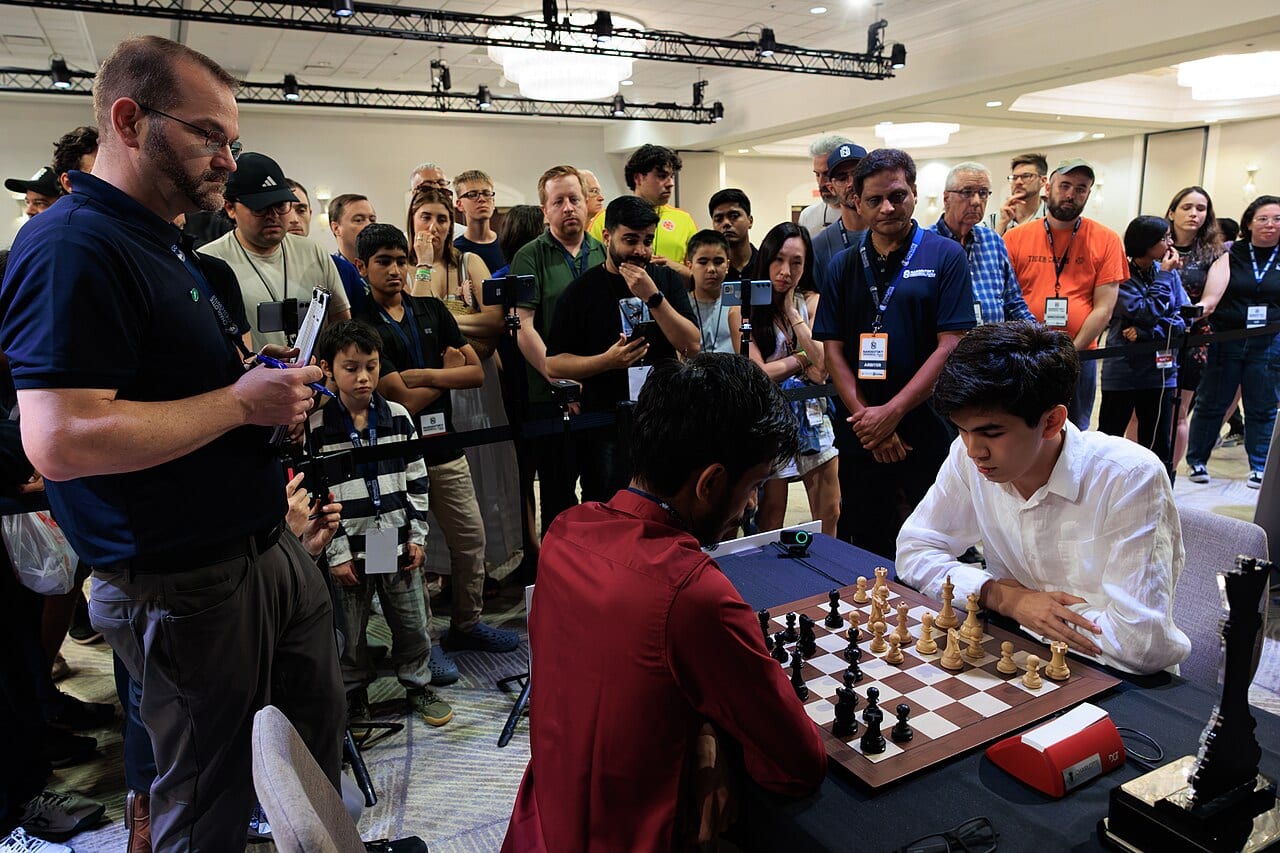
Photo: ChessKelly / Wikimedia Commons (CC BY 4.0)
Game 1 of the World Chess Championship in Geneva ended in a draw on Tuesday, 24 November. Javokhir Sindarov had White, world champion Gukesh Dommaraju had Black, and after 38 moves the same position had come up on the board again and again. The match score is 0.5-0.5.
On the board, the game was close all the way. Our Stockfish 17.1 run, at depth 20, never rated either side more than half a pawn better. The real fight was on the clock. Gukesh spent 36 minutes on a single move, and by the end he had less than five minutes left while Sindarov still had more than a quarter of an hour. Gukesh saw the board the same way. After the game he said it "looked equal the whole time."
The opening: the Berlin, with the queens gone on move 8
Sindarov opened with , and Gukesh answered with the Berlin Defence, a solid way to meet the Spanish Opening: .
After 8...Kxd8. The queens are off the board and Black's king has moved, so Black can no longer castle. In return Black has two bishops, and White's pawn on e5 has no black pawn opposite it.
This position is famous enough to have a nickname, the Berlin Wall. With the queens gone it plays like an early endgame. Black's king cannot hide by castling, so it walks back to e8 with . That sounds risky, but with no queens on the board there are few pieces that can attack it.
At this point most masters play the quiet 9.Nc3. In the Lichess masters database it was played 6,242 times from this position, against 1,097 times for the check . Sindarov chose the check and played his knight a move later.
Sindarov played his first 13 moves in a little over five minutes. Moving that quickly usually means a player is still inside the lines he studied at home. Gukesh, meanwhile, had already used about 25 minutes by his 12th move.
The move that made him think was . The position before it has been reached in 49 games in the Lichess masters database, and was played in only two of them. Gukesh answered with after about 15 minutes. He could have tried 13...Bf5, which attacks the knight and, after 14.Ng3 Bxc2, wins a pawn. But our engine still liked White there, by about four tenths of a pawn, because White's pieces become very active after . A free pawn is not always a good deal. Gukesh said afterwards that he had "underestimated it a little bit." The idea he pointed to, ...Bf5 followed by Ng3, is the line above: White gives up the pawn and gets the f5 square.
Sindarov's first long think came at move 14: he spent almost 23 minutes on . Afterwards he said that 14.Rd2 might have been better, because it keeps his ideas hidden. Our engine rated the two moves almost the same, +0.17 for Rd2 and +0.13 for c4.
The 36-minute think
Gukesh pushed his a-pawn twice, with and , to gain space on the queenside. It also had a point. White's pawn on c4 needed protection, so b2-b3 was coming, and once that pawn moved the a-file would open for the rook already waiting on a8. White doubled his rooks on the d-file, the only open file on the board. Then came the moment that shaped the rest of the game.
After 17...Bb4. The bishop attacks the rook on d2. Gukesh spent 36 minutes on this move, and the clocks showed about 28 minutes for him against about 78 for Sindarov.
is a natural move. It hits the rook on d2 and puts the bishop on an active square. It was also our engine's first choice, a little ahead of 17...h6 and 17...f6, which it rated about two tenths of a pawn better for White. Black had to watch for White's plan of Nd4 followed by f4, which would hand White the centre. But finding the move cost Gukesh 36 minutes. With no extra time until move 40, he had about 28 minutes left for 23 more moves. Sindarov had about 78. Sindarov moved the rook with . The other rook move, 18.Rb2, scored almost the same in our engine run (+0.35 against +0.29), so this was a choice between two good moves. Sindarov said afterwards that 18.Rb2 would have given him the best practical chances.
Sindarov spent part of Gukesh's long think in the players' lounge. "I'm not just wasting my time," he said after the game, explaining that he used the minutes to think about which moves his opponent might play. Gukesh said he took so long because he could not see how else to stop White's knight jumping to g5 or d4. He called the bishop move and the ...h6 that followed "quite precise." He also admitted the clock was "getting a bit little scary," but added: "I never felt like I was too much in trouble."
Here is a lesson for your own games. A long think in a position you do not know is often worth it. But every minute you spend now is a minute you will not have later, when the position may be harder.
Gukesh wins a pawn
Sindarov played , and , putting his pieces on the kingside. Gukesh brought his king to the centre with , a good place for a king when there are no queens. After , the pawn on e5 had lost its guard.
After 23...Nxe5. The knight on f3 had gone back to e1, and no white piece protected the e5 pawn. Gukesh's knight from g6 took it, and Black was a pawn up.
Before , the knight on f3 had been guarding e5. When it went back, the only piece looking at e5 was Black's knight on g6, so won a pawn. When a piece moves away, always ask: what was it protecting?
Sindarov had another way to play, 22.Nh2, but it would have been worse. After 22...b5 Black's queenside play gets going first, and our engine rated that position at -0.79, nearly four fifths of a pawn in Black's favour.
By now the clock was a real problem for Gukesh. After he had 9 minutes and 26 seconds left for 15 moves. Sindarov had 27 minutes.
Sindarov hits back
Sindarov did not wait. He pushed and then , to open lines towards the black king. Gukesh took with , and White's knight took back with check: .
After 27.Nxf5+. The knight gives check to the king on e7. One pawn each has been traded, so Black is still one pawn up, but the white knight now sits close to the black king.
Pieces came off quickly. After , Black was still a pawn ahead. Then Sindarov found the move that won it back.
: why the king could not take
The rook move attacked the pawn on h6, and Black had to decide how to meet it. Our engine rated four replies as equal: 31...Nd4, , 31...Ra2 and 31...Rd6. Gukesh chose the bishop. After , White played , taking the pawn on h6 with check.
After 32.Bxh6+. The bishop on h6 gives check. The king on g7 cannot take it, because the rook on h5 guards h6. Black had five legal moves, all of them king moves: Kh8, Kg8, Kh7, Kg6 and Kf6.
A king can never capture a piece that is protected, because it would be moving into check. The rook on h5 is standing guard over the bishop. Material was now level again. Gukesh played .
The repetition
What followed was a dance between two squares. gave check, and the king stepped to h7. Now the king was attacking the bishop on h6, and nothing was guarding it, so went back to protect it. Then , and the position was the same as after .
After 33...Kh7. The king attacks the bishop on h6, and with the rook on g5 nothing guards it. White's answer is 34.Rh5, guarding the bishop again.
Gukesh had other choices when the rook checked from g5. The king could go to h8, and Black could also block on g7 with the bishop from c3, which had been sitting on that long diagonal since move 31. Our engine rated the position as level at every step of this sequence. Gukesh said afterwards that he had been "getting a little optimistic" when he played the bishop, but then saw that White could bail out with the repetition.
The match rules do not allow the players to agree a draw before Black's 40th move. A repeated position is different: if the same position appears three times, a player can claim a draw, and the arbiter checks the claim. During the game Sindarov was penalised for an incorrect draw claim. Under the Laws of Chess, the opponent then gets two extra minutes, and the broadcast clocks show Gukesh's time jumping from 4:40 to 6:38 during move 37. The rook and king went back and forth once more, and the game was drawn after . The position after had now appeared four times. Sindarov explained afterwards that he felt they had already repeated the position three or four times, but that a draw claim has to be made the right way, so they played two more moves before the draw was settled.
What it means for the match
One game played, 0.5 points each. The first player to 7.5 points out of 14 wins the title, so there is a long way to go.
For Sindarov, Game 1 showed good preparation: he played fast in the opening, made Gukesh spend his time, and kept the pressure on. For Gukesh, it showed a calm defence, holding a level position with very little time left on the clock.
Sindarov called the draw "not bad result." He said that in a first game he tries "to learn your opponent" and play safe.
Gukesh has White in Game 2 on Wednesday, 25 November, at 15:00 in Geneva (9 am in New York). In a match, the players swap colours every game, so the champion now gets the first move.
Before the match started we looked at what White's first move decides in our Game 1 preview. For the full story of both players, read our beginner's guide to the match.
Update: Game 2 was drawn in 20 moves. Read our Game 2 report.