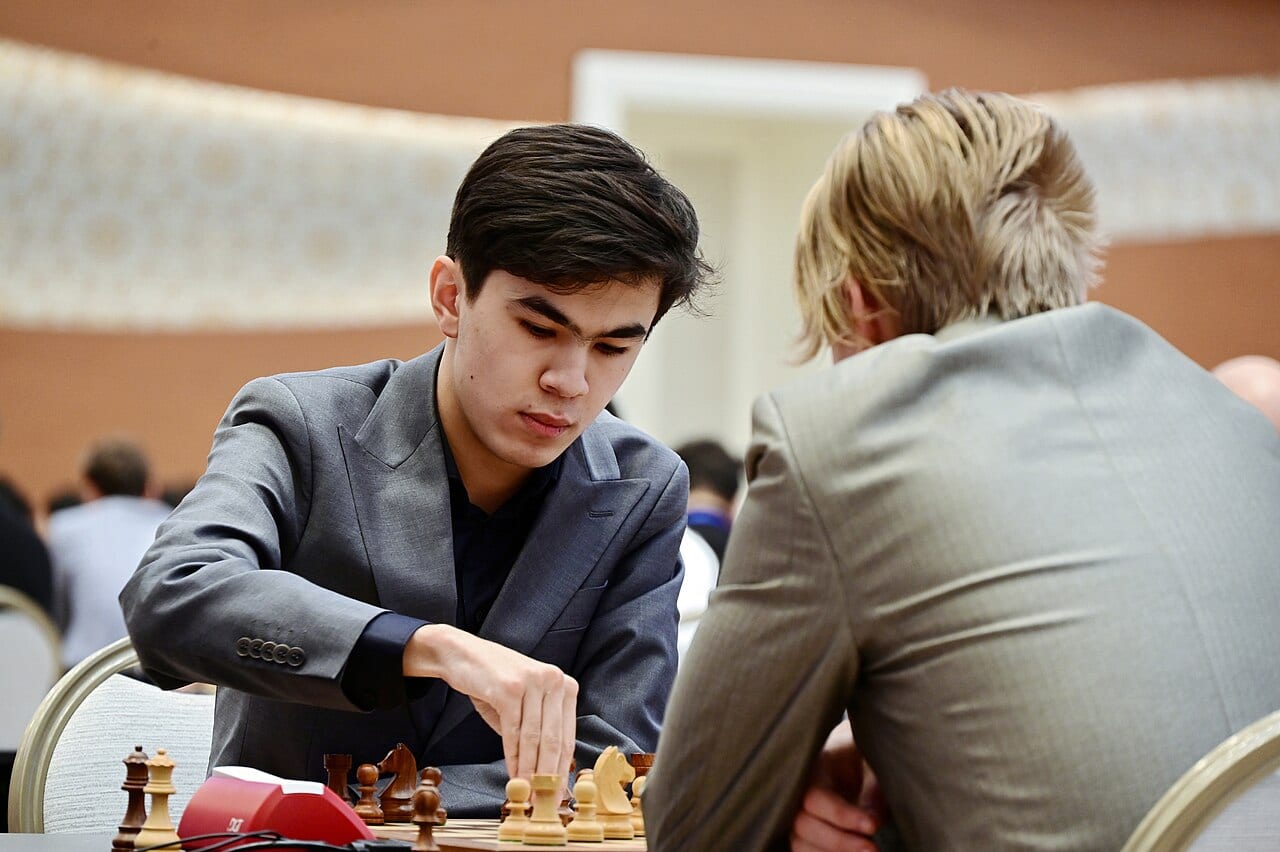
Photo: Husniddin Ato / Wikimedia Commons (CC BY-SA 4.0)
Game 3 of the World Chess Championship in Geneva ended in a draw on Thursday, 26 November, after 60 moves. Javokhir Sindarov had White, world champion Gukesh Dommaraju had Black, and for the third game in a row neither player won. The match score is 1.5-1.5.
Game 3 was longer than Game 1 (38 moves) and Game 2 (20 moves). The clock told the story again, but this time it was Sindarov who ran short of time. By move 39 he had 8 seconds left.
The opening: the Berlin, with the queens staying on
Sindarov played , and Gukesh answered . After , Gukesh took the pawn with . That is the Berlin Defense, the same opening as in Game 1.
The two games split at move 7. In Game 1, Gukesh recaptured on c6 with his d-pawn, and the queens came off the board at move 9. In Game 3, the game went , and this time Gukesh recaptured with his b-pawn. The queens stayed on the board until move 16.
Recapturing with the b-pawn leaves Black with two pawns on the c-file, called "doubled pawns", which is usually a small weakness. After , the Lichess broadcast engine showed White ahead by 0.65 of a pawn at its highest, and that was at move 9. That is a small edge.
The clock starts to matter
Sindarov spent more than 9 minutes on , another 9 minutes on , and 15 minutes on , our count from the broadcast clocks. After 20 moves he had used about 1 hour 9 minutes.
After 16.b3. The pawn attacks Black's queen on c4, and the two queens face each other on c4 and d4. Black took, and the queens came off.
At move 16 the queens met. White's attacked Black's queen, and Gukesh answered . After the queen trade, the broadcast engine's evaluation never went above 0.2 of a pawn for either side. Gukesh then pushed his kingside pawns with , and the clock shows he spent about 14 minutes on .
After , the broadcast clocks showed about 35 minutes for Sindarov and about 1 hour 22 minutes for Gukesh, who had not yet replied.
The 8-second move
The moves that followed were a series of trades. swapped a knight for a bishop. Later, opened the kingside, and Gukesh spent almost 16 minutes on .
By move 37, Sindarov had 1 minute 20 seconds left. He played , and the rooks traded with .
After 39.Bb4. Sindarov had 8 seconds left, our reading of the broadcast clock. Gukesh had about 6 minutes 50 seconds.
Sindarov played with 8 seconds on his clock, according to the broadcast. Gukesh took the pawn with , and reached the time control. After move 40, each player gets 30 more minutes. Sindarov's clock jumped from 8 seconds to about 30 minutes, and the danger of losing on time was over. Gukesh had about 34 minutes after .
A rare move: en passant
At move 42 the board showed something beginners often ask about.
After 42...f5+. Black's pawn jumped two squares and gave check. White can capture it as if it had moved one square, by playing exf6.
Gukesh played . The pawn on f7 jumped two squares to f5, passing the square f6, and gave check to the white king on e4. White's pawn on e5 stood next to it, so White could take it as if it had stepped one square. That move is called en passant, French for "in passing". Sindarov played . We checked with python-chess that exf6 is an en passant capture in that position.
The bishop ending
The players kept trading. After , all the rooks were gone. Each side had one bishop, and the two bishops stood on squares of opposite colours.
Opposite-coloured bishops are famous for drawing. White's bishop runs on dark squares and Black's runs on light squares, so neither bishop can attack the other side's pawns when they stand on the other colour, and the player with fewer pawns can often defend. At the end of the game Black had three pawns (c5, d3 and h5) and White had two (a4 and h4), so Gukesh was a pawn ahead. It was not enough.
The final position after 60...Kf3. Black has the extra pawn on d3, but White's king on c3 and bishop on d2 keep it in check. The game was drawn here.
In the last position White's king stood on c3 and the bishop on d2, next to Black's pawn on d3. Sindarov had about 14 minutes left, and Gukesh had about 17.
What it means for the match
Three games, three draws, and the score is 1.5-1.5. The first player to reach 7.5 points out of 14 wins the title, so 11 games are left. Sindarov has had White twice, in Games 1 and 3, and Gukesh once, in Game 2.
For Sindarov, Game 3 showed how much a long think can cost. He used about 1 hour 9 minutes on his first 20 moves, reached the time control with 8 seconds to spare, and still held the draw. For Gukesh, it was a second Berlin Defense with Black and a second draw.
Game 4 is on Saturday, 28 November, at 15:00 in Geneva (9 am in New York), with Gukesh playing White. Friday, 27 November, is a rest day.
Read how the match started in our Game 1 report, see how Game 2 ended in a quick repetition in our Game 2 report, or start with our beginner's guide to the match.