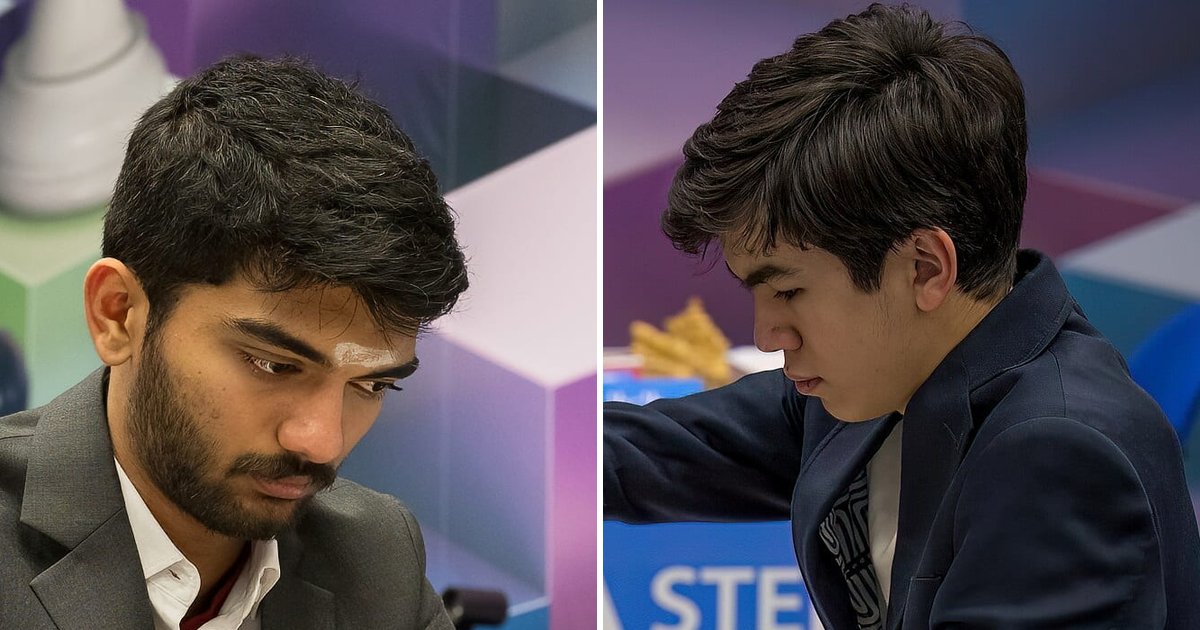
Left: Gukesh Dommaraju, 2025. Right: Javokhir Sindarov, 2023. Photos: Frans Peeters / Wikimedia Commons (Gukesh, Sindarov), CC BY-SA 2.0. Two separate photos, not taken at the same game. Placed side by side by ChessBotBuddies, with the Gukesh photo mirrored so the players face each other.
On November 24, in Geneva, two 20-year-olds sit down to play for the world chess title. The champion is Gukesh Dommaraju of India. The challenger is Javokhir Sindarov of Uzbekistan. No two players this young have ever met in a World Championship match.
If you have never followed a World Championship, start here. Here is how the match works, what each player brings, and a look at the last game they played against each other.
What the World Championship is
The world title is decided in a match: two players, one board, many games. One player is the champion. The other is the challenger, who earns the place by winning the Candidates Tournament, an eight-player event for the players who qualify through the strongest events of the year.
The title goes back to 1886, when Wilhelm Steinitz beat Johannes Zukertort. For a few years, from 1993 to 2006, there were two rival world champions. Since 2006 there has been one.
How this match works
- 14 classical games at the Fondation Martin Bodmer in Cologny, Geneva. Classical means slow chess: each player has 120 minutes for the first 40 moves, then 30 more minutes, plus 30 seconds for each move from move 41. A game can last five hours or more.
- A win is 1 point and a draw is half a point. The first player to 7.5 points wins.
- The opening ceremony is on November 22. Game 1 is on Tuesday, November 24, and the last scheduled game is on December 11, with rest days during the match.
- If the score is 7-7, faster games on December 12 decide it: first four rapid games, then shorter and shorter games until someone wins.
- The prize fund is 2.5 million US dollars.
The key idea for a beginner: this is not a tournament. It is a duel. Every game is against the same opponent, so each player's team of helpers, called seconds, spends the rest days preparing openings for that one opponent.
The two players
Gukesh Dommaraju, 20, India. The champion. At 18 he became the youngest undisputed world champion, beating Ding Liren 7.5 to 6.5 in Singapore in 2024. His rating dropped after the title, as low as 2703 on the August list. At the Olympiad in September he won the individual silver medal on board four for India. On the November 2026 FIDE list he is rated 2710, 26th in the world. You can read about five of his games here.
Javokhir Sindarov, 20, Uzbekistan. The challenger. He won the World Cup in 2025. In 2026 he was second at Tata Steel without a loss, then won the Candidates Tournament with 10 points out of 14, also without a loss, the highest score in that event's current format. At the Olympiad he won team gold with Uzbekistan and the individual bronze on board two. On the November list he is rated 2782, fourth in the world and the highest rating of his career. He turns 21 on December 8, during the match. You can read his story here.
The challenger is rated 72 points higher than the champion. That sounds strange, but it happened last time too: in 2024 Gukesh was the challenger, and he was rated 55 points higher than Ding.
Their last meeting: Tata Steel, January 2026
In classical games Sindarov leads 2.5 to 0.5. His two wins came in 2018 and 2022, when both players were still very young. The two played in Round 1 of the Tata Steel Masters in Wijk aan Zee, on January 17, 2026. Sindarov had White. It was a long, strange game, and it shows how both of them play when things get messy.
The Game: Sindarov vs Gukesh, Tata Steel 2026
Javokhir Sindarov 1/2-1/2 Gukesh Dommaraju, Tata Steel Masters 2026, Wijk aan Zee, Round 1, 17 January 2026.
The game began quietly. . For many moves both players moved their pieces around, looking for a small edge. .
Then the game exploded. . Gukesh took a knight with his queen, Sindarov took the queen, and Gukesh took a rook with check. So Gukesh gave his queen for a rook and a knight.
After 41.Kh2. Black has two rooks and a knight. White has a queen and a rook. Our engine says Black is better.
Count it the way beginners learn: a queen is worth 9, a rook 5, a knight 3. Black has 13 in pieces against White's 14, but our Stockfish 17.1 run rated Black better by more than a pawn. Two rooks working together can be stronger than the numbers say.
. Sindarov gave up his rook on f7 to open up the black king and started checking. But now Gukesh's rooks went after the white king.
. The white king was chased all the way to a4. Around move 56 our engine rated Black about five pawns better.
After 70.Qf8+, Black to move. The white queen keeps checking. Our engine wanted 70...Ke6, walking the king away, and still rated Black about two pawns better.
Gukesh played , blocking the check. That let the white queen keep checking: . The black king could not get away from the checks, and the players agreed a draw.
What to Learn from Their Last Meeting
1. Count material, then look again. By the point count, Black's two rooks and knight were worth less than White's queen and rook. The engine still liked Black, because the rooks worked together and the white king was open.
2. A king without pawns around it is in danger. After both kings were out in the open, and the game became a race of checks.
3. When you are winning, get your king away from checks. On move 70, a king walk kept Black's winning chances. Blocking with the knight let White check forever. When the other side has only checks left, find the squares where the checks run out.
Five things to watch in Geneva
1. Form against experience. Sindarov has the higher rating, and he did not lose a game at Tata Steel or at the Candidates this year. Gukesh has the experience: he has already won a match like this one.
2. The Abdusattorov factor. Nodirbek Abdusattorov, fifth in the world and Sindarov's friend and Olympiad teammate, said in an October interview on the Lolazor Podcast, as reported by Rook Review: "In my personal opinion, it's 80-20 in favor of Javokhir." He also said he would spend a week training with Sindarov before the match.
3. Openings against calculation. Watch the first 20 moves of each game. A player who gets the position he prepared at home starts with an advantage. A player who drags the game into new positions makes both players think for themselves.
4. The youngest match ever. Both players are 20 when the match starts. Every earlier World Championship match had at least one player aged 21 or older.
5. The draws. Most World Championship games are draws. In 2024, 9 of the 14 games were drawn. A match is often decided by two or three wins, so watch how each player plays the game after a loss.
How to follow it as a beginner
You do not need to understand every move. Pick one habit: after each game, find the one moment everyone talks about. There is usually one moment per game, a mistake, a sacrifice, or a clever defense, that explains the result. Learn that moment, and you will understand the match better than most people watching.
We will cover the match game by game, with a lesson from each one. Game 1 is on November 24.