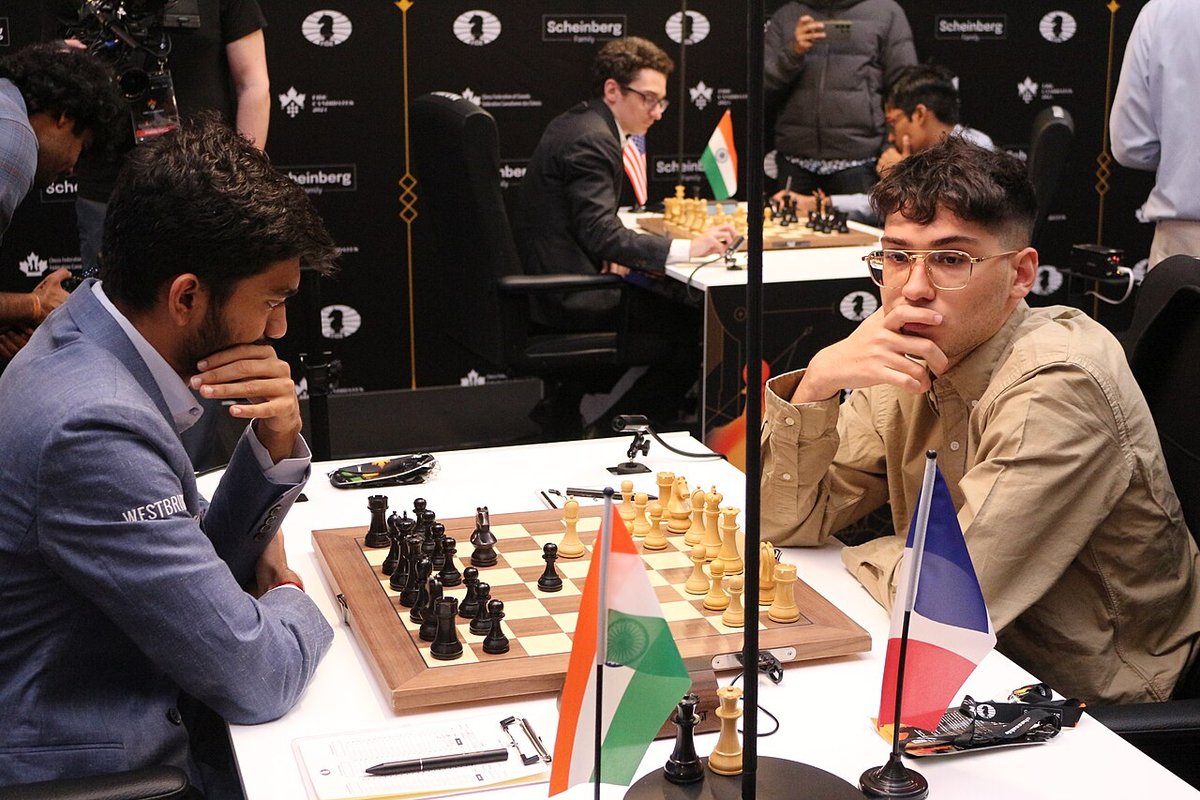
Photo: Eldar Azimov / Wikimedia Commons (CC BY-SA 4.0)
Gukesh learned chess at seven, became a grandmaster at 12 and beat Magnus Carlsen at 16. You can read that part of his story in our piece on his childhood. This time we look at five games from the years when he won the Candidates and the World Championship, from April 2024 to June 2025. In each one, a single idea decided the game, and you can use all five in your own games.
Each section starts from the first moves, then jumps to the moments that matter. When you see a board with "Black to move" or "White to move" and a question, stop and think before you read on. The positions come straight from the game record, and the engine numbers come from our own Stockfish 17.1 run at depth 24.
1. Say No to the Draw
Gukesh v Alireza Firouzja, Candidates tournament, Toronto, 20 April 2024
Gukesh was 17. It was round 13 of 14, and the winner of the Candidates would play the world champion. He had the white pieces against Alireza Firouzja, the only player who had beaten him in the tournament.
The game began 1.e4 e5 2.Nf3 Nc6 3.Bb5 Nf6, a Ruy Lopez. Gukesh then chose a quiet setup with 4.d3. After 4...Bc5 5.O-O Nd4 6.Nxd4 Bxd4 7.Nd2 c6 8.Bc4, both players made calm moves, and the game stayed close to equal for a long time.
Around move 38, both players began to repeat moves. A position that appears three times can end the game as a draw, and one more repeat was all it would take.


 3
 2

 g
White to move at move 42. This exact position has now appeared twice. Playing 42.Rgd1 would bring it a third time and the game could end in a draw.
Gukesh played 42.Qh4 instead. It was a safe choice, because our engine still saw the position as equal after it. The lesson is simple. Before you take a draw, ask whether you can keep playing without taking a real risk. If you can, keep playing and wait for your opponent to slip.
The slip came at move 45. Firouzja played 45...Qg6, offering to swap queens.
32After 45...Qg6, White to move. The engine says this swap is a mistake. Before it, the position was nearly equal. After it, White is better by more than one and a half pawns. The better move was 45...Ne6.
White took the queen with 46.Qxg6 hxg6 and then played 47.Rd6.
32After 47.Rd6, Black to move. White's rook has reached the sixth row and attacks the pawn on g6. The pieces are equal in number, but White's rook is the one that is active.
Without queens, the rook that gets into the enemy camp first becomes the boss of the board. Gukesh picked up the pawn on g6 at move 48, the pawn on b7 at move 51, and Firouzja resigned after 63.Kg3. The win put Gukesh alone in first place with one round to go. In round 14 he drew with Hikaru Nakamura, won the Candidates and became the youngest challenger in the history of the World Championship.
2. Know Where Your Opponent's Preparation Ends
Gukesh v Ding Liren, World Championship, game 3, Singapore, 27 November 2024
Gukesh had lost game 1 and drawn game 2. For game 3 he changed his first move. In game 1 he had played 1.e4. Now he played 1.d4, and the game went 1...Nf6 2.Nf3 d5 3.c4 e6 4.cxd5 exd5 5.Nc3 c6 6.Qc2 g6 7.h3 Bf5 8.Qb3 Qb6 9.g4.
8 721a
 cefh
After 9.g4, Black to move. The pawn on g4 attacks the bishop on f5, and the two queens face each other on the b-file.
That early pawn push on the g-file was part of Gukesh's homework. He said, "I was prepared until 13th move." Ding Liren, the world champion, had to think. He spent more than 30 minutes on his 13th move. After 13...Nbd7 14.Nd2 Rg8 Gukesh played 15.g5.
871aefgAfter 15.g5, Black to move. The pawn on g5 attacks the knight on f6, so the knight has to move. Gukesh later said he had a very nice position here.
Gukesh said, "I just got a very nice position after 15.g5." Now see if you can find the move that Ding missed, three moves later.
871aefgAfter 18.Bg3, Black to move. Black played 18...Rh5, which looks active but was a mistake. The engine prefers 18...Be7. Can you find a safer way to play?
After 18...Rh5 White played 19.e4, and the engine's view swung by about one pawn, from slightly better for Black to slightly better for White. Gukesh kept making accurate moves, and the clock did the rest. At one point Ding had just over eight minutes to make 11 moves, and his time ran out by move 37. The match was level at 1.5 points each.
Opening preparation does two jobs. It gives you a good position, and it makes your opponent think. A minute spent remembering something is a minute that cannot be spent later, when the game gets hard.
3. Check What Your Move Leaves Behind
Gukesh v Ding Liren, World Championship, game 11, Singapore, 8 December 2024
Game 11 was wild from the start. Gukesh opened with 1.Nf3 d5 2.c4, and Ding replied 2...d4, a sharp move. After 3.b4 c5 4.e3 Ding thought for almost 40 minutes. Then came 4...Nf6 5.a3, a move Gukesh called "a new move which is almost never played before." The game went on with 5...Bg4 6.exd4 cxd4 7.h3 Bxf3 8.Qxf3 Qc7 9.d3 a5 10.b5.
8731abcdefhAfter 5.a3, Black to move. The new pawn on a3 supports the pawn on b4, which attacks the pawn on c5. The pawn on e3 attacks the pawn on d4.
The game stayed tense. At move 15 Gukesh thought he was in trouble. He said, "I thought I was in trouble here already." But he kept finding moves, and by move 28 White's pieces pointed at the black queenside. Here is the position before Ding's fatal move.
54bgAfter 28.Rdb1, Black to move. White's queen on e4 attacks the knight on c6, and the bishop on g2 stands right behind the queen. The knight is guarded by the queen on c7 and the pawn on b7. The engine's choice is 28...Nb4. What would you play?
Ding played 28...Qc8. It looks fine, because the queen still guards the knight. But White had a shot.
54bgAfter 29.Qxc6, Black to move. If 29...Qxc6, then 30.Bxc6 and the bishop that was hiding behind the queen wins a knight. If 29...bxc6, the b-file opens, and 30.Rxb8 wins material for White.
Count the attackers and the defenders. The knight on c6 was attacked by the queen and the bishop behind it. It was guarded by the queen and the b7 pawn. But the pawn could not take back, because that would open the b-file for White's two rooks. So the knight was really defended just once. Ding resigned. The engine moved from about half a pawn for White to about four and a half pawns for White the moment 28...Qc8 was played.
Before you move any piece, ask what it was protecting, and what it leaves loose. Gukesh led the match 6 to 5 with three games to go.
4. Count the Pawns Before You Trade the Pieces
Ding Liren v Gukesh, World Championship, game 14, Singapore, 12 December 2024
The score was level at 6.5 to 6.5. One game was left, and a draw would mean tie-breaks. Gukesh had the black pieces. Ding opened 1.Nf3 d5 2.g3 c5 3.Bg2 Nc6 4.d4 e6 5.O-O cxd4 6.Nxd4 Nge7 7.c4 Nxd4 8.Qxd4 Nc6 9.Qd1 d4 10.e3 Bc5 11.exd4 Bxd4. After a long series of trades, the game became a rook and bishop ending.
8dgAfter 32...g5, White to move. The queens are gone. Each side has a rook and a bishop, and Black has one extra pawn.
Many moves later it was still the same story, and Black was still a pawn up.
8gAfter 54...Ke5, White to move. Black has an extra pawn, but White can hold the balance with Bc6, Ra4 or Bg2. The engine rates all three about equal. One other natural move loses.
Gukesh said he was pressing as hard as he could, but he thought the game would end in a draw and the match would go to tie-breaks. Then Ding played 55.Rf2. After 55...Rxf2 56.Kxf2 Bd5 57.Bxd5 Kxd5 the board looked like this.
After 57...Kxd5, White to move. White has one pawn and Black has two, and Black's king stands in the middle of the board. This ending is lost for White, whatever White plays.
Gukesh described the moment himself: "suddenly after 55.Rf2?? I saw this chance." Ding played 58.Ke3 Ke5 and resigned. Gukesh won the match 7.5 to 6.5, and at 18 he became the youngest world champion in history.
Did You Know?
A tablebase is a giant list made by computers. It knows the perfect result for positions with seven pieces or fewer, kings and pawns included. The ending above has just five pieces, so a tablebase can tell us for sure that it is lost for White, whatever White does.
This is the lesson of game 14. Before you trade your last pieces, picture the position that is left. Rook and bishop endings are hard to judge, but a king and pawn ending is easy to count. One extra pawn and an active king can be enough to win.
5. Keep Making Problems When You Are Losing
Gukesh v Magnus Carlsen, Norway Chess, Stavanger, 1 June 2025
Gukesh was now the world champion, and Carlsen was the number one player in the world. Gukesh had lost to Carlsen in round 1 of the tournament, and this was the rematch in round 6.
Gukesh chose a quiet Ruy Lopez again, with the same 4.d3 he had played against Firouzja: 1.e4 e5 2.Nf3 Nc6 3.Bb5 Nf6 4.d3 Bc5 5.c3 O-O 6.O-O d6 7.h3 a6 8.Ba4 h6 9.Re1 b5 10.Bc2 Bb6. Carlsen played the middlegame very well. By move 35 the position looked like this.
7dAfter 35...Rd1, White to move. Both sides have the same material, but Black's pieces are much more active. The rook on d1 is deep in White's camp, and the bishop on e4 stands in the center. The engine has Black better by about three pawns.
Gukesh said, "I knew it was completely lost." But he did not give up. He explained what he does in a lost position: "you just keep making moves which don't lose right away." Slowly, Carlsen's edge got smaller, and both players ran low on time. By move 50 the engine had Black better by about one pawn.
eAfter 52.Nd7, Black to move. Black is still a little better. The checking move 52...Ne2+ looks strong but gives away a knight. The engine prefers 52...Re8. Which would you choose?
Carlsen played 52...Ne2+. After 53.Rxe2+ Kxe2 54.Nxf8, Black had two pawns that could run, but was down a knight. Now Gukesh's knight had a job: stop the pawns. At move 56 the position was this.
After 56...Ke3, White to move. Black's pawns on d3 and e5 are close to queening. Gukesh found 57.Na4, and the knight arrives in time.
Gukesh found 56.Nc5 and 57.Na4. He said later, "I just kept making moves which just stop the pawn." The knight reached b2 and c4 in time, and Carlsen resigned after 62.Kf4. It was Gukesh's first win over Carlsen in a classical game.
A knight can be a wonderful goalkeeper. If it stays close to the pawns, it can stop two of them by itself.
What the Five Games Teach
Put the five lessons side by side. Do not take a draw too early when you are not in danger. Know where your opponent's preparation ends. Check what your move leaves loose. Count the pawns before you trade the last pieces. And keep making problems when you are losing, because your opponent might run out of time or ideas before you run out of moves.
Later this month, in Geneva, Gukesh defends his title against Javokhir Sindarov. While you wait, set up a board and play through these five games, starting from move 1. Stop at each question and try to find the answer before you look. And if you want to see how he beat Carlsen at 16, read the story of that game and the story of Magnus Carlsen's own childhood.
Update: Five Sindarov Games and the Lessons Inside Them looks at five of his 2026 wins, with one lesson each.
Update: A beginner's guide to the Gukesh and Sindarov World Championship match explains the format and their last game.