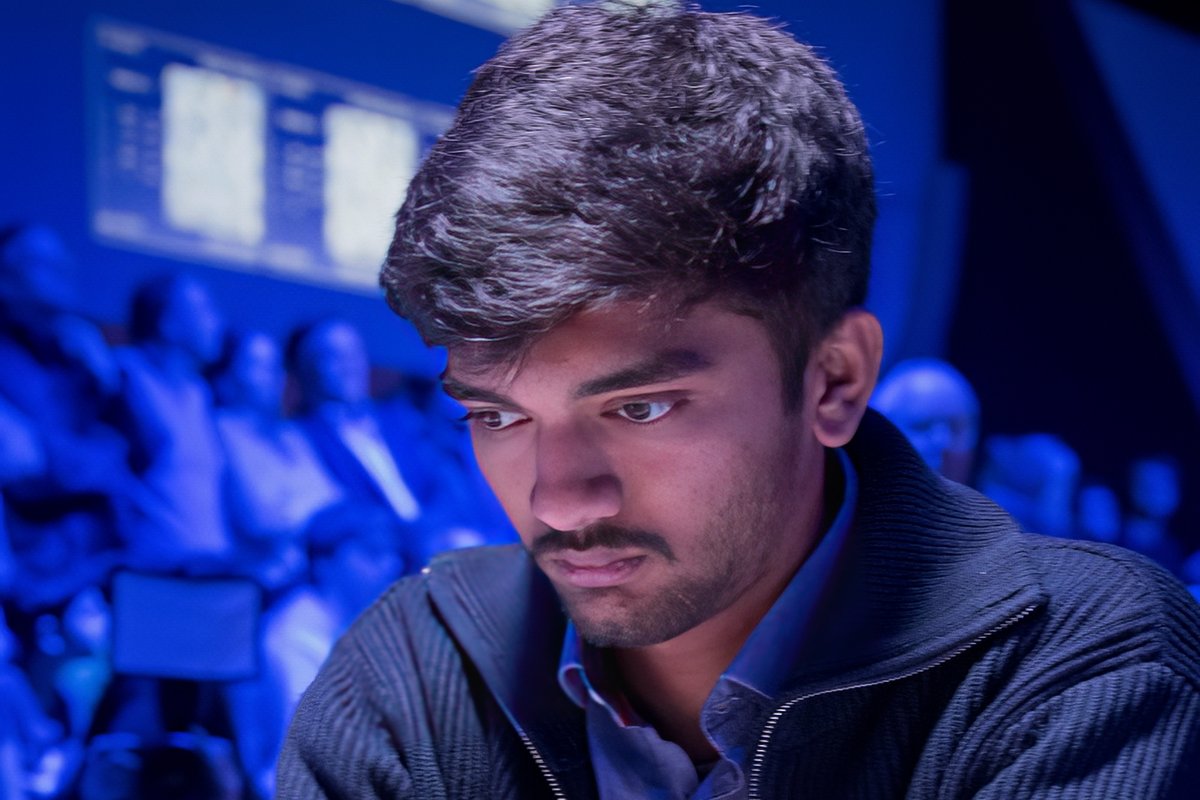
Photo: Frans Peeters / Wikimedia Commons (CC BY-SA 2.0)
Let us start with a puzzle. Look at the position below. It is Black's move, and Black has two extra pawns. The white rook on c7 attacks the knight on e7, and nothing defends that knight. Black's queen cannot simply take the rook, because the white knight on b5 guards it.
Black to move. White's rook on c7 attacks the knight on e7, which has no defender. Black is two pawns ahead. Which move keeps the advantage? One natural move throws it away.
The player with the black pieces was Magnus Carlsen, the world champion and the number one player in the world. The player with White was Gukesh Dommaraju, a 16-year-old from Chennai, India. They played online on 16 October 2022, in round nine of the Aimchess Rapid.
Carlsen played , a move that guards the knight. Three moves later he resigned. Our Stockfish 17.1 run at depth 20 had the position before his move as better for Black by about two pawns. After his move, it had White ahead by about four pawns. One rook move swung the whole game.
Gukesh was 16 years, 4 months and 20 days old. That made him the youngest player to beat Carlsen while Carlsen was world champion. The record before him belonged to another prodigy from Chennai, R Praggnanandhaa, who had done it at 16 years, 6 months and 10 days.
Here is how a boy who learned chess at seven got to that board, and what happened in the game.
A Boy in Chennai
Gukesh was born on 29 May 2006 in Chennai, a big city in southern India. Chennai is also the home of Viswanathan Anand, India's first world champion. You can read his story in our piece on Viswanathan Anand.
Gukesh learned chess at the age of seven. He soon had regular lessons, and his coach was the Indian grandmaster Vishnu Prasanna. In his early years, the coach kept chess engines out of his training. An engine is a computer program that plays better than any person. Without one, Gukesh had to find ideas in a position with his own head.
As he got stronger, he spent less time in a classroom and more time at tournaments, and his family backed that choice.
Medals, Titles and Records
- 2015: He won the Under-9 section of the Asian School Chess Championships and earned the FIDE Master title, a step on the road to grandmaster.
- 2018: He became Under-12 World Youth Champion. At the Asian Youth Championships he won five gold medals, in classical, rapid, blitz and team events.
- 15 January 2019: At the Delhi International Grandmaster Open he became a grandmaster, the highest title in chess. He was 12 years, 7 months and 17 days old, the second youngest in history at that time, behind Sergey Karjakin.
- 2022: He won the individual gold medal on the first board at the Chess Olympiad in Chennai, with 9 points from 11 games, while India's second team won the bronze medal. He also passed a rating of 2700. A rating is a number that shows how strong a player is, and 2700 is very high. Only Wei Yi and Alireza Firouzja had reached it at a younger age.
- 16 October 2022: He beat Magnus Carlsen. That is the game below.
- 2023: In August he became the youngest player ever to reach a rating of 2750. In September he became India's top-rated player, which ended Anand's 37 years in that spot.
The Game From Move 1
Gukesh had the white pieces. The game began , which is the French Defence. After , Gukesh pushed . That pawn attacked the knight on f6, so Carlsen moved it to d7. Then came .
After 5.f4. White's pawns on d4, e5 and f4 stand together, and the pawn on e5 is guarded by both d4 and f4. It was the pawn on e5 that pushed Black's knight back from f6. Black to move.
A pawn chain like this is strong, but it has a weak spot at its base. Carlsen went straight for it with , which attacks the pawn on d4. The next moves were . Black was starting a pawn push on the queenside.
After , the pawn on b4 attacked Gukesh's knight on c3, so it went to e2. Black played , and after the bishop on a6 offered to trade off White's bishop on d3.
Then Gukesh changed the mood of the game with . After he played .
After 16.Nf4. White's knight attacks the pawn on d5 and also watches the square e6. Black to move.
Black defended with . Then Gukesh played , and Carlsen answered .
After 17...f6. White's pawn on e6 is guarded by the knight on f4. It sits deep in Black's camp and stays there for the rest of the game. White to move.
Our engine run saw the game as roughly equal until about move 18. From then on it favored Black, by about one pawn after and by about one and a half pawns after Carlsen's 24th move. The moves in between were .
After 24...Qe5. White to move. Black has two extra pawns, but White's pieces are active: the knights on b5 and f4 and the pawn on e6 all press on Black's camp.
Look at what Black had won: two pawns. Now look at what White had: a knight on b5, a knight on f4, a pawn on e6 and a rook about to land on the seventh row. Those pieces gave Black problems to solve. When you are behind, this is a good idea to copy. Put your pieces on squares where they ask your opponent a question every move.
Gukesh then played , and we are back at the puzzle from the start.
The Move That Changed the Game
The answer to the puzzle is 25...Ng6. The knight steps out of danger, and it attacks the white knight on f4. In our depth 22 run it was the only move that kept a big advantage. The next best move was 25...d4, and it kept only about a quarter of a pawn.
Carlsen played instead. It looks natural, because it guards the knight on e7. But it allowed .
After 26.Qb6. Black to move. White now threatens two things: 27.Rxe7, and 27.Nd3, which would attack the black queen.
The queen on b6 made two threats at once. White wanted to take on e7, and White also wanted to play Nd3, hitting the queen on e5. Black could not stop both. Carlsen tried , and Gukesh took the knight with .
After 27.Rxe7. Black to move. The rook on e7 cannot be taken: 27...Rxe7 28.Qd8+ Re8 29.Qxe8 is checkmate.
Black's rook could not take back. After 27...Rxe7 comes 28.Qd8+, the only way to block is 28...Re8, and 29.Qxe8 is checkmate. Carlsen played , and Gukesh answered . After , Black resigned.
Did You Know?
Before you make a move, ask one question: what does my opponent want to do next? Here the answer was a queen move to b6, and it decided a game between the best player in the world and a 16-year-old.
From Chennai to World Champion
In April 2024, at 17, Gukesh won the Candidates Tournament in Toronto with 9 points out of 14 games. The Candidates decides who plays the world champion, and he became the youngest challenger in history.
On 12 December 2024 he won game 14 of his match against Ding Liren. In the whole match he won three games and Ding won two, and nine were drawn. At 18, Gukesh became the youngest world champion in history.
Later this month, in Geneva, he defends the title against Javokhir Sindarov. Before that match starts, go back to the puzzle at the top once more. Can you still see why 25...Ng6 was the move? If you can, you looked at the board the way Gukesh did.
Update: Five more Gukesh games, from the Candidates to the World Championship to a win over Carlsen in 2025, each with its own lesson. Study them here.