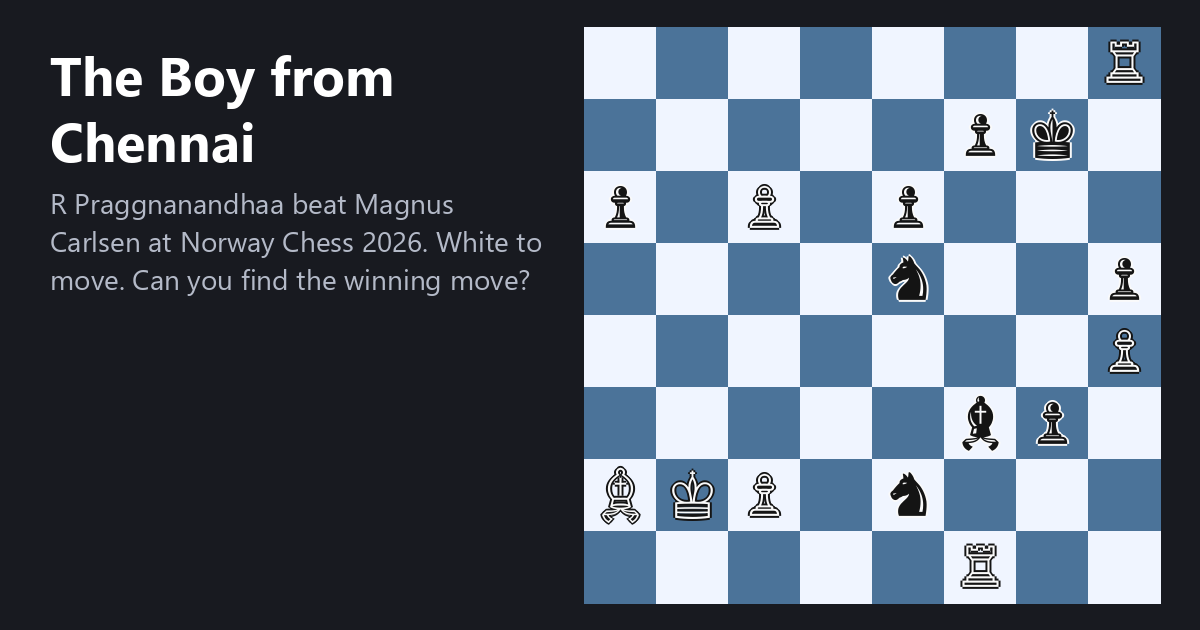
Let us start with a puzzle. Look at the position above. It is White's move, and White's rook on h8 is under attack. Black's king, standing on g7, can simply take it. Black also has a bishop on f3, two knights and a pawn on g3 that is ready to run. White has two rooks, a bishop and a pawn on c6, one step from the seventh row. White has a way to win the game quickly. Keep it in mind: you will meet the answer in the game below.


 6
6


 2
2 f
fWhite to move. White's rook on h8 is attacked by the black king, and Black's pawn on g3 is only two steps from queening. White's pawn on c6 is one step from the seventh row. Is there a way to win the game?
The player with the white pieces was R Praggnanandhaa, a 20-year-old from India, usually called Pragg. The player with Black was Magnus Carlsen, the world number one. The game was played in Round 3 of Norway Chess in Oslo, in May 2026.
A Boy from Chennai
Rameshbabu Praggnanandhaa was born on 10 August 2005 in Chennai, in southern India. His older sister, Vaishali, also plays chess, and in 2023 the two of them became the first brother and sister to both earn the grandmaster title.
He was very young when he started to win. In 2016, when he was ten years old, he became an International Master, the title one step below grandmaster, and he was the youngest in history to do it at that time. On 23 June 2018, at the Gredine Open in Ortisei, Italy, he finished the last of the three grandmaster norms he needed. That made him a grandmaster at 12 years, 10 months and 13 days, the second-youngest in chess history at that time.
Climbing to the Top
- In February 2022, at 16, he beat Magnus Carlsen for the first time, in an online rapid game at the Airthings Masters. Rapid chess is a faster kind of chess, with less time on the clock.
- In August 2023 he reached the final of the World Cup in Baku, Azerbaijan, at 18. He drew both classical games against Carlsen, then lost the rapid tie-break 1.5 to 0.5. The run won him a place in the 2024 Candidates Tournament.
- In May 2024, at Norway Chess, he beat Carlsen for the first time in a classical game, the slow kind.
- In January 2025 he tied with D Gukesh on 8.5 points out of 13 at the Tata Steel Masters in Wijk aan Zee, the Netherlands, then won the playoff and the title.
- In May and June 2026 he won Norway Chess in Oslo with 18 points, the first Indian to win it. He beat Carlsen in Round 3 and again in Round 8, and he won his last game against Vincent Keymer.
- In August 2026, in St. Louis, he trailed Fabiano Caruana by six points in the final of the Grand Chess Tour Finals, came back, and won it 15 to 13.
- In September 2026 he played first board for India at the Olympiad in Samarkand. He scored 6½ points out of 10, with three wins and seven draws, and one of the wins was against Anish Giri.
The Game: R Praggnanandhaa vs. Magnus Carlsen, Norway Chess 2026
R Praggnanandhaa 1-0 Magnus Carlsen Norway Chess 2026, Oslo · Round 3 · Classical, two hours for the first 40 moves, then 10 seconds added for every move from move 41 White: R Praggnanandhaa · Black: Magnus Carlsen
A sharp start
The game began as a Sicilian Defence, the Najdorf Variation, one of the most popular openings.
1.e4 c5 2.Nf3 d6 3.d4 cxd4 4.Nxd4 Nf6 5.Nc3 a6 6.h4 h6 7.Bc4 e6 8.a3 Nc6 9.Be3 Bd7 10.Ba2 Be7 11.Qe2 h5 12.f3 Ne5 13.O-O-O Rc8
On move 6 Pragg pushed his h-pawn two squares. Our own Stockfish 17.1 run, at depth 22, preferred 6.Be3, but it still called the position level after 6.h4. Carlsen played 6...h6 and later 11...h5, which stopped White's h-pawn from advancing. Then both players got their pieces out. Pragg castled on the queenside on move 13. Black's king stayed in the middle of the board.
An exchange sacrifice
14.Bg5 Rxc3 15.bxc3 Qa5 16.Kb1 Qxa3

 6
6 32
32 cdh
cdhPosition after 14...Rxc3, with White to move. Black's rook has just taken the white knight on c3. Black gives up a rook for a knight, and the pawn on b2 can take it.
Carlsen took the knight on c3 with his rook, and Pragg took back with the b-pawn. Black had given a rook (worth five points) for a knight (worth three). This is called an exchange sacrifice. Carlsen got something for it. White now had two pawns on the c-file, and Black's queen took the pawn on a3, right next to the white king. Our engine called the position equal after 15.bxc3. You can see why Carlsen liked it.
The knight jump that gave White a chance
17.f4 Neg4
632bdhPosition after 17...Neg4, with White to move. Black's knight has jumped to g4, and Black's queen is on a3, far from its own king. White's pawn can push to e5, hitting the knight on f6.
The knight on e5 jumped to g4. It looks active, but our engine marked it as Black's first real mistake, and it preferred 17...Nc6. It moved the score from about a third of a pawn for White to about one pawn. The reason is the move that follows.
18.e5 dxe5 19.fxe5
The pawn on e5 attacks the knight on f6, and it was the engine's first choice. After the black pawn takes it, the other white pawn takes back on e5 and attacks the knight on f6 again.
19...Nh7 20.Qd2 Nf8 21.Nf3 Qc5 22.Bxe7 Qxe7 23.Ng5 Ng6 24.Ne4 N6xe5 25.Nd6+ Kf8
White's pieces came toward the black king. Our engine had White better by about one pawn to one and a third pawns for most of this stretch.
The middle of the game slips away
26.Rhf1 Nf6 27.Qd4 Neg4 28.Nxb7 Bb5 29.Qd8+ Ne8 30.Qxe7+ Kxe7 31.c4 Ba4 32.Rd8 Bc6 33.Rb8 Bxg2 34.Rg1 Bf3 35.Rg3 Ne5
Our engine marked 26.Rhf1 and 28.Nxb7 as moves that gave away some of White's edge, and by move 29 the queens were being traded and the game was almost level. After the queens came off, the game became a fight with rooks, a bishop and knights. It was also becoming a race against the clock. After 35...Ne5 Carlsen had 269 seconds left, about four and a half minutes. After 36.c5 Pragg had 122 seconds, just over two minutes.
36.c5 g5 37.Nd6
62bPosition after 37.Nd6, with Black to move. White's knight attacks Black's knight on e8 and the pawn on f7. Black's bishop on f3, knight on e5 and pawns on g5 and h5 are all very active. Our engine had Black better by about two pawns here.
Here the game turned the other way. Our engine thought 36.c5 and 37.Nd6 were mistakes. By 37.Nd6 it rated Black better by about two pawns. By our engine's count, Carlsen was close to winning. His pieces were active, and the pawns on g5 and h5 could race forward.
37...g4 38.Nc8+ Kf6 39.Nd6 Nxd6 40.Rxh8 Ne4 41.Rg1 Nc3+ 42.Kb2 Ne2 43.Rf1 g3
Carlsen kept pushing his pawn, and Pragg kept making threats. After 39...Nxd6, which our engine marked as a slip, Carlsen had 56 seconds on his clock. The engine's choice there was 39...Bc6. After 40.Rxh8 Pragg had 41 seconds. From move 41 each player got only ten seconds back after every move.
The last mistakes
43...g3 The pawn took another step toward the first row, and the engine marked it as a big mistake. It preferred 43...Nf4.
62fPosition after 43...g3, with White to move. Black's pawn on g3 is two steps from queening, and White's pawn on c5 is three steps from queening. White's rooks are on h8 and f1.
44.c6 Kg7
Now Pragg answered with 44.c6, but our engine did not love it: it preferred 44.Rg8, and after 44.c6 it said Black could hold the game with 44...g2. Carlsen played 44...Kg7, and he had only 30 seconds left. It looks like a good move. The king attacks the rook on h8. But it is the decisive mistake. This is the position at the top of the article.
45.c7
The pawn runs to the seventh row. If Black takes the rook, 45...Kxh8, then 46.c8=Q+ is check, and White gets a new queen. Our engine rated White more than five and a half pawns better after 45.c7.
45...Bb7 46.Rb8 g2
Carlsen put his bishop on b7 to cover the queening square on c8, but 46.Rb8 attacked the bishop. The game ended with Pragg's win after 46...g2.
What to Learn from This Game
- An exchange sacrifice can be worth it. Carlsen gave up a rook for a knight on move 14 and got an equal game. Before you try it, ask what you get: broken pawns near the king and a queen that can grab pawns.
- A passed pawn is a big weapon. From move 36 to the end the c-pawn kept White's pieces, and Carlsen's, busy. A pawn that nobody can stop makes the other side watch it all the time. When it reached c7, it won the game.
- When the clock is short, you still have to look for checks, captures and threats. From 36.c5 to 45...Bb7 our engine marks seven moves, and both players had about a minute or less on the clock for the last stretch. Pragg kept the position complicated until Carlsen went wrong.
- A move that attacks a piece is not always a good move. 44...Kg7 attacked a rook and lost the game, because the pawn on c6 could run to c7 with a threat that was bigger.
Five More Games to Study
- R Praggnanandhaa vs. Alireza Firouzja, Norway Chess, Oslo 2026, Round 7 (1-0). A Giuoco Piano, one of the oldest openings in chess. It was a slow squeeze. Our engine had White slightly better from around move 15, by about four tenths of a pawn, and about one and a quarter pawns better by move 36. Firouzja's 44...f4 and 49...Qf7 are the moves it marks, and White won in 51 moves.
- Magnus Carlsen vs. R Praggnanandhaa, Norway Chess, Oslo 2026, Round 8 (0-1). Pragg's second win over Carlsen in the same tournament, with Black in a French Defence. Our engine had Pragg a little better in the middlegame, and by move 39 it had the game level, with Black's queen giving check after check. Carlsen's 48.Kf4 walked into a forced mate. 48.Ke2 would have held the draw.
- D Gukesh vs. R Praggnanandhaa, Norway Chess, Oslo 2026, Round 9 (0-1). Gukesh was the reigning world champion. On move 14 Pragg's knight jumped to b3, attacking the rook on a1 and the bishop on c1, and it took the rook on move 15. Our engine had Pragg better by about a pawn and three quarters after that. Gukesh's 27.Kb1 is the move it marks, and the game ended in 34 moves. You can try the knight jump below.
- R Praggnanandhaa vs. Vincent Keymer, Norway Chess, Oslo 2026, Round 10 (1-0). The last round, with the title on the line. A Queen's Gambit that never gave either side more than about half a pawn for the first 27 moves. Keymer's 35...g6 and 41...h4 are marked, and White won in 45 moves.
- R Praggnanandhaa vs. Anish Giri, Olympiad, Samarkand 2026, Round 5 (1-0). A Ruy Lopez with a comeback. Our engine had Giri slightly better, by up to about a pawn, between moves 20 and 27. Giri's 36...Ke8 and 40...Kc7 are marked, and Pragg's king walked up to g5 as he won in 58 moves.
A Position to Try
76531acehGukesh vs. Praggnanandhaa, Norway Chess 2026, after 14.g4. Black to move. Black's knight on a5 can make a fork. Find it.
The answer is 14...Nb3. The knight attacks both the rook on a1 and the bishop on c1, and no white pawn can take it. White cannot save both pieces. In the game Gukesh played 15.Bb2, and Pragg took the rook, 15...Nxa1. Our engine rates Black better by about a pawn and a quarter after 14...Nb3.
A Champion Still Growing
On 10 August 2026 Praggnanandhaa turned 21. He started as a boy in Chennai, finished the requirements for grandmaster at 12, beat Magnus Carlsen in a classical game for the first time in 2024, and in 2026 won Norway Chess and the Grand Chess Tour. In the games above he kept the position complicated and gave the other player chances to go wrong. Try playing the same way the next time you are in a tough position. You do not need to be better, you only need to be difficult to beat.