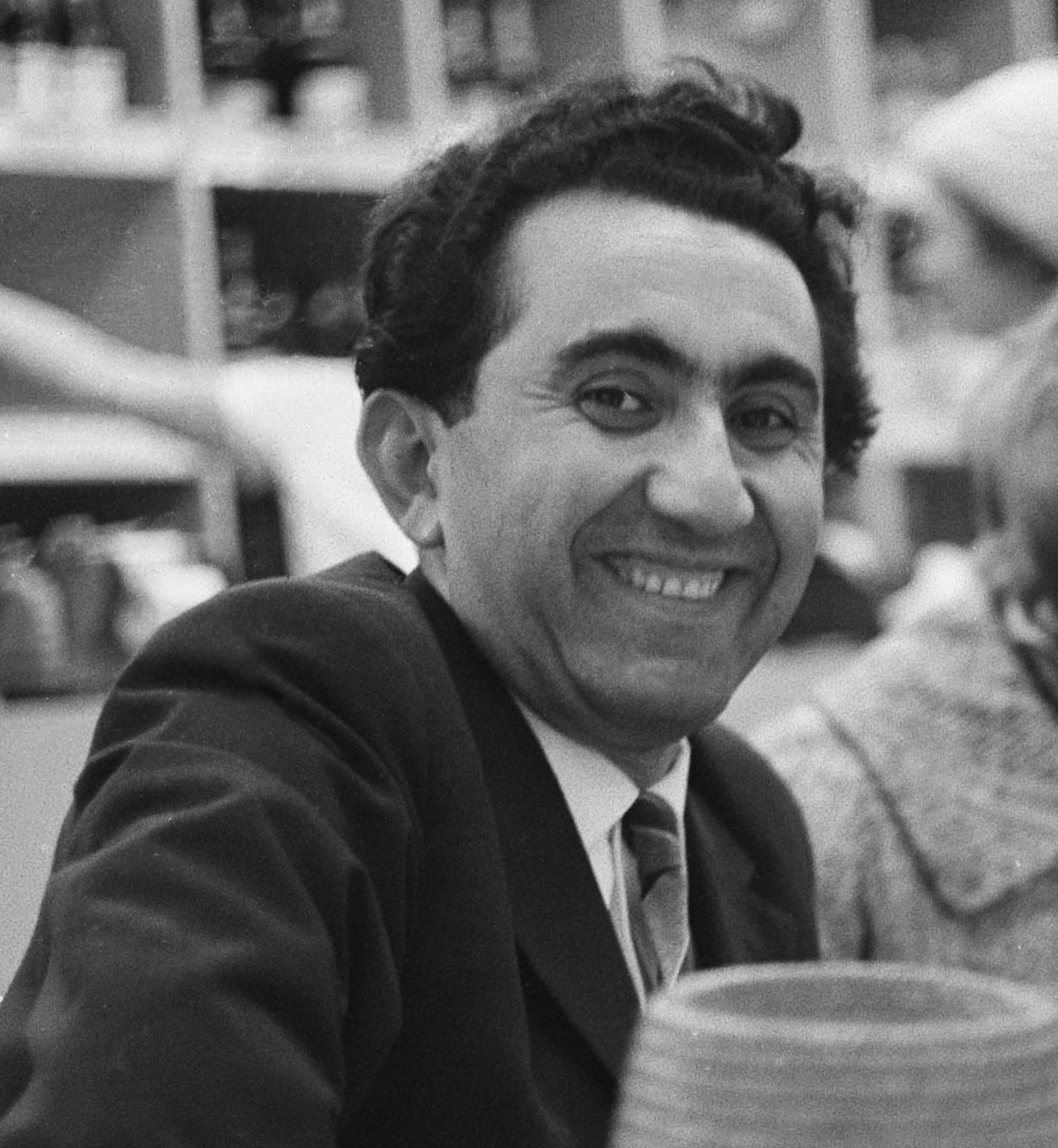
Photo: Harry Pot / Anefo / Wikimedia Commons (CC0)
Tigran Petrosian built a career on not losing. He removed danger from the board before his opponent knew a plan was coming. So when he defended his world title against Boris Spassky in Moscow in 1966, the tenth game of the match was a surprise. Petrosian gave away both of his rooks, kept attacking, and won in 30 moves.
This is the story of how a boy from Tbilisi became world champion, and of the game in which the quiet defender showed how much he understood about sacrifice.
From Tbilisi to the Palace of Pioneers
Petrosian was born on 17 June 1929 in Tbilisi, then called Tiflis, to an Armenian family. He lost his parents while he was still a teenager and worked as a street sweeper to live. As a boy he trained at the Tiflis Palace of Pioneers under Archil Ebralidze, and two influences shaped him there. One was the writing of Aron Nimzowitsch, whose idea of prophylaxis, preventing the opponent's plan before it starts, became the centre of Petrosian's style. The other was the play of Capablanca.
He won the Soviet junior championship in 1946. At the turn of the 1950s he moved to Moscow to find stronger opponents, and a strong result at the 1951 Soviet Championship took him to the Interzonal tournament in Stockholm in 1952, where he earned the grandmaster title.
Did You Know?
Petrosian played on ten Soviet Olympiad teams between 1958 and 1978, and he lost only one game in all of those events.
The Match Player
Petrosian won the Soviet Championship four times, in 1959, 1961, 1969 and 1975. In 1962 he won the Candidates Tournament in Curaçao, which earned him a match with the champion, Mikhail Botvinnik. In the spring of 1963 in Moscow he won it by 5 wins to 2 with 15 draws and became the ninth world champion. You can read about the man he beat in our story on Mikhail Botvinnik.
In 1966 Spassky challenged him. Petrosian won the match, 4 wins to 3 with 17 draws, and kept the title. In 1969 the same two players met again and Spassky won, 12½ to 10½. Petrosian was a Candidate again in the 1970s and played at the top of the game for years after losing the title.
The Game: Petrosian vs. Spassky, Moscow 1966, Game 10
Tigran Petrosian 1-0 Boris Spassky
Petrosian had White. The game began . White has grabbed space in the centre and pushed the black knight back. Spassky's knight went to the rim, , and the game continued .
Black now has a classic King's Indian setup with pawns on c5, d6 and e5, and the freedom to attack on both wings. White has a firm hold on the centre. .
After 14...b5, White to move. Black's pawns on b5, c5, e5 and f5 claim space on both wings, and the knight on g4 points at the white kingside. White's knights on d1 and d2 are tucked away behind their own pawns.
The position looks pleasant for Spassky. Black's pawns are rolling on both wings, and White's pieces are cramped. White answered with a break against the black centre. .
After 18.Qxb2, Black to move. The black bishop that guarded the long diagonal is gone, and the white queen on b2 looks along the open diagonal toward g7 and h8.
Remember this diagonal. The trade of bishops cost Black the piece that normally guards g7 and h8, and White's queen now stares straight at those squares. For the moment a black knight blocks it, after .
After 20...Bh3, White to move. The black bishop attacks the rook on f1. White is a pawn up, but the pawn on f4 is attacked and the bishop on h3 threatens to win the exchange.
This is the critical moment. The rook on f1 is attacked, and White has three reasonable looking choices. Moving the rook with 21.Rf2 loses time, and our engine, Stockfish 17.1 searching to depth 22, gives Black an edge after it of about six tenths of a pawn. 21.Ne4 also leaves Black slightly better, by about a quarter of a pawn. Petrosian left the rook where it stood and played !
The knight covers g4 and f5 and keeps Black's pieces off those squares. It is the engine's first choice too, and it keeps White about half a pawn ahead. Petrosian simply let the bishop take the rook: .
After 23.Bg4, Black to move. White has given a rook for a bishop, but the pieces on e3, g4 and b2 are pointed at Black's king. Black's best defence was 23...Qf6.
White has given up the exchange, a rook for a bishop, and the compensation is not material. White's bishop on g4 eyes e6, the knight on e3 guards the key squares and the queen on b2 has the long diagonal. White's pawn on f4 is attacked twice, and takes it. Our engine prefers 23...Qf6, which puts the queen on the long diagonal and offers a trade of queens, and it still rates White about one pawn better. After the evaluation jumps to more than three pawns for White.
Petrosian replied with a second exchange sacrifice: .
After 24...Rxf4, White to move. White has no rooks at all, against Black's two. Black is four points ahead on the usual scale, but White has three minor pieces and a queen for the attack.
Count the material. White has a queen, a bishop and two knights. Black has a queen, two rooks and a knight, and that knight is far away on a5. On paper White is four points behind. On the board the knight on a5 and the rook on a8 are far from the king, and White's pieces are close to it.
The finish came quickly. . The bishop on e6 pins the rook on f7 to the king, and after the rook is attacked twice and defended once. Black's last defence was , bringing a second defender to f7.
Now stop and look at the position after . White to move. Is there a win?
After 29...Rxf7, White to move. White is a rook and a piece down on paper, and Black's queen on g5 is next to the king. Find the move that wins.
The answer is ! The queen goes to the diagonal it took over on move 18. Only the king can take it, 30...Kxh8, and then 31.Nxf7+ forks the king and the queen on g5. After either king move White wins the queen with 32.Nxg5 and is a knight and a pawn ahead. Our engine at depth 18 also picks and puts White about seven pawns ahead.
What Petrosian Can Teach You
What Tigran Petrosian Can Teach You
- Count the squares, not only the points. After 24.Rxf4 White was four points behind, but Black's pieces were far from their king.
- When a rook is attacked, ask what it is doing before you save it. The knight on e3 mattered more than the rook on f1.
- A trade of bishops can open a diagonal for the queen. The exchange on b2 prepared 30.Qh8+ many moves later.
- An exchange sacrifice needs a target. Here it was the king on g8, with no defenders nearby.
- Quiet moves make loud moves possible. The break with 15.f3 and the bishop trade came long before the sacrifices.
Petrosian, World Champion
Petrosian held the world title from 1963 to 1969 and stayed among the best players in the world for another decade. He lived in Moscow, and he died there on 13 August 1984. He is remembered for prophylaxis and for defence, and Game 10 shows the other side of his play. When the moment arrived, he could attack as well.
Related Stories
world • 2026-11-21
Gukesh vs Sindarov: A Beginner's Guide to the World Championship
tournaments • 2026-11-21
Firouzja Takes the First Total Chess Title in Budapest
tournaments • 2026-11-17
Giri and Firouzja Lead Total Chess Semifinals
tournaments • 2026-11-15