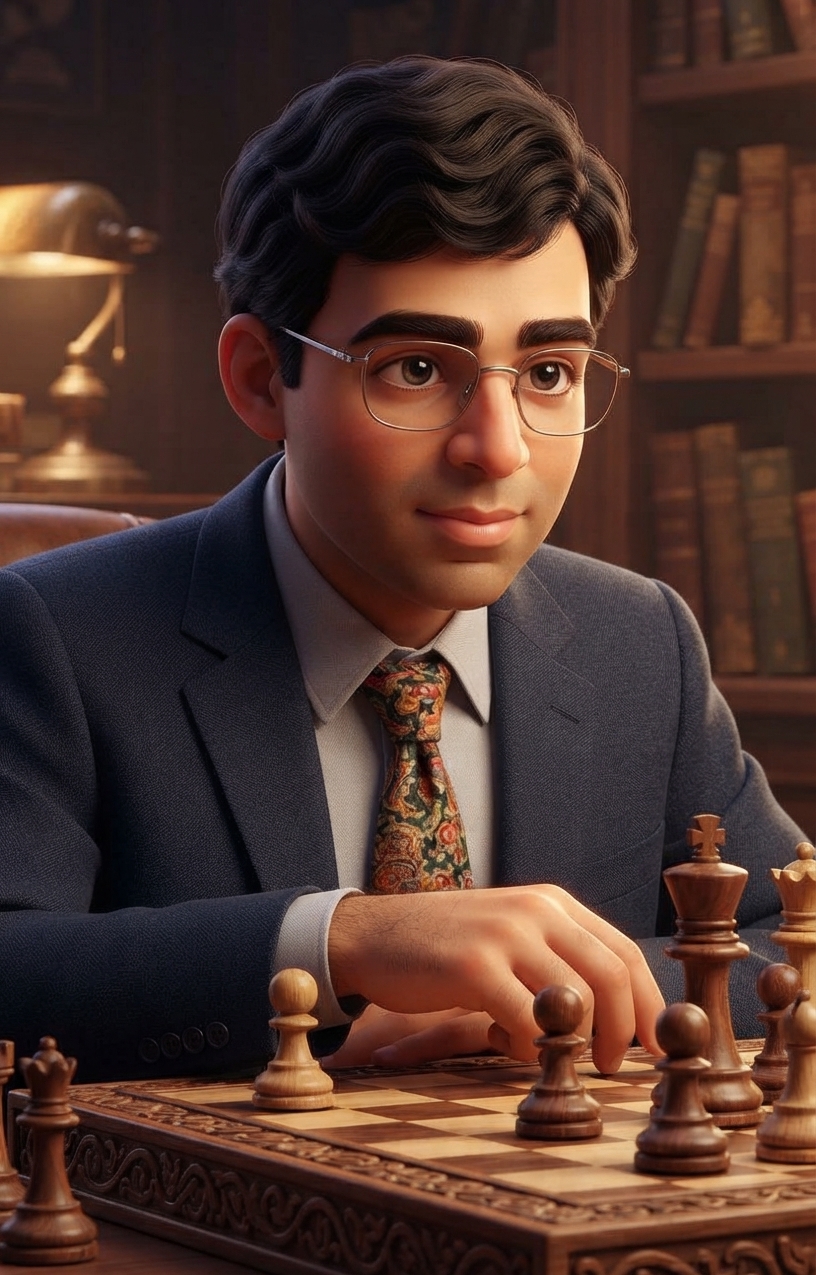
Illustration of Viswanathan Anand at the chessboard. This is not a real picture of him, and the board shown is not a position from a real game.
Let us start with a puzzle. Look at the position below. It is Black's move. White has a pawn on b6, almost on the seventh row, and pawns on a5, e5 and g5. But Black has a pawn on b4 with no white pawn in front of it, and Black has a rook while White has only a bishop. One pawn move starts a race that White cannot win. Which one? Keep it in mind: you will meet the answer in the game below.


 5
5

Black to move. Black has a rook on d8, a king on c6 and pawns on b4, g6 and h7. White has a bishop on e3, a king on f4 and pawns on a5, b6, e5, g5 and h2. One pawn move starts a race that Black wins. Which pawn, and where?
The player with the black pieces was Viswanathan Anand, an 18-year-old from India. The player with White was Efim Geller, a Soviet grandmaster. They met in the seventh round of a tournament in Coimbatore, India, in December 1987.
A Boy Who Played Fast
Viswanathan Anand was born on 11 December 1969 in Mayiladuthurai, a town in Tamil Nadu, in southern India, and grew up in Chennai. His mother taught him to play chess when he was six. For some of his childhood his family lived in Manila, in the Philippines, from 1978. Back in India he became known for how quickly he played, and a journalist nicknamed him the Lightning Kid.
Climbing to the Top
- In 1983 he won the Indian sub-junior championship with a perfect score, 9 wins in 9 games. He was 14.
- In 1984 and 1985 he won the Asian Junior Championship. He also became the youngest Indian to earn the title of International Master.
- At 16 he became the Indian national champion, the youngest ever. He won the title again in 1987 and 1988.
- In 1987 he became the first Indian to win the World Junior Championship.
- At 18, after the tournament in Coimbatore where he beat Geller, he became India's first grandmaster.
- In 1995 he played Garry Kasparov for the World Championship in New York. The first eight games were draws, and Anand won Game 9. Kasparov won the match 10½ to 7½.
- In 2000 he beat Alexei Shirov 3½ to ½ in Tehran and became FIDE World Champion.
- In 2007 he won the World Championship tournament in Mexico City, a full point ahead of the next players, and became the undisputed World Champion. He defended the title in matches against Vladimir Kramnik in 2008, Veselin Topalov in 2010 and Boris Gelfand in 2012. In 2013 he lost it to Magnus Carlsen.
Anand won the world title in three different ways: a knockout tournament, a round-robin tournament and a match.
The Game: Efim Geller vs. Viswanathan Anand, Coimbatore 1987
Efim Geller 0-1 Viswanathan Anand Coimbatore 1987 · Round 7 White: Efim Geller · Black: Viswanathan Anand
Queens off
The game began as a Petroff Defence. Anand took the pawn on e4 on move 4 and White opened the center with 5.d4.
1.e4 e5 2.Nf3 Nf6 3.Nxe5 d6 4.Nf3 Nxe4 5.d4 d5 6.Bd3 Be7 7.O-O Nc6 8.c4 Nf6 9.Nc3 O-O 10.cxd5 Nxd5 11.Re1 Be6 12.a3 Bf6 13.Be4 Nce7 14.Ng5 Bxg5 15.Bxg5 f6 16.Bd2 Qd7 17.Qc2 f5 18.Bf3 c6 19.Re2 Ng6 20.Rae1 Nxc3 21.Bxc3 Bc4 22.Re3 f4 23.Bb4 fxe3 24.Qxc4+ Qf7 25.Qxf7+ Rxf7 26.fxe3
87 3
3 eg
egPosition after 25...Rxf7, with White to move. The queens are off. White has two bishops and a rook, and Black has two rooks and a knight.
For the first 25 moves our own Stockfish 17.1 run, at depth 22, kept the game within about eight tenths of a pawn of level. The queens came off on move 25. After 25...Rxf7 White had two bishops and a rook, and Black had two rooks and a knight. Our engine called it equal.
Anand takes the lead
26...Re8 27.Bc5 a6 28.Bd1 Kh8 29.a4 Nf4 30.Bc2 Rd7 31.Kf2 Nd5 32.e4 b6 33.Ba3 Nf6 34.Ke3 Nd5+ 35.Kf3 Nc7 36.Rd1 Red8 37.Ke3 Ne6 38.a5 Nxd4
653dPosition after 38...Nxd4, with White to move. Black's knight has taken a pawn on d4. White has two bishops and a rook, and Black has two rooks and a knight.
Our engine marks White's 27.Bc5 and 31.Kf2 as small slips, and by move 37 it had Black better by more than one pawn. White's 38.a5 made it worse, and Anand's knight took the pawn on d4. After 38...Nxd4 our engine had Black better by about two and a half pawns. Anand did not play perfectly either. His 39...b5 gave back more than a pawn of that edge, and the engine's first choice was 39...bxa5.
39.Rc1 b5 40.Bc5 Nxc2+ 41.Rxc2 Kg8 42.Bb6 Rc8 43.b4 Kf7 44.Bd4 Ke6 45.g4 Rcd8 46.Rxc6+ Rd6 47.Rb6 Rxb6 48.axb6 g6 49.g5 Kd6
After 40.Bc5, which our engine marks, Anand traded his knight for White's bishop and Black was better by about three pawns. Then the trades came one after another. By move 49 one pair of rooks had gone, and White was left with a bishop and five pawns against Black's rook and four pawns. Our engine now said the game was close to equal.
One careless king move
6Position after 49...Kd6, with White to move. White has a bishop on d4, a king on e3 and five pawns. Black has a rook on d8, a king on d6 and four pawns. Our engine finds 50.e5+, 50.h4 and 50.Kd3 all about equal, and 50.Kf4 loses a lot.
50.Kf4 Kc6 51.Be3 a5 52.bxa5 b4 53.e5
This is the moment that decided the game. In the position above, our engine finds three moves that keep the game about equal: 50.e5+, 50.h4 and 50.Kd3. Geller played 50.Kf4, and the engine marks it as a mistake of about two and a half pawns. After 50...Kc6 he made a second mistake, 51.Be3, and Black was better by almost five pawns. Anand's pawn on b4 was now a passed pawn, which is a pawn with no enemy pawn in front of it or beside it. The puzzle position is the one after 53.e5.
The passed pawn runs
53...b3 54.Bc1 Rd1 55.Ba3 Re1
5Position after 53...b3, with White to move. Black's pawn on b3 is two steps from becoming a queen, and Black's rook on d8 can support it. White's bishop on e3 has to stop it, and the bishop is not enough.
The answer to the puzzle is 53...b3, and it was our engine's first choice at depth 22. The pawn stood two steps from b1. Geller's bishop went to c1 to cover the squares, and Anand's rook attacked the bishop with 54...Rd1. After 55.Ba3 Anand played 55...Re1, and Geller resigned. The rook and the passed pawn worked together, and the bishop could not hold them back.
What to Learn from This Game
- A passed pawn is a plan. A pawn with nothing in front of it makes the opponent's pieces run to stop it. Anand's pawn on b4 kept White's bishop busy.
- A rook can help a passed pawn. Anand's rook attacked the bishop that tried to stop the pawn.
- In an equal endgame, keep playing good moves. Our engine found the game close to equal at move 49, and one careless king move turned it in a single move.
- Check before you move the king. 50.Kf4 looks natural, but 50.e5+ gives a check first and keeps the king where it is. Look for checks and captures before you move the king.
Five More Games to Study
Every engine number below comes from our own Stockfish 17.1 run at depth 20.
- Viswanathan Anand vs. Garry Kasparov, World Championship match, New York 1995, Game 9 (1-0). A Sicilian. Game 9 was the first win of the match, after eight draws. On move 27 Anand gave a rook for a knight with 27.Rd5 and our engine had him a little better, about one pawn, for the rest of the middlegame. Kasparov's 31...Rg5 is the move it marks, at more than two pawns, and Anand won in 35 moves.
- Viswanathan Anand vs. Anatoly Karpov, World Championship match, Lausanne 1998, Game 6 (1-0). A Trompowsky Attack, in the last game of a six-game match. Anand needed a win to force a playoff, and our engine had the game close to level for about 27 moves. Karpov's 28...Qd8 is the move it marks, and after it White won material and the game.
- Vladimir Kramnik vs. Viswanathan Anand, World Championship match, Bonn 2008, Game 3 (0-1). A Semi-Slav, in the Meran line, and a win as Black. Our engine marks Kramnik's 32.f3 and his 33.Bd3, the second a big mistake. Anand's 33...Bh3 gave much of it back, but he won.
- Veselin Topalov vs. Viswanathan Anand, World Championship match, Sofia 2010, Game 12 (0-1). A Queen's Gambit Declined in the Lasker line, in the last game of the match, with the score level. Topalov took pawns with 31.exf5 and 32.fxe4, and our engine marks both. Anand won in 56 moves.
- Viswanathan Anand vs. Boris Gelfand, World Championship match, Moscow 2012, Game 8 (1-0). An Anti-Grünfeld, and a win in 17 moves. Black's queen took a rook on h1 and could not get out. You can try the position below.
A Position to Try
87
 2
2 bdfh
bdfhAnand vs. Gelfand, Moscow 2012, after 14...Qf6. White to move. White's pawn on g4 attacks Black's knight on h5, and Black's queen on f6 attacks the pawn on f3. What would you play?
Anand played 15.gxh5, and our engine's first choice at depth 22 is the same move. The next best move is almost two pawns worse. After 15...Qxf3+ 16.Kc2 Qxh1 17.Qf2 every square the black queen can reach is attacked, and Gelfand resigned.
A Champion Who Kept Going
Anand was nicknamed the Lightning Kid for his speed, but in the game above he won a long endgame. On move 49 the position was close to equal, and one wrong king move gave him a passed pawn that he ran home. When the position is equal, keep playing good moves and give your opponent a chance to go wrong.