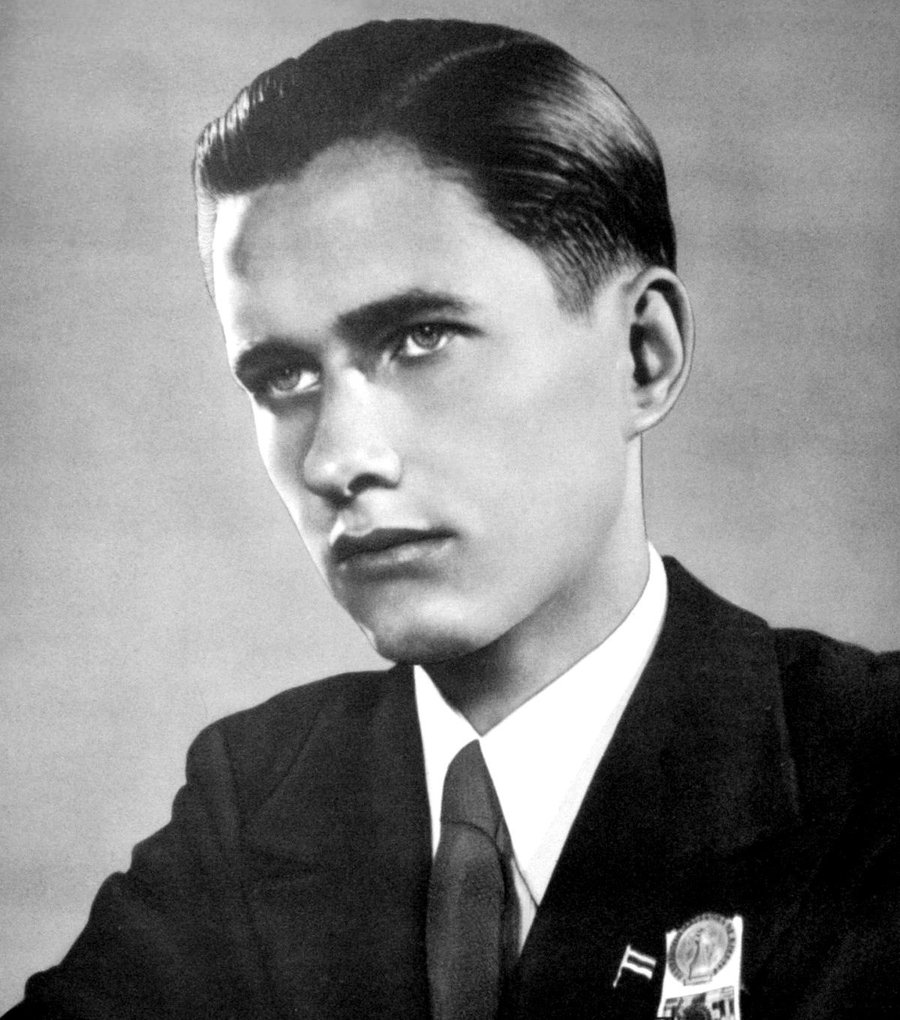
Photo: El Gráfico / Wikimedia Commons (Public domain)
In November 1938, in the Netherlands, a 22-year-old from Estonia sat down to play José Raúl Capablanca, a former world champion. Paul Keres won the game in 38 moves. The hero of the game was a white knight that jumped from square to square and never stood still.
Here is the story of Paul Keres, the game, and what it can teach you.
A Small Boy in Pärnu
Paul Keres was born on 7 January 1916 in a village near Narva, in Estonia. He grew up in the town of Pärnu. He learned chess as a small child, from his father and his older brother Harald. In the early 1930s he won the Estonian schoolboy championship more than once.
Keres also played chess by mail. In a mail game, each move travels as a letter or a postcard, so a single game can take many months. Keres said that at one time he had up to 150 of these games going at once. All those games showed him many different openings and ideas.
Did You Know?
Keres also made chess puzzles. He began composing chess problems while he was still young.
From Estonian Champion to the Top
In 1935 Keres became champion of Estonia. The same year he played for his country at the Olympiad in Warsaw, and newspapers around the world wrote about the young star.
The invitations came quickly. In 1936 he shared first place with Alexander Alekhine, a former world champion, at Bad Nauheim in Germany. You can read about Alekhine in our story on Alexander Alekhine. In 1937 Keres won the strong tournament at Semmering and Baden in Austria, ahead of Reuben Fine, Capablanca, Samuel Reshevsky and Erich Eliskases.
The AVRO Tournament of 1938
In November 1938 eight of the best players in the world met in the Netherlands for the AVRO tournament. Each player met every other player twice. Keres and Fine finished tied for first place, with 8½ points out of 14. Keres was placed first because he had beaten Fine by 1½ points to ½ in their two games.
They finished ahead of Botvinnik, Max Euwe, Reshevsky, Alekhine, Capablanca and Salo Flohr. You can read how Botvinnik beat Capablanca in the same tournament in our story on Mikhail Botvinnik.
The winner was expected to play Alekhine for the world title. But the Second World War began in 1939, and the match never took place.
The Game: Keres vs. Capablanca, AVRO 1938
Paul Keres 1-0 José Raúl Capablanca
Keres had White. The game began with . This is called the French Defense, in a line called the Tarrasch Variation. You can read about Capablanca in our story on José Raúl Capablanca.
The play went on with . Then Keres traded knights: .
After 13...bxc6, White to move. Black has pawns on a6, c6 and d5. The pawn on a6 has no pawn next to it on the b-file. A pawn alone like this is called an isolated pawn, and it is hard to defend.
The game continued .
After 17.Qxc4, Black to move. Now Black has two isolated pawns, on a6 and c6, and the white queen on c4 attacks both of them. Material is equal.
Our engine, Stockfish 17.1 searching to depth 18, gave White a small edge here, a little less than one pawn. But the weak pawns gave Keres something to aim at. The game went on with . The black rook on b6 guards both weak pawns, because it stands next to the pawn on a6 and the pawn on c6.
The Knight on the Move
Now look at the white knight on d4. It got there from f3 on move 21. It is about to start a tour of the board.
After 21...Rb6, White to move. The knight on d4 can jump to many squares. One jump hits the black queen on c7, and Black cannot safely take the knight. Can you find it?
Keres played ! The knight attacks the queen on c7. The only black pawn that can take it is the pawn on f7, but taking loses. After 22...fxe6 23.Qxe6+ White gives check, and the rook on d1 is ready to take the bishop on d6. Our engine, at depth 18, says White would be about four pawns ahead.
After 22.Ne6, Black to move. The knight attacks the queen on c7 and also the pawn on g7. If Black takes it, 22...fxe6, the check 23.Qxe6+ follows.
Capablanca moved his queen, . Then the knight jumped again: . Now the pawn on f7 was attacked twice, by the knight and by the queen on c4, and it was guarded only by the black king. Capablanca added a defender with .
Keres kept pushing: . The black bishop attacked the knight on g5, but the queen on g4 guarded it. Then attacked the bishop in turn.
Capablanca played . His rook attacked the knight too, so now the knight on g5 was attacked twice and guarded once. But the rook had left the seventh rank, and the pawn on f7 lost a guard. Our engine, at depth 20, says Black's best moves were 25...Re8 or 25...Re7, and then White would be a little more than one pawn ahead. After the engine says White is more than four pawns ahead.
After 25...Rb5, White to move. The rook has left the seventh rank, and the pawn on f7 has only the king to guard it. The white knight on g5 is attacked by the bishop and the rook.
The Knight Takes f7
Keres played ! The knight took the pawn. Our engine found an even stronger move, 26.Rxf4. But Keres's move leaves White about two and a half pawns ahead, and it hides a trap.
After 26.Nxf7, Black to move. The knight on f7 can be taken by the king. But after 26...Kxf7 27.Rd7+ White attacks with check after check, and our engine finds a forced checkmate.
If Black takes the knight with the king, 26...Kxf7, then 27.Rd7+ starts an attack that ends in checkmate. So Capablanca left the knight alone and played . Then attacked the bishop on f4 with a pawn. Capablanca offered to trade queens, , and Keres first took the bishop, . The queens came off the board: .
After 29...Kxf7, White to move. White won a bishop and a pawn, and gave up a knight. White has five pawns and Black has four. The white bishop on b2 now looks down the long diagonal at the pawn on g7.
Count what happened. White won a bishop and a pawn, and gave up a knight. That is one pawn extra. Next, . Trading the rooks pulled the black king away from the pawn on g7. won a second pawn.
After 32.Bxg7, Black to move. White has a rook and a bishop, and Black has a rook and a knight. White has five pawns and Black has three.
The last moves were . Keres traded the rooks and kept his extra pawns.
After 38.f4, Black to move. White has a bishop and five pawns. Black has a knight and three pawns. Our engine, at depth 18, has White more than five pawns ahead.
The game ended there, with a win for Keres.
What Paul Keres Can Teach You
What Paul Keres Can Teach You
- Look for isolated pawns. They have no pawn neighbors to help, and a queen or a rook can attack them again and again.
- A knight can plan a route. From move 21 to move 26 the same knight went to d4, e6, g5 and f7.
- Count attackers and defenders on a square. The pawn on f7 fell when one defender walked away.
- Before you take a piece, ask what happens next. After 26.Nxf7 the black king could not take the knight, because Rd7+ came with check.
- Trades can drag defenders away. When the rooks came off, the black king left g7 behind.
Keres, the Eternal Second
Keres was one of the best players in the world for many years. He won the Soviet Championship three times, in 1947, 1950 and 1951. He won games against nine world champions, from Capablanca to Bobby Fischer.
But he never became world champion himself. In 1953, 1956, 1959 and 1962 he finished second, or tied for second, in the Candidates Tournament, the event that chose who would play the champion. In 1965 he lost a quarter-final match to Boris Spassky. It was his last Candidates event. Fans called him "the Eternal Second."
Keres died in Helsinki on 5 June 1975, at the age of 59.
A Habit to Practice
When you see a knight that has a free square, do not ask only "what can it attack now?" Ask "where can it go in two or three jumps?" Keres looked at the board that way, and his knight reached f7.
Try it with the position after . Set it up on a board, play , and then look at every reply Black has. Then play through the whole game slowly, covering the next move and guessing it.