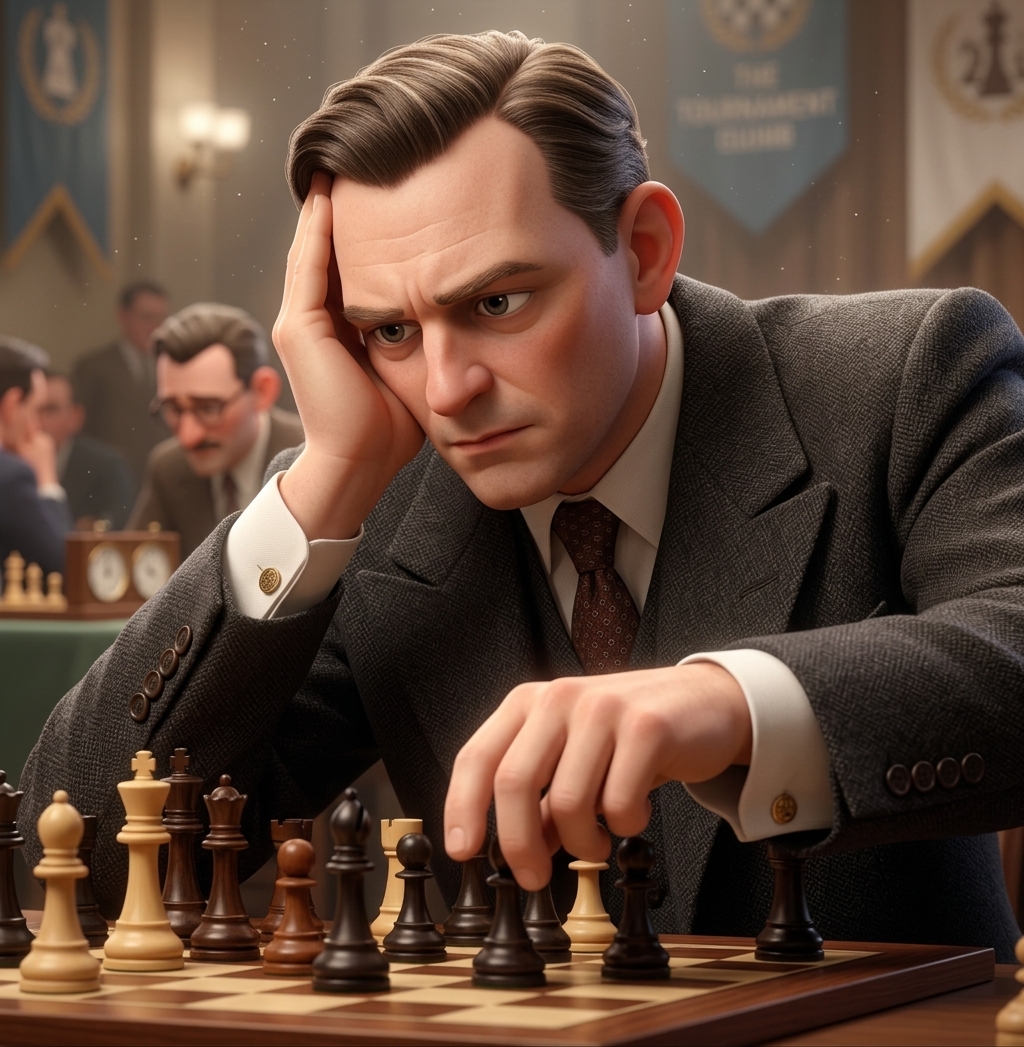
Illustration of Alexander Alekhine at the chessboard. This is not a real picture of him, and the board shown is not a position from a real game.
Let us start with a puzzle. It is Black's move in the position below. Black has 16 legal moves. Can you find one that does not lose something? Look hard. Keep your answer in mind: you will meet this position again at the end of the game below.


 7
7

 6
6 4
4

 c
c g
gBlack to move. White's queen and two rooks stand in a line on the c-file, pointing at Black's knight on c6. Black has 16 legal moves. Is there one that loses nothing?
The player with White was Alexander Alekhine. The player with Black was Aron Nimzowitsch. They met at a tournament in San Remo, Italy, in 1930.
A Boy Who Played by Mail
Alexander Alekhine was born in Moscow, Russia, on 31 October 1892. He learned chess at home, and his older brother Alexei was one of his first teachers.
He started young, and he started by mail. In 1902, when he was ten, he was already playing in correspondence tournaments, where each player sends a move by post and waits days for the answer. A chess magazine called Shakhmatnoe Obozrenie sponsored those tournaments.
Climbing to the Top
- In 1908, at 15, he won the Spring Tournament of the Moscow Chess Club.
- In 1909, at 16, he won the All-Russian Amateur Tournament in Saint Petersburg.
- In 1927 he played José Raúl Capablanca for the World Championship in Buenos Aires. The match lasted 34 games. Alekhine won six, lost three and drew 25, and became the fourth world champion.
- In 1930 he won the tournament at San Remo with 13 wins and two draws in 15 games, without a loss. The game below is from that tournament.
- In 1935 he lost the title to Max Euwe. In 1937 he won it back in a rematch.
- He died in 1946 in Estoril, Portugal, still the champion. He is the only world champion who died while holding the title.
An opening is named after him: Alekhine's Defence, which starts 1.e4 Nf6.
The Game: Alexander Alekhine vs. Aron Nimzowitsch, San Remo 1930
Alexander Alekhine 1-0 Aron Nimzowitsch San Remo 1930 White: Alexander Alekhine · Black: Aron Nimzowitsch
A knight deep in Black's camp
The game began as a French Defence. Black's bishop came out to b4 on move 3, a line called the Winawer Variation, and White pushed his pawn to e5.
1.e4 e6 2.d4 d5 3.Nc3 Bb4 4.e5 c5 5.Bd2 Ne7 6.Nb5 Bxd2+ 7.Qxd2 O-O 8.c3 b6 9.f4 Ba6 10.Nf3 Qd7 11.a4 Nbc6 12.b4 cxb4 13.cxb4 Bb7 14.Nd6
87 41aefh
Position after 14.Nd6, with Black to move. White's knight sits on d6, inside Black's half of the board, and the pawn on e5 guards it.
Look at the white knight on d6. It stands deep in Black's half of the board, and White's pawn on e5 protects it. For the first 14 moves our own Stockfish 17.1 run, at depth 22, had White a little better, by under one pawn.
Black's pieces get pushed back
14...f5 15.a5 Nc8 16.Nxb7 Qxb7 17.a6
8761aefhPosition after 17.a6, with Black to move. White's pawn on a6 attacks Black's queen on b7, and the square b5 is ready for White's bishop.
After 14...f5 our engine had White better by about one and a half pawns, and after 16...Qxb7 by about two. White traded his knight for Black's bishop and then played 17.a6, which attacked the queen. Black's pieces were being pushed toward the back rows, while White's light-squared bishop could come to b5 and point at the knight on c6.
Building the gun
17...Qf7 18.Bb5 N8e7 19.O-O h6 20.Rfc1 Rfc8 21.Rc2 Qe8 22.Rac1 Rab8 23.Qe3 Rc7 24.Rc3 Qd7 25.R1c2 Kf8 26.Qc1
76cgPosition after 26.Qc1, with Black to move. White's rooks on c3 and c2 and the queen on c1 stand one behind the other on the c-file, all aimed at the knight on c6.
Now look down the c-file. No pawns stand on it, so it is an open file, a road the rooks can use. White has a rook on c3, a rook on c2 and the queen on c1, one behind the other. Chess players call this formation Alekhine's gun, after this very game. Rooks and queens are called heavy pieces, and three of them on one open file push together like the parts of a cannon.
The target is the black knight on c6. By move 26 our engine had White better by about four pawns, even though no piece had been captured since move 16.
Nowhere to go
26...Rbc8 27.Ba4 b5 28.Bxb5 Ke8 29.Ba4 Kd8
764cgPosition after 29...Kd8, with White to move. Black's king has walked to d8, next to the rook on c7. Every black piece is tied to the defence of the c-file.
White's bishop went to a4, ready for the b-pawn to come to b5 and attack the knight. Black pushed his own b-pawn to b5, and White's bishop took it. Black's king walked to d8, next to the rook on c7. Every black piece was now busy defending.
So Alekhine did not hurry. He played 30.h4, a quiet pawn move. That brings us back to the puzzle.
The Answer to the Puzzle
There is no safe move for Black. We asked our engine to check every one of Black's 16 legal moves in the puzzle position. After every one of them, White is ahead by more than four and a half pawns. The best try, 30...Ke8, is met by 31.b5, and the pawn attacks the knight on c6.
A position where every move makes things worse is called zugzwang, a German word that means "forced to move". Black would love to pass, but in chess you cannot.
Records of the game end slightly differently. Some stop at 30.h4, and others add a few more moves. All of them agree that Alekhine won.
What to Learn from This Game
- Put your heavy pieces on the open file. Two rooks and a queen in a row on one file work together.
- Find a target. Alekhine aimed everything at one piece, the knight on c6.
- When your opponent is tied up, you do not need to rush. A quiet move like 30.h4 can be enough when the other side has no good moves.
- A strong knight deep in the other camp can cramp a whole army. The knight on d6 came early in the game, before Black's pieces were pushed back.
Two More Games to Study
Every engine number below comes from our own Stockfish 17.1 run at depth 18 or 20.
- Alexander Alekhine vs. José Raúl Capablanca, World Championship, Buenos Aires 1927, Game 34 (1-0). A Queen's Gambit Declined, and the last game of the match. Our engine had White better by less than one and a half pawns until Capablanca's 47...Qa1. After that White's edge grew, and Alekhine won a long rook endgame on move 82. It was his sixth win of the match, and it made him world champion.
- Richard Réti vs. Alexander Alekhine, Baden-Baden 1925 (0-1). Alekhine had Black. On move 26 he put a rook on e3, where White's f-pawn could take it. Try the position below.
A Position to Try
8cghRéti vs. Alekhine, Baden-Baden 1925, after 26...Re3. White to move. The pawn on f2 can take the black rook on e3. Should White take it?
Taking the rook is legal, but it loses. After 27.fxe3 our engine finds a forced checkmate for Black in four moves, starting with 27...Qxg3+. Réti did not take. He played 27.Nf3, and our engine marks that move too: it left Black better by about a pawn. Alekhine won the game.
A Champion Who Saw the Whole Board
Alekhine started by playing chess by mail as a boy and became the only world champion to die with the title. In the game above, he did not win with a flashy sacrifice. He lined up his pieces on the one file that mattered, aimed them at one target, and waited until his opponent had nothing safe left to move.
Related Stories
legends • 2026-10-04
Nineteen Seconds on the Clock: Divya Deshmukh Wins the World Cup
legends • 2026-10-03
A Pawn on the Second Row and a Gold Medal: Arjun Erigaisi
legends • 2026-10-03
The Lightning Kid and the Soviet Grandmaster: Viswanathan Anand
legends • 2026-10-02