Photo: Unknown author / Wikimedia Commons (Public domain)
One hot afternoon in Havana, a four-year-old boy was bored. He spent most of his days at Morro Castle, the old fort by the harbor, where his father was an officer in the Spanish army. The boy went looking for his father and found him sitting very still at a table with another officer. Neither man said a word. Between them was a board with strange carved pieces on it.
The boy had never seen chess before. He watched one game, and by the end of it, he said later, he felt sure he knew how the pieces move. Then he watched a second game, and he noticed something the other officer had not: his father had moved a knight the wrong way.
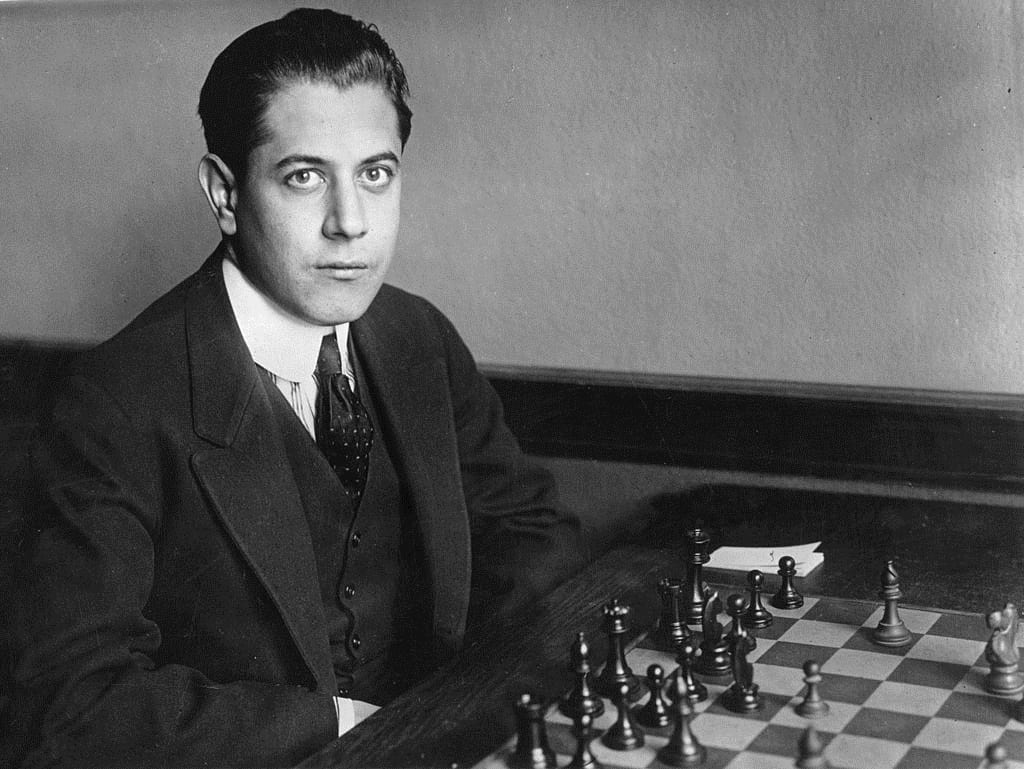
That boy was José Raúl Capablanca. He grew up to be the third world chess champion, famous above all for his skill in endgames. Here is his story, one of his most famous games, and five more of his games you can study.
The Boy at Morro Castle
José Raúl Capablanca was born in Havana, Cuba, on November 19, 1888. His father, José María Capablanca, was a cavalry officer in the Spanish army, which ruled Cuba at that time.
We know how he learned chess because he told the story himself, in a magazine article in 1916. After the second game, he told his father about the knight move. His father did not believe him. So the four-year-old challenged his father to a game, and his father sat down to play. "I had beaten him in my very first game of chess," Capablanca wrote.
He also wrote that his father's friends called him a prodigy, a child with an amazing gift, and that his father took him to a doctor. The doctor said the boy's mind was unusual for his age and advised that he should not be allowed to play chess. So he had to wait. He was not taken to the Havana Chess Club until he was eight.
Capablanca's article is the only source for some of these details, and a newspaper columnist in Scotland gently questioned parts of it the next year. But it is the story in his own words.
A Match at Thirteen
At the Havana Chess Club, the boy played the club's best players. In late 1901, around his 13th birthday, he played a match against Juan Corzo, the champion of Cuba, and narrowly won it.
That did not make him the best in Cuba overnight. In April 1902 he played in the national championship, finished fourth out of six players, and lost both of his games against Corzo. Even a future world champion loses.
Baseball, College and a Record Tour
In 1905 Capablanca passed the entrance exams for Columbia University in New York. He loved baseball. According to a magazine profile from 1935, he played shortstop on Columbia's freshman team. He also joined the Manhattan Chess Club and was soon its strongest player. In 1906 he won a fast chess tournament there, ahead of the world champion, Emanuel Lasker.
In 1908 he left college to spend his time on chess. The next year he toured the United States giving simultaneous exhibitions, where one player takes on many opponents at once, walking from board to board. He played 602 games in 27 cities and scored 96.4%.
Then he played a match against Frank Marshall, the United States champion, and won with 8 wins, 1 loss and 14 draws. After the match, Capablanca said he had never opened a book on chess openings.
The Newcomer Nobody Wanted
In 1911 Capablanca was invited to a tournament in San Sebastián, Spain, with nearly all the best players in the world. Two of them, Ossip Bernstein and Aron Nimzowitsch, objected. They said he had not earned his place, because he had not yet finished in the top three at two master tournaments.
Capablanca played Bernstein in the very first round and beat him in a brilliant game. Then he won the whole tournament, with 6 wins, 1 loss and 7 draws, ahead of famous masters like Akiba Rubinstein and Siegbert Tarrasch. You can study his win against Bernstein in the list at the end of this article.
In 1913 Cuba gave him a job in its Foreign Office. He had no fixed duties. The job was to travel and be a famous Cuban wherever he went.
Eight Years Without a Loss
On February 10, 1916, Capablanca lost a game to Oscar Chajes. He did not lose another serious game until March 21, 1924. In those eight years he played 63 games, with 40 wins and 23 draws.
In the middle of that streak he became world champion. Lasker had held the title since 1894. In 1920, before they had even played, Lasker offered to give up the title to Capablanca. "You have earned the title, not by the formality of a challenge, but by your brilliant mastery," Lasker wrote.
They played the match anyway, in Havana, starting on March 15, 1921. After 14 games, Capablanca had 4 wins and 10 draws, and Lasker had no wins. Lasker stopped the match there, and Capablanca was world champion.
Did You Know?
Capablanca's book Chess Fundamentals does not start with openings. It starts with endings: how to checkmate with a king and a rook, a king and a queen, and a king and two bishops. Mikhail Botvinnik, a later world champion, called it the best chess book ever written.
Losing the Crown
In 1927 Capablanca defended his title against Alexander Alekhine in Buenos Aires, Argentina. Almost everyone expected Capablanca to win. Alekhine had never beaten him before. But Alekhine had prepared hard and studied Capablanca's games. He won the match with 6 wins, 3 losses and 25 draws. It was the longest world championship match until 1984.
The two men never played a rematch. They argued about the money and the rules for years, and they became bitter rivals.
Capablanca kept playing and kept winning tournaments. In 1939, playing for Cuba at the Chess Olympiad in Buenos Aires, he won the gold medal for the best score on top board.
He had high blood pressure, and it was not treated properly for a long time. On March 7, 1942, he was watching a game at the Manhattan Chess Club in New York when he collapsed. He died early the next morning, at the age of 53. Havana gave him a public funeral.
The Game: Capablanca vs. Tartakower, New York 1924
Capablanca's greatest skill was the endgame, the last part of the game, when most pieces are gone. To see it, look at his win over Savielly Tartakower on March 23, 1924, at an elite tournament in New York with eleven of the best players of the time. Tartakower was a strong master and a well-known chess writer. Two days earlier, Richard Réti had beaten Capablanca in the same tournament, ending his run of eight years without a loss. This endgame is one of the most famous ever played.
Capablanca had White. The queens came off on move 25, and after 26...Kxe8 this was left.

 7
7
 5
5 4
4

 1a
1aAfter 26...Kxe8, White to move. Each side has a rook, one minor piece and six pawns. Count the points: 14 each.
The material is even. Chess players call your pieces and pawns your material, and coaches count it in points: a pawn is 1, a knight or bishop 3, a rook 5. Here White has a rook and a bishop, and Black has a rook and a knight. Our engine, Stockfish 17.1 searching to depth 22, gives White only a small edge. The position looks quiet. Capablanca found a plan.
Step one: open a road for the rook. Capablanca pushed his h-pawn, 27.h5, and traded it off with 28.hxg6 hxg6. Now the h-file was open, a column with no pawns on it. His rook used it: 29.Rh1 and 30.Rh7.
754After 30.Rh7, Black to move. White's rook has reached the seventh rank, the row where Black's pawns started. It attacks the pawn on c7.
A rook on the seventh rank is a classic endgame weapon. It attacks the pawns that are still on their starting squares, and it keeps the enemy king stuck on the back row.
Step two: push the pawns. Capablanca marched his g-pawn forward, 31.g4 and 32.g5. Black's knight jumped around, 31...Nc4 32...Ne3+ 33...Nf5, and landed on f5.
74After 33...Nf5, White to move. Our engine finds only one strong move here. Can you find it?
The answer is 34.Bxf5 gxf5. Capablanca gave his bishop for the knight. Our engine rates this as White's only strong move. It leaves a pure rook endgame, and Black's pawn on f5 now has no pawn beside it to protect it.
Step three: bring the king. In the endgame, the king becomes a fighter. Capablanca played 35.Kg3 and let Black take a pawn with check, 35...Rxc3+. He was now one pawn behind. But his king walked on: 36.Kh4.
Then Tartakower made the mistake that decided the game: 36...Rf3. Our engine prefers 36...a6. After 36...Rf3, White's advantage grew from about two pawns to more than three.
74After 36...Rf3, White to move. White is a pawn behind, and the f4 pawn is attacked. Find the move that makes the g-pawn dangerous.
Capablanca ignored the attack on f4. He pushed 37.g6. Black took with 37...Rxf4+, and the king kept walking: 38.Kg5 Re4 39.Kf6.
74After 39.Kf6, Black to move. White is two pawns behind, but look at the three white pieces together: the king on f6, the pawn on g6 and the rook on h7. Black's king is trapped on the back row.
Count the material again: White has 8 points and Black has 10. Our engine still rates White more than four pawns ahead. The g-pawn is now a passed pawn: no black pawn stands in front of it or beside it, so no pawn can stop it on its way to g8. The king, the rook and the g-pawn work as a team.
Capablanca took pawns back with 41.Rxc7 and 42.Kxf5, pushed 45.g7+, and then his king walked across the board to help his d-pawn. After 52.d6, the game ended.
4Final position after 52.d6. The d-pawn is two steps from becoming a queen, and the pawn on g7 keeps Black's king stuck in the corner. Our engine rates White far ahead.
Look at how Capablanca's king traveled in this game: g2, f3, g3, h4, g5, f6, f5, back to f6, then e5, d5, d6 and c6. It walked all the way up the board and fought like a rook. That is the big lesson of this game. When the queens are gone, bring your king into the fight.
Five More Capablanca Games to Study
Set up each game on a board, or play through it on your computer, and look for the idea in the note. The engine numbers in these notes come from our Stockfish 17.1, searching to depth 20 or 22.
- Capablanca vs. Juan Corzo, Havana, December 11, 1901 (1-0). The 13-year-old against the champion of Cuba. By move 19 only the kings, one bishop, one knight and pawns are left, and our engine calls the position level. Then watch the white king walk from f1 all the way to a7, where it takes a pawn with 51.Kxa7. The game ends with 59.g7. We looked at this game move by move in Capablanca's Endgame Symphony.
- Capablanca vs. Ossip Bernstein, San Sebastián, 1911 (1-0). The first-round game against the man who said Capablanca should not be there. Bernstein grabs two pawns with 22...Qxa2 and 23...Qxc2. Capablanca sends his knights toward the king, 25.Nh5 and 28.Nfxg7. After 33...Kg5, our engine finds a forced checkmate for White, and the game ends with 34.Qe3+.
- Ossip Bernstein vs. Capablanca, Moscow, 1914 (0-1). A famous queen move, 29...Qb2. The queen can be taken, and White is even a point ahead in material. Look at the diagram below and work out why every White move loses.
- Capablanca vs. Frank Marshall, New York, 1918 (1-0). Marshall gives up a pawn to attack Capablanca's king with a surprise opening that is now called the Marshall Attack. People often say Marshall saved it for years just for Capablanca, but the chess historian Edward Winter found games that argue against that story. Capablanca takes the pawn, survives the storm, and our engine rates him ahead the whole way. It ends with 36.Bxf7+, which leads to a forced checkmate.
- Emanuel Lasker vs. Capablanca, World Championship, Havana, 1921, game 10 (0-1). The slow squeeze. After 24...cxd5, look at Lasker's pawn on d4. It has no pawn beside it on the c-file or the e-file, so no pawn can ever protect it. Chess players call this an isolated pawn. Capablanca trades pieces, keeps up the pressure, and wins in the endgame. His pawn move 64...e5, which attacks the d4 pawn, finally opens the position.
72
 g
gBernstein vs. Capablanca, after 29...Qb2, White to move. If 30.Qxb2, then 30...Rd1 is checkmate. The queen on b2 also attacks the rook on c3, and White's back row has no rook left to guard it. Our engine checked every White reply: each one loses by at least six pawns, or runs into checkmate.
Why Capablanca Still Matters
In his books, Capablanca did not print long lines of analysis. He explained the key moments in plain words. Bobby Fischer, another world champion, said Capablanca had a "real light touch."
His own book gives beginners a simple first step. "The first thing a student should do," he wrote in Chess Fundamentals, "is to familiarise himself with the power of the pieces. This can best be done by learning how to accomplish quickly some of the simple mates."
What Capablanca Can Teach You
- Learn endgames early. Capablanca's own book starts with them, not with openings.
- When the queens come off, bring your king into the game. Against Tartakower, his king walked from g2 to c6.
- Put a rook on the seventh rank. It attacks pawns and traps the enemy king.
- A passed pawn with its king and rook beside it can be worth more than a pawn or two. Capablanca was two pawns behind and still winning.
- Look for a plan in quiet positions. Tartakower's endgame looked even, and Capablanca still found a way forward.
- Losing is part of it. At 13 he beat Corzo in a match, and a few months later lost both their games in the national championship.
A Habit to Practice
Do what Capablanca's book tells you to do first. Set up a king and a rook against a lone king, and checkmate it. Then try a king and a queen against a king. Time yourself, and play it again until you can do it quickly without thinking.
When you can, play through the Tartakower endgame on a real board. Before each of White's moves, ask: where is the king going, and why?
Related Stories
legends • 2026-10-13
The $64,000 Prize Nobody Has Ever Won
legends • 2026-10-05
The Bishop in the Corner: How Anatoly Karpov Squeezed a Grandmaster
legends • 2026-10-05
Black's King Takes a Long Walk: Wei Yi's Famous Attack at 16
legends • 2026-10-04