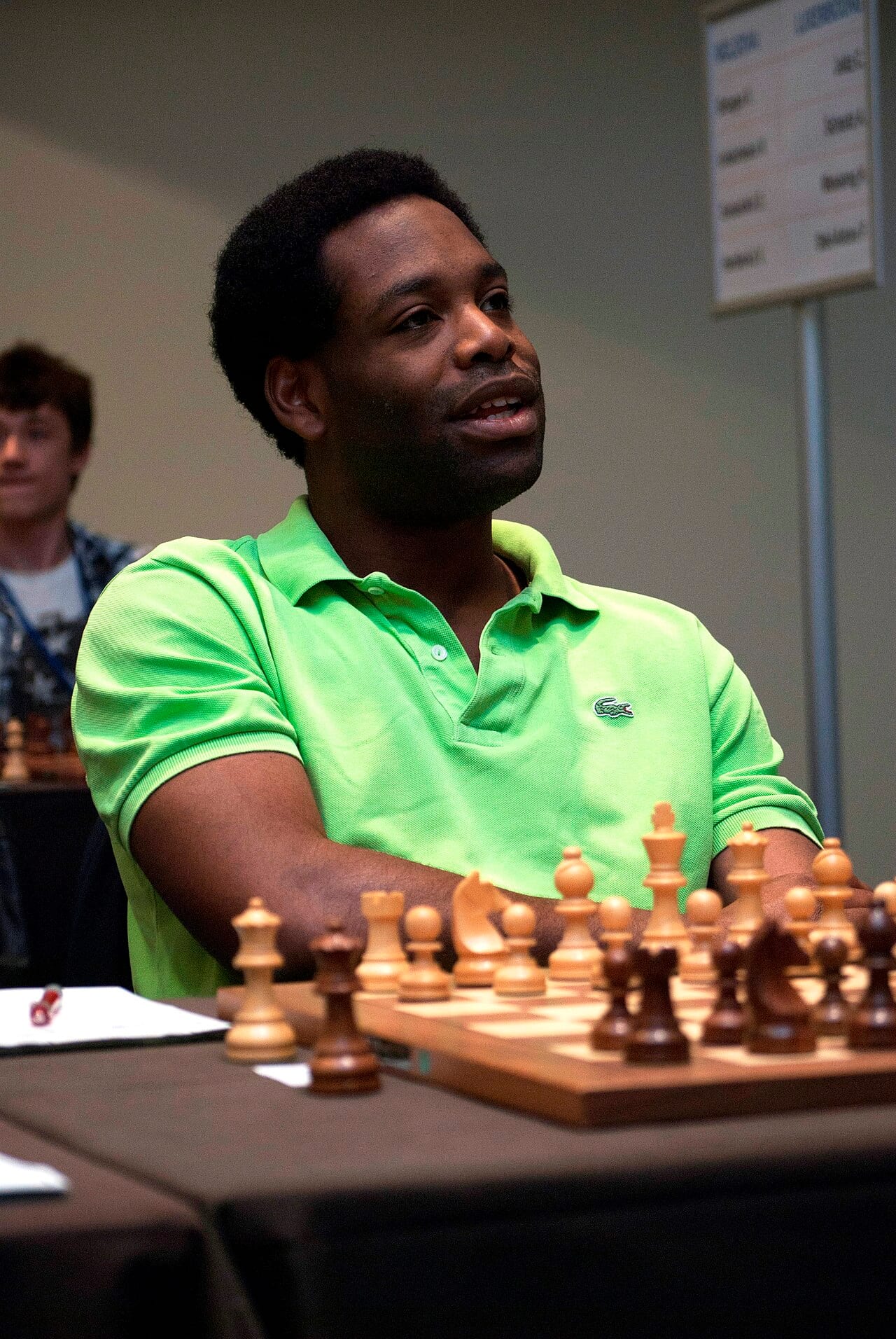
Photo: Andreas Kontokanis from Piraeus, Greece / Wikimedia Commons (CC BY-SA 2.0)
In October 2000, at the World Under-18 Championship in Spain, a 17-year-old from Sweden sat down with the white pieces against Baadur Jobava of Georgia. Jobava became a grandmaster the next year and, years later, one of the 20 highest-rated players in the world. On this day, the Swedish teenager won in 36 moves.
His name was Pontus Carlsson. Here is his story, that game, and five more of his early games you can study.
From Cali to Linköping
Pontus Carlsson was born on December 18, 1982, in Cali, Colombia. Both of his birth parents died, and as a small child he was placed in an orphanage in Cali. In 1985 he was adopted by Ingvar Carlsson, a former head of the Swedish Chess Federation, who took him home to Linköping, Sweden. His new father began teaching him chess when he was four.
- In 1992 he played the European Under-10 Championship in Rimavská Sobota, in what is now Slovakia, his first international tournament on record.
- He won youth championships in his region and in Sweden.
- In 2001, at 18, he played his first Swedish Championship, in his hometown of Linköping.
- In August 2005 he became an International Master, and in October 2007 a grandmaster.
He holds citizenship in both Colombia and Sweden.
The Game: Pontus Carlsson vs. Baadur Jobava, 2000
Pontus Carlsson 1-0 Baadur Jobava World Under-18 Championship, Oropesa del Mar, Spain · Round 4 · October 11, 2000 White: Pontus Carlsson, age 17 · Black: Baadur Jobava, Georgia, age 16
1.e4 c5 2.Nf3 d6 3.d4 cxd4 4.Nxd4 Nf6 5.Nc3 a6 6.f4 e5 7.Nf3 Nbd7 8.a4 Be7 9.Bd3 O-O 10.O-O Nc5 11.Kh1 d5 12.Nxe5 dxe4 13.Be2 Qc7 14.a5 Ncd7 15.Nc4 b5 16.axb6 Nxb6 17.Ne3 Bb7 18.Qe1 Rfe8 19.Qg3 Nfd5 20.Ncxd5 Nxd5 21.Nf5 Bf8 22.c4 Nb4 23.Bd2
The opening is a Sicilian Defence, Najdorf Variation. For the first 23 moves our Stockfish 16 check rates the game close to level. Now Black's knight on b4 has to decide where to go.
23...Nc6
This is the mistake. Our engine's choice was 23...a5, keeping the knight on b4. In our engine's line, the knight and White's dark-squared bishop then trade each other off. After 23...Nc6, our engine rates White about two pawns ahead.
 8
8


 6
6


 1af
1af h
hAfter 23...Nc6, White to move. White's bishop on d2 can now go to c3, where it aims along the long diagonal toward the black king's corner. Our engine's choice, 24.Bc3, is what Carlsson played.
Two Bishops Aim at the King
24.Bc3 Re6 25.Bh5 g6 26.Ne3 Ne7 27.f5 Rc6 28.Be5 Qb6
Look at White's pieces now. The bishop on e5 points at g7 and h8. The bishop on h5 and the pawn on f5 both attack the pawn on g6. All of them are aimed at the squares around the black king.
861afhAfter 28...Qb6, White to move. White's two bishops, the pawn on f5 and the queen on g3 all point at the black king. Our engine rates White about three pawns ahead.
29.Ng4 f6
Our engine preferred 29...Rac8. The move 29...f6 attacks the bishop on e5, but the knight on g4 can take the new pawn on f6, with check.
861afhAfter 29...f6, White to move. The knight on g4 can take on f6 with check. Our engine rates White more than four pawns ahead.
30.Nxf6+ Rxf6 31.Bxf6 Qxf6 32.fxg6 Nf5 33.gxh7+ Kxh7 34.Qh3 Bc8
White has given up a knight and a bishop for a rook and two pawns, and the black king has no pawns left in front of it. White's queen on h3 stands on the same file as the king on h7. Only White's own bishop on h5 is in between.
The Discovered Check
35.Bg4+
This is a discovered check. The bishop moves out of the way, and the queen behind it gives check. At the same time, the bishop on g4 attacks the black knight on f5.
861afhAfter 35.Bg4+, Black to move. The bishop has moved off the h-file, so the white queen on h3 now gives check. The bishop also attacks the knight on f5.
35...Bh6 36.Bxf5+
Black blocks the check, and the bishop takes the knight, giving check again from f5. The official game score ends here with White's win.
861afhFinal position after 36.Bxf5+, Black to move. White is ahead by a rook for a bishop, and two pawns. Our engine rates White about six pawns ahead.
Five More Carlsson Games to Study
These five games are from 1999 to 2005, when he was 16 to 22, before he became a grandmaster. Set each one up on a board, or play through it on your computer, and look for the idea in the note. The engine numbers come from our own Stockfish 16, searching to depth 16.
- Pontus Carlsson vs. Levente Vajda, World Under-18 Championship, Oropesa del Mar, November 2, 1999 (1-0). Vajda, from Romania, had won the World Under-16 Championship two years before and was rated 276 points higher. After 27...Re8, which our engine rates as a mistake, 28.Nf7+ checks the king, and 29.Nd6 attacks the rook on e8 and the bishop on f5 at once. That is a fork, and 30.Nxe8 wins the rook.
- Albert Bokros vs. Pontus Carlsson, World Under-18 Championship, Oropesa del Mar, November 4, 1999 (0-1). Two days later, with Black. A Sicilian Dragon where our engine rates Black better from about move 15. Watch Black's b-pawn. After 29.h3, which our engine rates as a mistake, it marches to 34...b2, one step from becoming a queen.
- Jonny Hector vs. Pontus Carlsson, Swedish Championship, Linköping, June 30, 2001 (0-1). Round 1 of his first Swedish Championship, at 18, against the Swedish grandmaster Jonny Hector. Carlsson castles queenside with 18...O-O-O, then opens the centre with 19...e5 and 22...d4. Our engine rates Black better from move 19 to the end.
- Pontus Carlsson vs. Vladimir Potkin, World Junior Championship, Athens, August 18, 2001 (1-0). Potkin, from Russia, later became a European champion. Black is slightly better for much of the endgame. After 39...Kg6, which our engine rates as a mistake, Carlsson breaks through on the queenside with 40.c6 and 43.b5, and his a-pawn runs to a7. After 45...d3, 46.Bb8 guards the pawn and blocks the black rook from reaching a8. Our engine rates White more than five pawns ahead.
- Pontus Carlsson vs. Radosław Wojtaszek, European Team Championship, Gothenburg, August 4, 2005 (1-0). Playing for Sweden at 22, against a player rated 197 points higher. This was the event where he earned his first grandmaster norm, a result that counts toward the title. Our engine rates White better from about move 14. 32.Nd5+ leaves Black only two legal moves, and after 32...Rxd5 33.Bxd5 White has won a rook for a knight.
62fhCarlsson vs. Vajda, Oropesa del Mar 1999, after 29.Nd6, Black to move. The knight on d6 attacks the rook on e8 and the bishop on f5 at the same time.
Grandmaster and Role Model
In 2007 Carlsson played for Sweden at the European Team Championship and scored 6 points out of 9 without losing a game. That October he became a grandmaster, the 16th Swedish player to earn the title. He is known for his rapid chess, and he has won the Swedish Tusenmannaschacket, a rapid tournament with more than 1,000 players, three times.
He has also spoken publicly about racism he has faced in Sweden and at chess tournaments across Europe, in interviews with the Colombian magazine Semana in 2016 and with Newsweek in 2020. In 2018 he took part in a program in New Orleans that uses chess to teach strategy and thinking skills to children.
What Pontus Carlsson Can Teach You
- Point your pieces at the enemy king. Against Jobava, both bishops, the queen and a pawn all aimed at the same corner.
- Look for discovered checks. When one of your pieces stands in front of your queen or rook, moving it can give check and attack something else.
- Knights love forks. Against Vajda, one knight attacked a rook and a bishop together.
- Passed pawns win endgames, as against Potkin and Bokros.
- Stronger opponents make mistakes too. Many of his best early wins came against players rated far higher.
- Start early and keep going. He learned at four, played abroad at nine, and became a grandmaster at 24.
A Habit to Practice
Set up the position after 34...Bc8 and find White's next move. Then look at your own games: every time one of your pieces stands between your queen or rook and the enemy king, ask what would happen if you moved it.
Related Stories
legends • 2026-10-13
The $64,000 Prize Nobody Has Ever Won
legends • 2026-10-05
The Bishop in the Corner: How Anatoly Karpov Squeezed a Grandmaster
legends • 2026-10-05
Black's King Takes a Long Walk: Wei Yi's Famous Attack at 16
legends • 2026-10-04