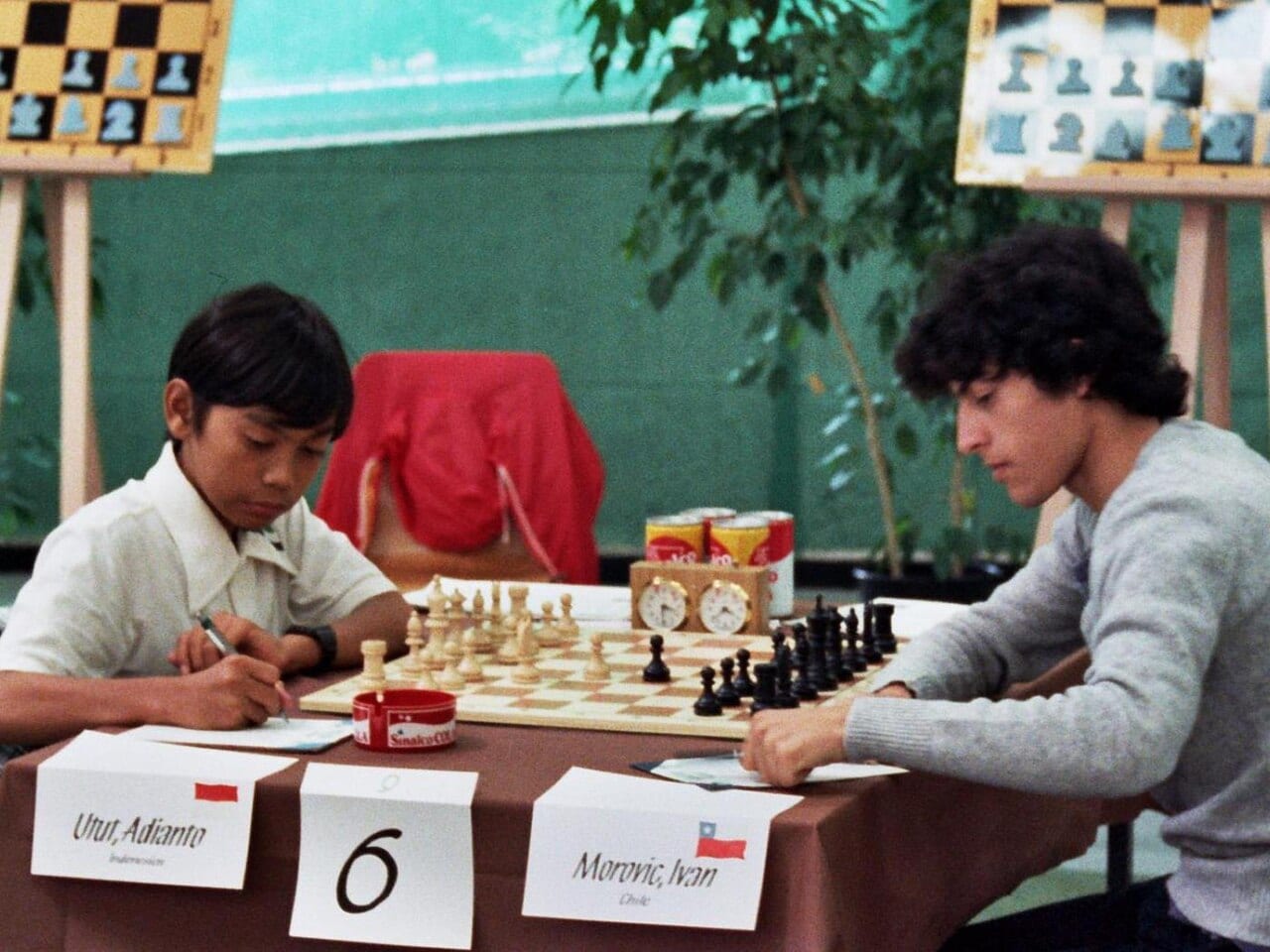
Photo: GFHund / Wikimedia Commons (CC BY 3.0)
In December 1983, at a tournament in Indonesia, an 18-year-old from Jakarta sat down with the white pieces against Lajos Portisch of Hungary, one of the strongest grandmasters in the world. After 39 moves, Portisch was facing checkmate.
The young man was Utut Adianto. Three years later he became a grandmaster. Here is his story, that game, and five more of his early games you can study.
A Boy From South Jakarta
Utut Adianto was born on March 16, 1965, in Jakarta, the fourth of five children. He grew up in a small street near Cipete Market in South Jakarta. His brother got him interested in chess, and in 1973, when he was eight, he started taking lessons at the Kencana Chess Club.
- In 1978, at 12, he won the Jakarta Junior Championship.
- In 1979 he became Indonesia's national junior champion.
- In 1982 he won the Indonesian Championship, the country's top title.
- He played in the World Junior Championship, the championship for players under 20, in 1980 and 1982.
- In 1986 he became a grandmaster at 21, the youngest Indonesian to do it at the time.
The Game: Utut Adianto vs. Lajos Portisch, 1983
Utut Adianto 1-0 Lajos Portisch First Lady's Cup, Indonesia · Round 19 · December 9, 1983 White: Utut Adianto, age 18 · Black: Lajos Portisch, Hungary
1.e4 c5 2.Nf3 e6 3.d4 cxd4 4.Nxd4 Nf6 5.Nc3 d6 6.Be2 a6 7.a4 Be7 8.O-O Nc6 9.Be3 Qc7 10.Nb3 b6 11.f4 O-O 12.Bf3 Rb8 13.Qe2 Rd8 14.Rad1 Na5 15.Nd4 Bb7 16.Kh1 Bf8 17.Qf2 Nc4 18.Bc1 d5 19.exd5 exd5 20.Qh4 Ne4
The opening is a Sicilian Defence. For much of the middlegame our Stockfish 16 check rates Portisch slightly better, by less than half a pawn. Utut keeps his pieces together and waits.
21.Nce2 Be7 22.Qh3 Bf6 23.Ng3 Ncd6 24.c3 Re8 25.Nc2 Qc5 26.Bxe4 Nxe4 27.Be3 Qc4 28.Nh5 Qe2 29.Rc1 Bc8 30.Qf3 Qxf3 31.gxf3 Nc5 32.Nxf6+ gxf6 33.Rg1+ Kf8
The queens are gone, but the black king has lost the pawn in front of it on g7. Now look at the white rook on g1. It already controls the whole g-file, next to the black king.


 6
6
 4
4

 cg
cg h
hAfter 33...Kf8, White to move. The white rook on g1 controls the g-file. The black king on f8 has no pawn on g7 to hide behind.
34.a5 Bf5 35.axb6 Nb3 36.Nd4 Rxe3 37.Nxf5
After a flurry of captures, material is almost level. Our engine calls this position even. Black has the choice here.
6cghAfter 37.Nxf5, Black to move. Black can take the rook on c1 with the knight, which our engine says keeps the game level. Or Black can take the pawn on f3 with the rook.
The Pawn That Cost the Game
37...Rxf3
Portisch takes a pawn. Our engine's choice was 37...Nxc1, taking the rook, which keeps the game level. After 37...Rxf3, our engine rates White more than five pawns ahead. Why? Because both white rooks are about to join the knight near the black king.
38.Rce1 Rh3 39.Ne7
6eghFinal position after 39.Ne7, Black to move. The knight on e7 guards g8, and it is protected by the rook on e1. White threatens 40.Rg8, which would be checkmate.
The knight on e7 covers g8. If Black does nothing, 40.Rg8 is checkmate: the rook checks, and the knight guards it. Our engine's best defences for Black all lose the rook on b8. The official game score ends here with White's win.
Five More Adianto Games to Study
These five games are from 1982 to 1986, the years before and just as he became a grandmaster. Set each one up on a board, or play through it on your computer, and look for the idea in the note. The engine numbers come from our own Stockfish 16, searching to depth 16 to 20.
- Nabil Doghri vs. Utut Adianto, World Junior Championship, Copenhagen, 1982 (0-1). A short one. 21...Rc4 attacks the white bishop on e4, which has no defender. Our engine preferred 22.Bf3. After 22.Rde1 Rxe4, Black has won a piece.
- Utut Adianto vs. Eugene Torre, First Lady's Cup, Indonesia, December 3, 1983 (1-0). A win over Asia's first grandmaster from outside the Soviet Union, whose story you can read on this site. After 27.exd6, White's pawn on d6 is a passed pawn: no black pawn can stop it. Then 28.Re7+ puts a rook on the seventh rank beside it.
- Tony Miles vs. Utut Adianto, Reykjavík Open, February 11, 1986 (0-1). Miles was one of the world's best grandmasters, rated 210 points higher. After 29.Bxc2 bxc2+, our engine says 30.Qxc2 keeps the game level. Miles played 30.Kxc2, and 30...Qb3+ gave Black a winning attack.
- Larry Christiansen vs. Utut Adianto, Reykjavík Open, February 17, 1986 (0-1). Another American grandmaster. Our engine rates Utut slightly better from about move 24. After 40.Re7 it rates Black far ahead, and in the final position, after 42...Qf5+, it finds a forced checkmate for Black.
- Utut Adianto vs. John Fedorowicz, Olympiad, Dubai, November 19, 1986 (1-0). A long endgame that ends in a pawn race. Both sides make a new queen, with 61...a1=Q and 62.b8=Q, and White's queen and knight are the ones that win.
 6
6 2cdf
2cdfDoghri vs. Adianto, Copenhagen 1982, after 21...Rc4, White to move. The black rook attacks the bishop on e4. No white piece defends it.
Grandmaster, Coach and Politician
From 1995 to 1999, Utut's rating stayed above 2600, a very high rating. In 1999 he played in the FIDE world championship in Las Vegas. He later led the Indonesian Chess Federation, helped start a chess school that has produced several national players, and in 2005 became a FIDE Senior Trainer, one of the highest coaching titles.
In 2009 he was elected to Indonesia's parliament, and from 2018 to 2019 he was its deputy speaker.
What Utut Adianto Can Teach You
- Stay patient when you are slightly worse. Against Portisch, the chance came at move 37.
- A king without its pawn shield is a target, even in the endgame. The g-file did the work against Portisch.
- Look for undefended pieces. Against Doghri, one rook move attacked a bishop no one was guarding.
- Passed pawns and rooks on the seventh rank work well together, as against Torre.
- When your opponent grabs a pawn, look for what they left behind.
- Start with a club. Utut began at the Kencana Chess Club at eight.
A Habit to Practice
Set up the position after 37.Nxf5 and look at it from Black's side. Compare 37...Nxc1 and 37...Rxf3. Before you grab a pawn in your own games, ask: which enemy pieces get free moves while I do it?
Related Stories
legends • 2026-10-13
The $64,000 Prize Nobody Has Ever Won
legends • 2026-10-05
The Bishop in the Corner: How Anatoly Karpov Squeezed a Grandmaster
legends • 2026-10-05
Black's King Takes a Long Walk: Wei Yi's Famous Attack at 16
legends • 2026-10-04