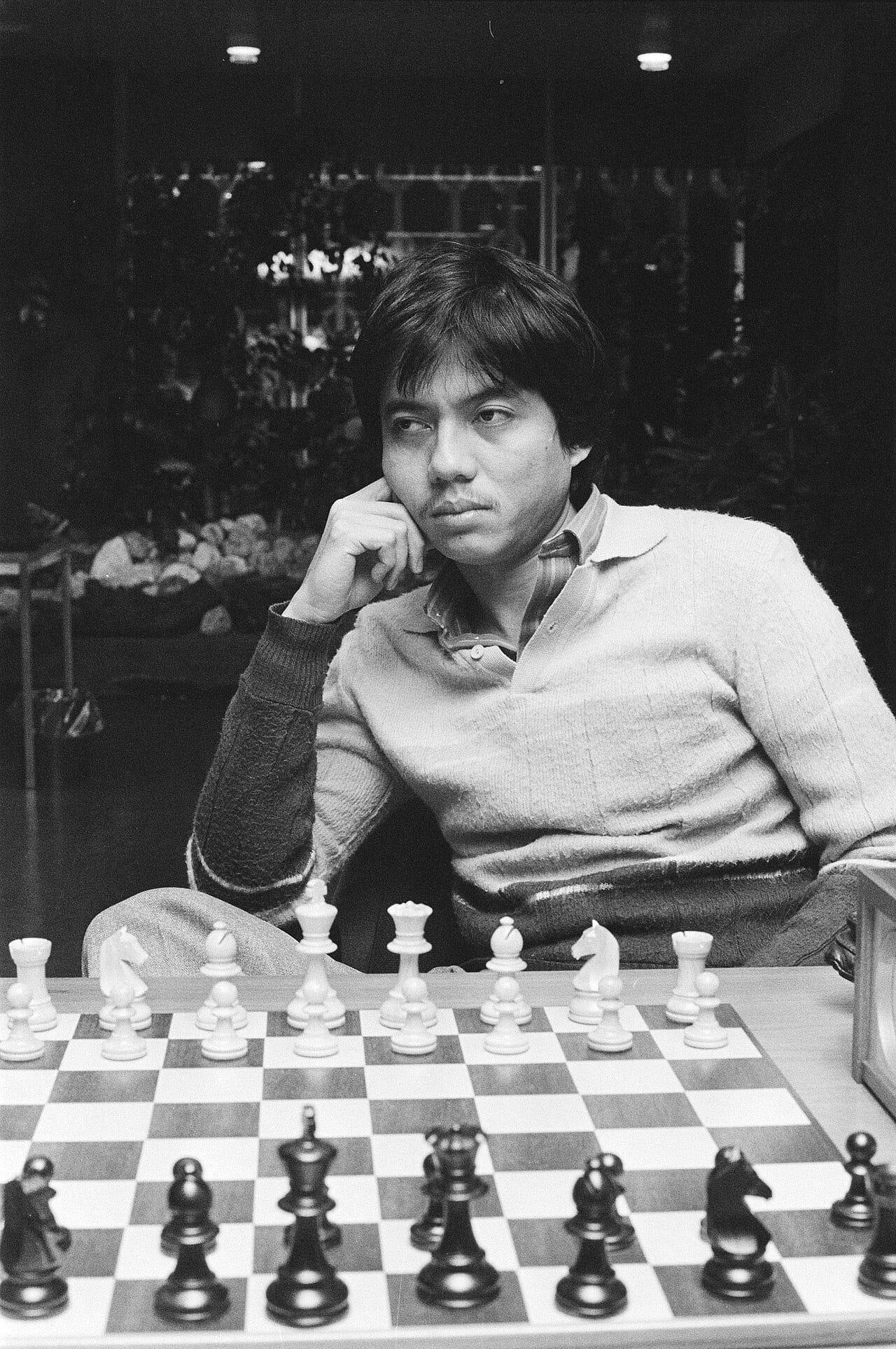
Photo: Hans van Dijk for Anefo / Wikimedia Commons (CC0)
In June 1973, in Leningrad, a 21-year-old from the Philippines sat down across from Mikhail Tal. Tal had been world champion, and he was famous for wild, dazzling attacks. The young man across from him was playing in an Interzonal, a big qualifying tournament on the road to the World Championship.
He beat Tal. His name was Eugene Torre, and a year later he became the first grandmaster from Asia outside the Soviet Union. Here is his story, that game, and five more of his early games you can study.
A Young Filipino Abroad
Eugenio Torre was born on November 4, 1951, in Iloilo, in the Philippines. As a young player he traveled far to find strong opponents. He played in the World Junior Championship, the championship for players under 20, in Stockholm in 1969 and in Athens in 1971. In Athens he finished fourth, after a tiebreak.
- In 1972 he won the Asian Zonal tournament and became an International Master.
- In September 1972 he won a match against Rodolfo Tan Cardoso to decide the Philippines' top player, and played first board for his country at the Olympiad in Skopje.
- Over New Year 1972-73 he tied for first at a tournament in Reggio Emilia, Italy.
- In June 1973 he played the Interzonal in Leningrad against Karpov, Tal, Korchnoi and Larsen, among others.
The Game: Mikhail Tal vs. Eugene Torre, Leningrad 1973
Mikhail Tal 0-1 Eugene Torre Interzonal tournament, Leningrad · Round 2 · June 4, 1973 White: Mikhail Tal, former world champion · Black: Eugene Torre, age 21
This is not a game of wild sacrifices. It is a game about active pieces, and about grinding out a rook endgame one pawn at a time.
1.Nf3 Nf6 2.c4 g6 3.Nc3 Bg7 4.g3 O-O 5.Bg2 c5 6.d4 cxd4 7.Nxd4 Nc6 8.O-O Nxd4 9.Qxd4 d6 10.Qd3 a6 11.Be3 Ng4 12.Bd4 Ne5 13.Qd1 Rb8 14.Rc1 Be6 15.Nd5 b5 16.cxb5 Bxd5 17.Bxd5 axb5 18.Qd2 e6 19.Bg2 Nc4 20.Qc3 Bxd4 21.Qxd4 d5 22.b3 Qb6 23.Rfd1 Qxd4 24.Rxd4 Nd6 25.Rc6 Rfd8 26.e3 Rbc8
The queens are gone, and our Stockfish 16 check gives Torre a small edge, less than a pawn. Both sides have two rooks, and Torre has a knight against Tal's bishop.


 2
2
 g
gAfter 26...Rbc8, White to move. The white rook on c6 faces the black rook on c8. Our engine's best move here is to trade them with 27.Rxc8.
27.Rb6
Tal keeps his rook and moves it to b6. Our engine preferred trading rooks with 27.Rxc8. Now the c-file is Torre's.
27...Rc1+ 28.Bf1 Ne4 29.Kg2 e5 30.Rb4 Rc2
2fAfter 30...Rc2, White to move. The black rook has reached White's second row. It attacks the pawns on a2 and f2, and the knight on e4 also attacks f2.
A rook on the second rank, deep in the enemy camp, is just as strong as a rook on the seventh. Torre's rook attacks the pawns on a2 and f2, and his knight on e4 attacks f2 as well. Our engine now rates Black about three pawns ahead.
31.a4 bxa4 32.bxa4 Rxf2+
Torre wins the f2 pawn, with check.
The Long Endgame
33.Kg1 Ra2 34.Rb8 Rxb8 35.Rxb8+ Kg7 36.Rb5 Nc3 37.Rc5 Nd1 38.Rxd5 Nxe3 39.Rxe5 Nxf1 40.Kxf1 Rxh2
4fAfter 40...Rxh2, White to move. Only rooks are left. Black has three pawns, on f7, g6 and h7. White has two, on a4 and g3.
All the other pieces are gone. Torre has three pawns against two, and all three of his are on the kingside. Tal has a passed a-pawn on the other side. Now watch how Torre uses his king and his pawns.
41.Re7 Ra2 42.Re4 h5 43.Rh4 f6 44.Kg1 Kf7 45.Kf1 Ke6 46.Re4+ Kf5 47.Rf4+ Ke5 48.Rh4 Rd2 49.Rb4 g5 50.Rb3 Ra2 51.Rb4 Kf5 52.Kg1 Kg6 53.Rc4 g4 54.Rb4 f5 55.Rb8 h4 56.gxh4 Rxa4
Torre's king walks up behind his pawns, and his pawns march forward together: h5, g5, g4, f5, h4. When they had gone far enough, his rook took White's a-pawn.
4gAfter 56...Rxa4, White to move. White's passed a-pawn is gone. Black has two connected pawns on f5 and g4.
57.Kg2 Ra3 58.Rg8+ Kf7 59.Rg5 Kf6 60.Rg8 Rh3 61.Rh8 Ke5 62.h5 Kf6 63.h6 Kg6 64.Rg8+ Kxh6 65.Kf2 Ra3 66.Kg2 Kh5 67.Kf2 Kh4
3Final position after 67...Kh4, White to move. Black has a rook and two connected pawns. White has only a rook. Our engine rates Black more than eight pawns ahead.
The official game score ends here with Black's win. It took 67 moves, and every step of it was patient technique.
Five More Torre Games to Study
These five games are from 1969 to 1973, the years before he became a grandmaster. Set each one up on a board, or play through it on your computer, and look for the idea in the note. The engine numbers come from our own Stockfish 16, searching to depth 18 or 20.
- Eugene Torre vs. Anatoly Karpov, World Junior Championship, Stockholm, August 12, 1969 (½-½). Karpov won the championship that year and became world champion six years later. After 42...Re8+ our engine rates Torre about two pawns better, but Karpov held the draw after 77 moves.
- Eugene Torre vs. Kenneth Rogoff, World Junior Championship, Stockholm, August 28, 1969 (1-0). Rogoff later became a famous economist; you can read his story on this site too. 20.Bxh7+ is a classic sacrifice, a bishop taken on h7 with check, sometimes called the "Greek gift". Our engine picks it as White's best move. After 21.Qh4+ and 22.Ng5, White's queen and knight attack the king.
- Eugene Torre vs. Florin Gheorghiu, Olympiad, Skopje, September 24, 1972 (1-0). Gheorghiu was a strong Romanian grandmaster. Watch Torre put both rooks on Black's second row with 27.Re7 and 28.Rbxb7. Two rooks on the seventh rank tie Black down until the end.
- Arthur Bisguier vs. Eugene Torre, Reggio Emilia, December 29, 1972 (0-1). From the tournament where Torre tied for first. Bisguier, a former US champion, was rated 30 points higher. In the endgame Torre's two pawns march together to d3 and e3, and our engine finds a forced win for Black in the final position.
- Eugene Torre vs. Aleksandar Matanović, Madonna di Campiglio, January 1973 (1-0). A short, sharp one against a top Yugoslav grandmaster. After 26...R5a7, 27.Qxf7+ and 28.Bh6 set up a checkmate. If Black does nothing, 29.Bxg7 is mate.
 7
7
 3
3 ceg
cegTorre vs. Rogoff, Stockholm 1969, after 19...Rxe7, White to move. The bishop on c2 points at h7, and the queen on f4 and knight on f3 are ready to join. Our engine's best move is 20.Bxh7+.
Asia's First Grandmaster
At the 1974 Olympiad in Nice, France, Torre played first board for the Philippines. He played 19 games without a single loss, nine wins and ten draws, and won a silver medal. That made him a grandmaster at 22, the first from the Philippines, and the first from Asia outside the Soviet Union.
In 1976, at a tournament in Manila, he beat world champion Anatoly Karpov and finished ahead of him, the first player to do that since Karpov became champion. In 1982 he reached the Candidates matches. He played first board for the Philippines at 17 Olympiads, and in 1992 he was Bobby Fischer's second, his helper and training partner, in the match against Boris Spassky. In 2021 he was inducted into the World Chess Hall of Fame.
What Torre Can Teach You
- Get your rook to the enemy's second rank, where the pawns are. Against Tal, one rook on c2 won a pawn.
- Rook endgames are won slowly. Bring the king up behind your pawns and push them together.
- Learn the Greek gift. Against Rogoff, a bishop sacrifice on h7 opened the king.
- Two rooks on the seventh rank are a winning weapon, as against Gheorghiu.
- Travel to find strong opponents. Torre played in Sweden, Greece, Italy and the Soviet Union before he became a grandmaster.
- Do not be scared of big names. At 21 he beat a former world champion.
A Habit to Practice
Set up the position after 40...Rxh2 and play it out as Black against a friend or a computer. Your goal: keep your rook active, walk your king up behind your pawns, and push them together.