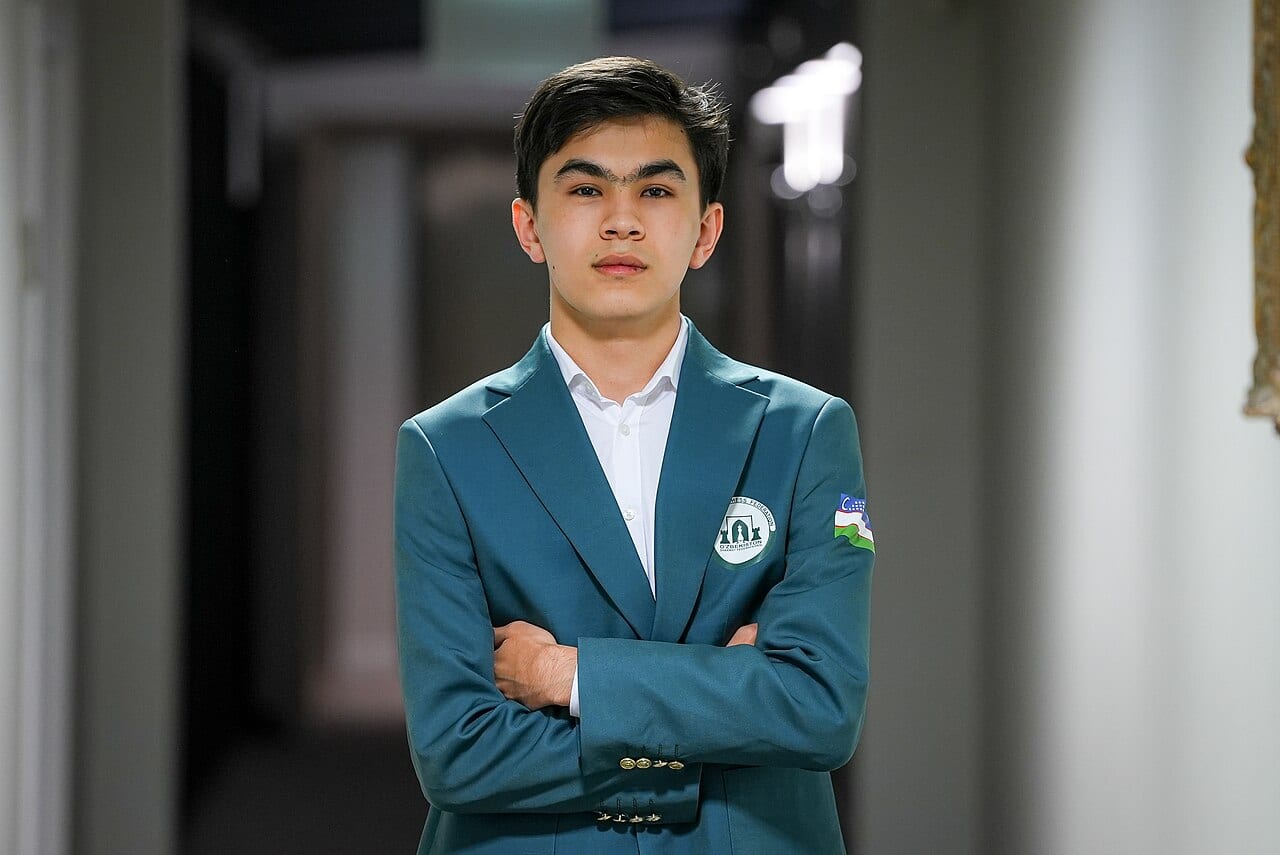
Photo: MiroJP / Wikimedia Commons (CC BY-SA 4.0)
Javokhir Sindarov is 20 years old. In April 2026 he won the Candidates Tournament in Cyprus, the event that picks the challenger for the world title, and he did it without losing one game. He scored 10 points out of 14, with six wins and eight draws, which is the best score the Candidates has seen since it became a 14-round event in 2013. Next he plays Gukesh for the world championship. You can read how he got here in our piece on his childhood, and you can read the same kind of lesson list for his rival in Five Gukesh Games and the Lessons Inside Them.
This time we look at five of Sindarov's wins from 2026. Four come from the Candidates and one from the Olympiad in Samarkand. In each one a single idea decided the game, and you can use all five yourself.
Each section starts from the first moves, then jumps to the moments that matter. When a board asks you a question, stop and think before you read on. The positions come straight from the game record. The engine numbers come from our own Stockfish 17.1, searching to depth 22. One pawn is worth about 1.00 in those numbers, and a plus sign means White is better.
1. Turn Your Homework Into Time
Javokhir Sindarov v Fabiano Caruana, Candidates tournament, Cyprus, 1 April 2026
Round 4 was the big one. Sindarov and Caruana both had 2½ points after three rounds and led the field. Caruana was rated 2795 and Sindarov 2745.
The game began , the Queen's Gambit Accepted. Black takes a pawn and White gets the center back. After the position looked like this.
After 16...Rg8, White to move. The pieces are equal, 31 points each, and our engine calls the position about equal. But look at the clocks. Sindarov has 1 hour 52 minutes left and Caruana has 51.
Sindarov had played his first 16 moves in about 7 minutes. Caruana had used more than an hour. He spent 12 minutes on , 10 minutes on , 18 minutes on and 16 minutes on . The board was level, but Sindarov had a full extra hour. That is what opening preparation is for. A prepared player does not need to find the moves at the board, so the clock stays full for the hard moves later. Afterwards Sindarov said, "before I go to round I really repeat this line and I was really lucky." On the clock he said, "I have a big time advantage, I think I have good chances to win."
Sindarov then spent 26 minutes on . Caruana answered , and our engine says that gave White a small edge, about two thirds of a pawn. Then came .
After 18.Bc4, Black to move. White's bishop attacks the pawn on e6. Black's king is still on e8, and the queen on d8 stands in the way of castling to the queen's side. Our engine says 18...Qxd4 was Black's best move. Caruana spent 18 minutes and played 18...Rg4.
Caruana's king was stuck in the middle, and Sindarov kept making simple, strong moves. After Caruana had less than four minutes left. Sindarov pushed his pawn with .
After 27.d5, Black to move. White is ahead by about two pawns, and the pawn on d5 attacks the pawn on e6. Caruana has 3 minutes 49 seconds for the rest of the game. Sindarov has 47 minutes.
The game ended after , with Caruana down to 48 seconds.
Did You Know?
In the Candidates each player starts with two hours for the first 40 moves. After move 40 they get 30 more minutes and 30 extra seconds on every move. That is why a player who is short of time at move 25 is in real danger. The time left on the clock is a resource, like a pawn or a piece.
The lesson: homework is worth more than a good position. Sindarov's preparation did not give him a big edge on the board. It gave him an hour. Learn the first moves of your opening, and learn why each one is played, so that you spend your time on the moves nobody can prepare.
2. A Long Think Is a Decision
Hikaru Nakamura v Javokhir Sindarov, Candidates tournament, Cyprus, 3 April 2026
Two days later Sindarov had Black against Hikaru Nakamura, rated 2810. The game went 3.Nc3 c6 4.e4, a sharp line of the Semi-Slav Defence called the Marshall Gambit. A gambit is an opening where one side gives up a pawn for faster development. After 4...dxe4 5.Nxe4 Bb4+ 6.Bd2 Qxd4 7.Bxb4 Qxe4+ 8.Be2 Na6 9.Bd6 Qxg2 10.Bf3 Qg5 11.Ne2 Ne7 12.Ng3 O-O, Black's queen had taken two pawns.
 8


 7
 6


 2
 1a
 d
 eh
After 12...O-O, White to move. White has two pawns less (33 points to 35), but the bishop on d6 stands deep in Black's camp and Black's pieces on a6 and c8 are not developed. Our engine says the position is level, and its first choice for White is 13.Ne4.
Nakamura had almost two hours left on his clock. Then he thought for almost 68 minutes and played 13.h4. His clock fell to 49 minutes. Our engine did not like the move. It moved the evaluation from level to about one pawn in Black's favor. Sindarov said afterwards, "I was surprised when he played H4."
Sindarov answered 13...Qa5+ 14.b4 Nxb4 15.O-O Re8 16.Qd2 c5 17.Rad1 Nf5 18.Nxf5 exf5 19.Qf4 Nc6 20.Kh1 Nd4 21.Rg1 g6 22.Bd5 Be6 23.Bxb7, and then found a shot.
8752dghAfter 23...Ne2, White to move. The knight on e2 attacks the queen on f4 and the rook on g1 at the same time. That is a fork. Nakamura has 14 minutes and Sindarov has 50. Our engine says Black is better by almost three pawns.
White saved the queen with 24.Qd2 Qxd2 25.Rxd2, but 25...Nxg1 won the rook. Black ended up with two extra pawns. After 26.Bxa8 Rxa8 27.Kxg1 Rd8 28.Bf4 Rxd2 29.Bxd2 Bxc4 30.Be3 Bxa2 31.Bxc5 a5 Nakamura played on for ten more moves, and the game ended after 41...gxh4+.
Of the moment after 13.h4 Sindarov said, "I'm just better and I have like again one hour more time."
The lesson: a long think is a decision, and the price comes later. Nakamura's hour did not find a better move. It left him with 14 minutes when the fork arrived. Before you spend half of your time on one move, ask if the move is really that hard, or if you are only afraid to choose.
3. Pawns Only Capture Forward
Wei Yi v Javokhir Sindarov, Candidates tournament, Cyprus, 4 April 2026
The next day Sindarov had Black against Wei Yi, rated 2754. The opening was a quiet mix of the Vienna Game and the Bishop's Opening: 1.e4 e5 2.Nc3 Nc6 3.Bc4 Nf6 4.d3 Na5 5.a3 Nxc4 6.dxc4 Bc5 7.Nf3 d6 8.Qd3 Be6 9.Bg5 a5 10.Nd5 c6 11.Nxf6+ gxf6 12.Bh4 Rg8 13.O-O a4 14.b4 axb3 15.cxb3 Bg4 16.b4 Bxf3 17.Qxf3 Bd4. The engine called it close to level.
Then Wei Yi played 18.Bxf6, winning a pawn. He thought for almost 47 minutes first, and his clock fell to 26 minutes. After 18...Qd7 19.Rad1 Qe6 20.h3 Qxc4 Black had won the pawn back, and after 21.Rd3 Qe6 22.Rfd1 Rg6 23.Bh4 Kf8 24.Qh5 Kg8 25.Kh1 c5 26.f4 exf4 27.Qf3 Re8 28.Bf2 Bxf2 29.Qxf2 Qxe4 the time looked like this.
3dhAfter 29...Qxe4, White to move. Wei Yi has 6 minutes left and Sindarov has 49. Our engine's choice is 30.bxc5, which keeps the game close to level. The move Wei Yi played, 30.Rxd6, looks natural because it trades a pair of rooks.
White played 30.Rxd6 Rxd6 31.Rxd6 Qe3 32.Qf3 c4.
3hAfter 32...c4, White to move. Black's c-pawn has slipped past White's b-pawn. A pawn captures forward and to the side, so the pawn on b4 can only capture on a5 or c5, and it cannot touch the pawn on c4. Our engine says Black is ahead by more than three pawns.
Black's pawn on c5 had faced White's pawn on b4, and White could trade them with bxc5. After 30.Rxd6 that chance was gone, the pawn slipped past to c4, and nothing could stop it. A pawn that no enemy pawn can block or capture is a passed pawn. After 33.Qg4+ Kf8 34.Rd1 c3 35.Qg5 f3 36.Qxe3 Rxe3 Black had pawns on c3 and f3 and a rook behind them. Wei Yi had 54 seconds and Sindarov had 44 minutes. After the game Sindarov said, "In time trouble Wei made small mistakes which I found."
The lesson: before you trade, check what the trade does to the pawns. The pawn on c5 faced White's b-pawn, and trading them was White's chance. After 30.bxc5 White would have taken that pawn away. After 30.Rxd6 it became a runner.
4. Count Before You Sacrifice
Javokhir Sindarov v R Praggnanandhaa, Candidates tournament, Cyprus, 9 April 2026
In round 3 Sindarov had beaten Praggnanandhaa with Black. In round 10 they met again, and this time Sindarov had White. The game began Nf6 d5 4.Nc3 Nbd7 5.Bf4 Bb4 6.cxd5 exd5 7.e3 Ne4 8.Qc2 g5. Praggnanandhaa pushed his g-pawn up the board, and the game went 9.Bg3 h5 10.Bd3 h4 11.Bxe4 dxe4 12.Qxe4+ Kf8 13.Be5 f6 14.Nxg5.
Sindarov gave up material to open the black king. After 14...Bxc3+ 15.bxc3 Nxe5 16.dxe5 fxg5 17.f4 h3 18.Rd1 Qe7 19.g3 gxf4 20.O-O Rh6 21.Rxf4+ Kg8 Black was a point ahead, 26 points to 25, but Black's king had no pawns in front of it. Our engine said White was better by about half a pawn. Then Sindarov played 22.Rdf1, and Praggnanandhaa answered 22...Bd7.
872fgAfter 22...Bd7, White to move. Black has 26 points and White has 25. Black's king is on g8 with no pawns in front of it, and White's rooks on f4 and f1 both look along the f-file. Find the move. Hint: it offers a rook.
Sindarov played 23.Rf7. This is a rook offer on f7, where the queen can take it. Our engine says 22...Bd7 was the mistake, because 22...Be6 was better, and that 23.Rf7 is the only move that gives White an edge. It moves the numbers from about half a pawn to more than two pawns for White. If Black takes the rook, 23...Qxf7 24.Rxf7 Kxf7, White has given two rooks for a queen. Sindarov said afterwards that when Praggnanandhaa played 22...Bd7, "I was thinking like come on this move should be not working because I saw something." Then the queen comes with check: 25.Qf4+ Kg7 26.Qg5+ Kh7 27.Qe7+ Kg8 28.Qxd7.
872gAfter 28.Qxd7, Black to move. White's queen has just taken the bishop with a check on the way. White has a queen and six pawns, 15 points. Black has two rooks and four pawns, 14 points. Our engine says White is better by more than two pawns, because Black's king is still exposed.
Look at what happened. The queen gave check on f4, g5 and e7, and each check kept the black king in the open until the queen could take the bishop on d7. Black had two rooks for a queen, which is 10 points against 9, but the white queen could attack the king, the pawns and the back rank at once, and the black rooks could not guard all three. Sindarov kept his queen active and won on move 53.
The lesson: a sacrifice is a count. Before you give up a rook, count what you get, move by move: the queen, then three checks, then the bishop. If every step is a check or a capture, your opponent has no time to take anything back.
5. The Poisoned Queen
Diego Flores Quillas v Javokhir Sindarov, Chess Olympiad, Samarkand, 17 September 2026
The last game comes from the Olympiad in Samarkand, where Sindarov played for Uzbekistan. In round 2 he had Black against Diego Flores Quillas of Peru, rated 2398, 380 points below him. The game began 1.e4 c5 2.Nf3 e6 3.b3 b6 4.Bb2 Bb7 5.Nc3 Nc6 6.g3 Nf6 7.Bg2 Be7 8.O-O O-O 9.d4 cxd4 10.Nxd4 Nxd4 11.Qxd4 Qc7 12.e5 Bxg2 13.Kxg2 Ne8 14.Ne4 Qc6 15.f3 Qxc2+, and Black had won a pawn.
Then White's king started to walk. It went to g2 on move 13, to h3 on move 22, to h4 on move 30 and to g5 on move 31. Each step took it further from its pawns. After a rook check on c7 and 26...Qf1+ the black queen stood deep in White's camp.
74fAfter 26...Qf1+, White to move. The black queen is next to the white king, but no white piece can take it. White has four legal moves: Kh4, Kg4, Qg2 and Rg2. White played 27.Rg2.
Black kept building with 27...f5 28.Qc2 Rcd8 29.Qe2 Rf6, and now for the first time White's queen on e2 could take the queen on f1.
74fAfter 29...Rf6, White to move. The white queen on e2 can take the queen on f1. But 30.Qxf1 Rh6 is checkmate. The white king on h3 has no square, because its own rook and pawns block g2, g3 and h2, and the pawn on f5 guards g4.
White did not take. He played 30.Kh4, and after 30...Rh6+ 31.Kg5 Kf7 he took the queen with 32.Qxf1, and 32...Rh3 ended the game. White's king had walked into the open, and the rooks and queen had too many checks to give. Uzbekistan beat Peru 3.5-0.5 in the match.
The lesson: when a free queen is offered, look for the mate. A piece that looks free is not free if taking it opens a door for a checkmate. Before you take anything, ask what your opponent's next check would be.
What the Five Games Share
In all five games one idea changed the game: time from his homework, a fork, a passed pawn, a rook offer and a poisoned queen. Each is something you can look for in your own games, and each starts with a player who looks at the board and asks, "what does this change?"
Try the same question in your next game. Before you move, ask what your move leaves loose, and what your opponent's best reply would do. Sindarov is about to ask it in the world championship match, against a champion who is just as young, and Gukesh has a list of his own.