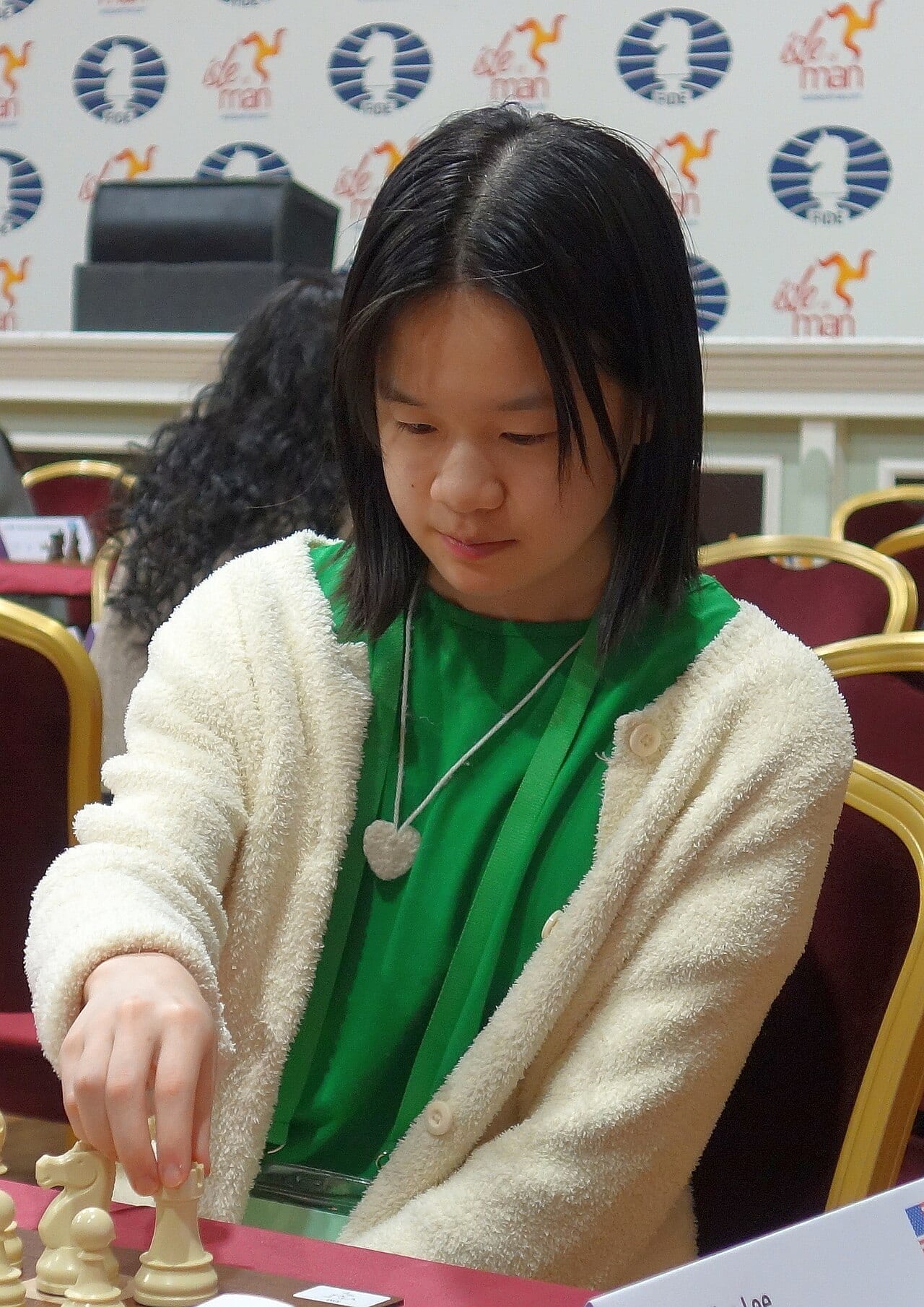
Photo: Stefan64 / Wikimedia Commons (CC BY-SA 3.0)
In Round 8 of the 2026 Cairns Cup, 16-year-old Alice Lee had the black pieces against Grandmaster Vaishali Rameshbabu. In April, Vaishali had won the Women's Candidates Tournament, which made her the next challenger for the women's world title. She attacked Lee's king for most of the middlegame. Lee kept her nerve, gave a piece back at the right moment, and won the rook ending that followed.
Who is Alice Lee? Her story starts in Minnesota, in a school chess club.
Following her brother
Alice Lee was born on October 13, 2009, in Minneapolis, Minnesota. She started playing chess at six in her school's chess club, where her older brother Linden was already a member. He became a chess master too, and he helped her look over her games.
By seven she was rated about 1700, and by ten she was a U.S. Chess National Master, rated 2200 or more. That is the first step on the master ladder.
Three world golds
Lee won gold at the World Youth and Cadet Championships three times: in the Girls Under 10 section in 2019, and in the Girls Under 12 section in 2020 and 2021. In 2019, the bronze in her section went to another American nine-year-old, Rachael Li.
International Master at 13
On June 11, 2023, at the Canadian Transnational Championship in Montreal, Lee completed the International Master title at 13. She beat Grandmasters Arturs Neiksans and Bator Sambuev in that event. That made her the youngest American woman ever to earn the IM title. The record before her belonged to Carissa Yip, who did it at 16.
An International Master is a lifetime title given by FIDE, the International Chess Federation. You need a 2400 rating and three norms. A norm is one very strong tournament result. Lee's first came at the 2022 Southwest Class Championships. Her second came in Saint Louis, where she won five games in a row and took first place.
Cups and medals
In 2024, at 14, Lee won the Women's American Cup in Saint Louis. It is a double elimination event: you have to lose two matches to be knocked out. Irina Krush beat her in the first final, which sent Lee to the second bracket. She fought her way back, beat Krush twice in the Grand Final, and won the last games in blitz. Blitz is fast chess, with only a few minutes for each player for the whole game. She was the first player ever to win the event from the second bracket. She won the Women's American Cup again in 2025 and 2026.
In 2026, at 16, she won the Women's Speed Chess Championship, an online event. She beat Ju Wenjun, the reigning Women's World Champion, 9.5 to 3.5 in the quarterfinals, and four-time Women's World Champion Hou Yifan 11.5 to 9.5 in the final. She is the youngest winner of the event.
In September 2026, at the Chess Olympiad in Samarkand, she won the individual gold medal on board two for the United States.
On the October 2026 FIDE list her rating is 2467, the highest it has ever been. That puts her joint 16th among all women in the world.
The Cairns Cup and the grandmaster norm
The Cairns Cup in Saint Louis is one of the strongest women's tournaments in the world. In August 2026 Lee beat four grandmasters there: Alexandra Kosteniuk, Divya Deshmukh, Humpy Koneru, and, in Round 8, Vaishali. She drew Carissa Yip in the last round. That gave her 6 out of 9, second place, and her first grandmaster norm. A grandmaster needs three norms and a 2500 rating, so she has two norms to go.
The puzzle
Here is the key moment of the Vaishali game. It is White to move, on move 31. Black is a pawn up, but the position is level. White has one move that keeps it level. Vaishali did not find it. Can you? The answer is at the end.


 7
7


 d
d h
hWhite to move. Find the move that keeps the game level.
The Game: Vaishali vs Lee, Round 8
Vaishali Rameshbabu 0-1 Alice Lee, Cairns Cup 2026, Saint Louis, Round 8, 18 August 2026. White: GM Vaishali Rameshbabu (2489). Black: IM Alice Lee (2430).
The opening: doubled pawns on purpose
The game began 1.e4 e5 2.Nf3 Nc6 3.Bc4 Bc5 4.d3 Nf6. This is the Italian Game, one of the oldest openings in chess. Then came 5.Be3 Bxe3 6.fxe3. White now had two pawns on the e-file, called doubled pawns, and none on the f-file.
Beginners learn that doubled pawns are bad, and often they are, because they cannot protect each other. But White got two things for them. The pawn on e3 guards the d4 and f4 squares, and the f-file is open for White's rook after castling.
6...O-O 7.Qd2 d6 8.Bb3 Ne7 9.O-O Ng6 10.h3 c6 11.Nc3 Be6 12.g4 Bxb3 13.axb3 d5. White pushed the g-pawn to start an attack on the black king. Lee answered in the center with 13...d5. Our Stockfish 17.1 run gave Black a small edge here, a little under half a pawn.
87
 1afg
1afgAfter 13...d5. White has doubled e-pawns and has pushed the g-pawn. Black strikes back in the center.
Two slow rook moves
14.Qg2 dxe4 15.dxe4 Qb6 16.Rae1 Qb4 17.g5 Nd7 18.Qg4 Rad8. The black queen went to b4, far from her own king, and now White was better by about half a pawn.
Then White made two slow moves in a row. 19.Re2 f6 20.Rg2. The rook went to e2 and then to g2, behind White's own pawn on g5. Both times our engine wanted 19.h4 or 20.h4 instead, pushing the h-pawn to help the attack. After 20.Rg2 the engine had turned to Black, about half a pawn. Lee brought her queen to the center with 20...Qc5.
7fgAfter 20...Qc5. The white rook on g2 stands behind its own pawn on g5. The black queen is now in the center.
Lee gives a piece back
21.Re1 Qe7 22.Kh1 Rde8 23.Rd1 Nc5 24.h4 fxg5 25.Nxg5 h6 26.h5. Now White attacked the knight on g6. Lee did not retreat it. She played 26...Nf4, giving the knight away. After 27.exf4 Rxf4 the f-file was open for her rook, and the rook hit the white queen. Then 28.Qg3 hxg5 took White's knight. Black had given a knight and taken a knight and a pawn back. She was a pawn up.
This is a good idea to remember. When you are under attack, giving material back can open lines for your own pieces and take the sting out of the attack.
Both players slip
29.Qxg5. Here our engine wanted 29...Kh7, keeping Black about a pawn better. Lee played 29...Nxe4. The knight attacked the queen on g5 and the knight on c3, but White had an answer: 30.Nxe4 Rxe4. Black was still a pawn up, but the engine now called the position level. Strong players slip too.
That brings us to the puzzle position. Vaishali played 31.Kg1, moving the king off the corner. It looks safe, but it lets Black trade queens on good terms, and the engine's number swung to more than a pawn for Black.
The best move was 31.Rd8. Our engine's main line goes 31...Rh4+ 32.Kg1 Qxg5 33.Rxe8+ Kf7 34.Rxg5 Kxe8 35.Rxg7 Rxh5. White's rook takes the black rook on e8 with check, the queens come off, and the rooks trade pawns: g7 for h5. Black is still a pawn up, but with one rook each and the white rook on Black's second rank, the engine calls it level.
The conversion: patience with an extra pawn
31...Qxg5 32.Rxg5 Re7. The queens were gone, and Lee had a rook ending with an extra pawn.
7dgAfter 32...Re7. A rook ending with one extra pawn for Black. Now the work is to turn it into a win.
Lee did not rush. 33.Rd2 Kh7 34.Rdg2 Re1+ 35.Kf2 Rb1 36.Ke3 Rxb2 put a rook behind White's pawns and won a second one. 37.Rg6 Rb1 38.h6 gxh6 39.Rf6 Re1+ 40.Kd2 Rh1 41.Ke3 e4 set the e-pawn moving. White had no pawn on the d- or f-file to stop it, so it was a passed pawn: a pawn with no enemy pawns in front of it or on the files beside it.
42.Rf8 Rh3+ 43.Ke2 e3 44.Rgg8 Rh2+ 45.Ke1 Rxc2. Black had five pawns against one, and Vaishali resigned. Over the last 14 moves, our engine's number for Black grew from about one pawn to almost five.
7eThe final position. Black has five pawns, White has one, and the e-pawn is two steps from becoming a queen.
What to Learn from Alice Lee
1. Every weakness has a price and a payment. Vaishali's doubled pawns gave her control of d4 and f4 and an open f-file. In the end, it was Black's rook that used the f-file, with 27...Rxf4.
2. Attacking moves must attack. 19.Re2 and 20.Rg2 looked active, but the rook ended up behind its own pawn. Before an attacking move, ask: does it make a real threat, or does it only look busy?
3. Giving material back can stop an attack. 26...Nf4 gave up a knight, opened the f-file, and won the material back two moves later.
4. Look one more time before you take. 29...Nxe4 attacked two pieces, but White had a simple answer, and most of Black's advantage was gone. Before you play a capture, check what your opponent can capture back.
5. Find the quiet move in a sharp position. The best move on move 31 was a rook move to the back rank, not a check or a capture.
6. When you are ahead, do not rush. With one extra pawn, Lee used her rooks to win a second pawn and then pushed her passed pawn one square at a time.
Puzzle answer
31.Rd8. After 31...Rh4+ 32.Kg1 Qxg5 33.Rxe8+ Kf7 34.Rxg5 Kxe8 35.Rxg7 Rxh5, only one rook each is left, White's rook is active, and our engine calls the ending level. In the game, 31.Kg1 let Black trade queens and keep her extra pawn.
More Alice Lee games on ChessBotBuddies
- Round 2 of the 2026 U.S. Women's Championship: a passed pawn on the seventh rank beats a rook.
- Round 4: Lee takes the lead in an 85-move grind against Megan Paragua.
- Round 6: Rachael Li ends Lee's winning streak.
The 2026 U.S. Women's Championship
Lee drew with Yip in Round 1 and then won four games in a row, against Jennifer Yu, Nazi Paikidze, Megan Paragua and Tatev Abrahamyan. Her streak ended in Round 6, when Rachael Li beat her. On Friday, in Round 7, Lee was back to winning, against Rose Atwell. The championship has eleven rounds, and with four to go, Lee is near the top.
What comes next
Lee has the IM title and one grandmaster norm, and she is still 17. She needs two more norms and a 2500 rating to become a grandmaster. If Saint Louis is any guide, the best way to get there is the one she showed against Vaishali: defend first, and take your chance when it comes.
Related Stories
Story • 2026-10-16
Rachael Li at 16: The Record Breaker Who Stopped Alice Lee's Streak
tournaments • 2026-10-16
The King That Went the Wrong Way: So Beats Robson to Lead the U.S. Championship
Story • 2026-10-15
The Pawn That Waited 44 Moves: Megan Paragua at 13
tournaments • 2026-10-14