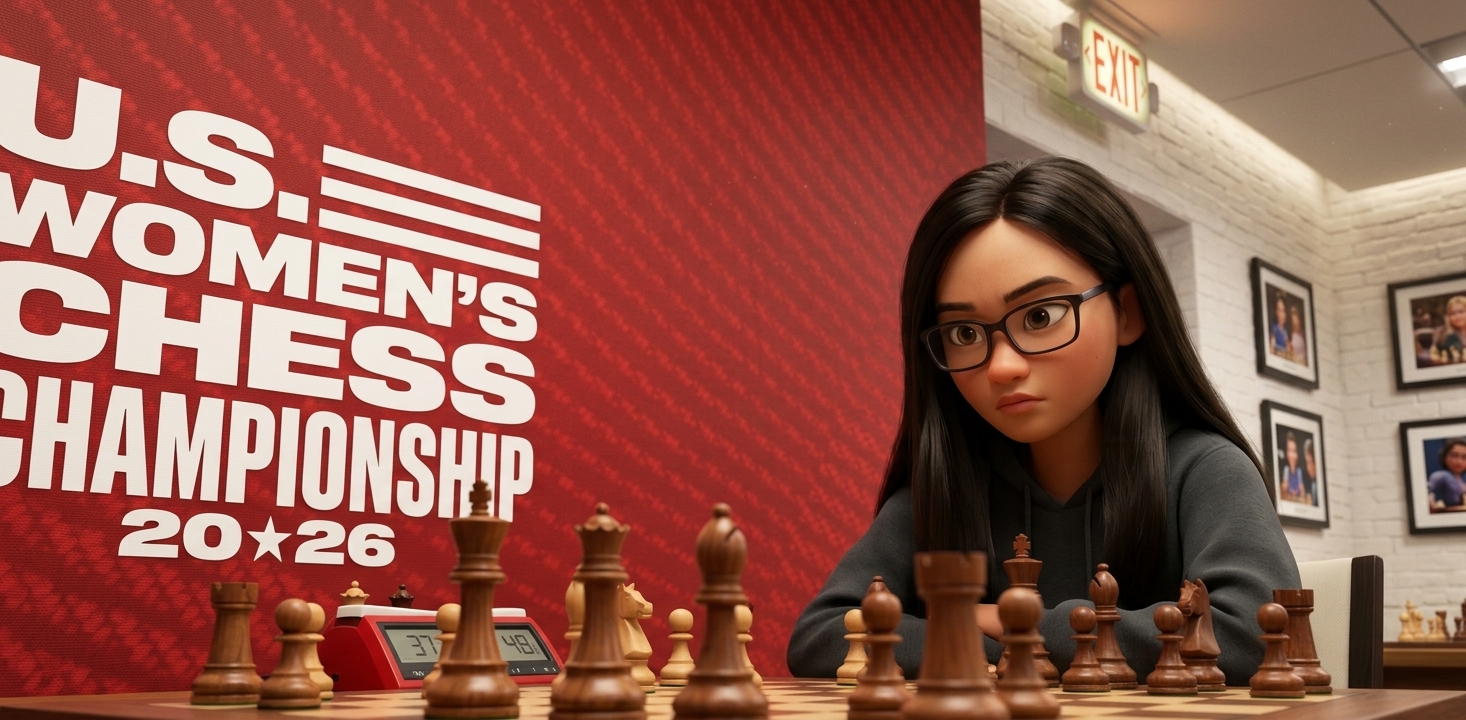
Illustration of Megan Paragua at the chessboard. This is not a real picture of Megan Paragua, and the pieces and clock shown are not from any of her games.
In Round 2 of the 2026 U.S. Women's Championship, Carissa Yip had 40 seconds on her clock and one move that kept the game level. Yip, the champion of the last three years, played a different move. Across the board, a 13-year-old with more than three minutes left found the check that forced checkmate, and the game ended there. We went through that game move by move in One Square Away.
Three rounds later, Megan Paragua beat another former champion, Nazi Paikidze, in a completely different way. There was no sudden attack. There was a pawn that went forward on move 7 and waited 44 moves for its moment.
Here is the story of how a 13-year-old from New York got this strong, and a study of that Round 5 win.
A chess family
Megan Althea Paragua was born in New York in December 2012. Her family comes from Marilao, Bulacan, in the Philippines, and chess runs deep in it. Her uncle is Mark Paragua, a Filipino grandmaster. Her father, Jan Vincent Paragua, was her first coach.
She started learning from her father at about five and played her first tournament at six. She finished on the podium at only her third tournament. "I liked the feeling when I first joined; I was excited, and I continued playing after that," she said.
First title at ten
At ten, Paragua won the girls under-12 section of the 33rd Pan-American Youth Chess Festival in Chicago in 2023. That earned her the Woman FIDE Master title. FIDE is the International Chess Federation, the body that gives out official chess titles around the world, and Woman FIDE Master was the first rung on her ladder.
Double world gold at eleven
In April 2024, in Durrës, Albania, she played the FIDE World Cadet Rapid and Blitz Championship. Rapid and blitz are faster kinds of chess, where each player has minutes for the whole game instead of hours. Paragua entered the girls under-12 section of both events as the top seed. She won both, with 9.5 points out of 11 each time, and became the first Filipino player to win both titles at the same championship.
Back home, the Philippine Consulate General in New York honored her. Asked what chess means to her, she said it lets her show her strategic thinking. "It's a unique achievement that proves challenging yet rewarding," she said. Her advice for other kids was simple: "Work hard, dream big, and your efforts can turn your dreams into reality."
The Grenke leap
In April 2025, at 12, Paragua played the Grenke Open in Germany, one of the strongest open tournaments in Europe. Through the first seven rounds she had a performance rating of 2506. A performance rating measures how well you played in one event, based on your results and your opponents' ratings, and 2506 is grandmaster strength.
On the way she beat two international masters, Ashot Parvanyan (rated 2396) and Michael Kopylov (rated 2333). She lost her last two games, but she still gained 79 rating points in one tournament and passed 2300. That made her a FIDE Master, one of the youngest in the United States. The FIDE Master title is open to all players. It sits above Woman FIDE Master and below International Master.
Climbing the American ladder
The national titles kept coming. She won the U.S. All Girls under-18 championship in 2025. That summer she finished second in the U.S. Girls' Junior Championship, unbeaten with four wins and five draws, half a point behind the winner, Zoey Tang. As a sixth grader she was part of the Columbia Grammar and Preparatory School team that won a national K-12 team title. In January 2026 she earned the Woman International Master title, the next rung up.
In July 2026 she was number 31 in the world on the FIDE list for girls under 21.
The 2026 U.S. Women's Championship
This is her second U.S. Women's Championship, and at 13 she is the youngest player in the field. She beat Anna Sargsyan in Round 1 and Yip in Round 2, and drew in Round 3. In Round 4 she lost a long endgame to Alice Lee, after missing a winning tactic. After the rest day she came straight back and beat Paikidze in 55 moves. That put her on 3.5 out of 5, tied for second place behind Lee.
Win early, take a hard loss, then win again. That is how a real competitor answers.
The Game: Paragua vs Paikidze, Round 5
Paikidze is an International Master and a two-time U.S. Women's Champion, and she was rated 75 points higher. Paragua beat her the way strong players have won for a hundred years. She got a small edge from the opening, never let it go, and pushed her pawns until Black's position cracked.
Let us start with a puzzle. It is move 51, and Paragua is White. She has passed pawns on a6 and c5, her rook stands on b7, and one pawn move breaks Black's position. Find it. The answer is at the end.

 7
7


 6
6
 b
bWhite to move, after 50...Ra7. One pawn move breaks Black's position. Find it.
Megan Paragua 1-0 Nazi Paikidze, 2026 U.S. Women's Championship, Saint Louis, Round 5, 14 October 2026. White: FM Megan Paragua (2234). Black: IM Nazi Paikidze (2309).
The opening: a pawn takes a trip
The game began 1.e4 c6 2.d4 d5 3.exd5 cxd5 4.c4 Nf6 5.Nc3 Nc6 6.Nf3 a6 7.c5. This is the Panov Attack against the Caro-Kann Defense, the opening where Black answers 1.e4 with 1...c6. With 7.c5, Paragua pushed a pawn deep into Black's half of the board. Keep an eye on this pawn. It is the hero of the game, 44 moves later.
8
 6
6 21ac
21ac defh
defhAfter 7.c5. The white pawn on c5 grabs space on the queenside and cramps Black's pieces.
The idea is simple. The pawn on c5 takes space on the queenside and takes away the b6 and d6 squares from Black's pieces. Our engine, Stockfish 17.1, gave White a small edge here, less than half a pawn.
7...Bg4 8.Be2 g6 9.O-O Bg7 10.Be3 Bxf3 11.Bxf3 e6 12.b4 O-O 13.Rb1. With 10...Bxf3, Paikidze traded her bishop for the white knight that could have jumped into e5. Paragua's 12.b4 backed up the c5 pawn, and 13.Rb1 put the rook behind the b-pawn, ready for a push later.
The squeeze: nothing happens, and that is the point
13...Nd7 14.a4 Qf6 15.Ne2 Rfc8 16.Qd2 h6 17.Ra1 Kh7 18.Rfd1 Ne7 19.Ng3 Nf5 20.Nxf5 Qxf5. After this trade the engine gave White an edge of more than one pawn, and from here to the end of the game it never dropped below that.
The next 20 moves are the kind of chess beginners find boring and masters find beautiful. Paragua improved her pieces one square at a time. Her dark-squared bishop went to f4 and later to d6. Her light-squared bishop went back to d1 and then out to a4. Her rooks moved between a3, d3 and e1. Black's queen shuffled between e7 and d7, waiting. The engine's verdict slowly grew from about one pawn to about three.
21.h3 Nf6 22.Be2 Ne4 23.Qe1 Kg8 24.Ra3 Qf6 25.f3 Ng5 26.Qd2 Rd8 27.Bf4 Qe7 28.Rd3 Qd7 29.Ra3 Qe7 30.a5. In her interview after the game, Paragua explained why she chose 30.a5 over the b4-b5 push. She saw that Black's only counterplay was a pawn break, and a5 shut the queenside down. "A5 just closes everything," she said.
Time was a big part of this game. Players get 90 minutes for the first 40 moves, then 30 more minutes, plus 30 seconds for every move. Paikidze had less than eight minutes left from move 23 all the way to move 40, and at move 40 both players had about three minutes on the clock.
The exchange she did not take
30...Bf6 31.Re1 Qd7 32.Bd1 Rac8 33.Bd6 Rc6 34.Ba4 h5 35.Qf4 Nh7 36.h4 Re8 37.Be5 Qe7 38.Bxf6 Qxf6 39.Qxf6 Nxf6. Look at the bishop on a4 and the black rook on c6. From move 35 to move 40, Paragua could have taken that rook with her bishop on every single turn. Winning a rook for a bishop is called winning the exchange, and it is usually a good deal.
6543egWhite to move, after 39...Nxf6. Bxc6 wins the exchange, but Paragua had a better plan: 40.b5.
Paragua did not take it. She explained that after Bxc6 she would have no way to break through on the queenside. "B5, I'm still winning. I could probably grind this," she said. The engine agrees with her. After 40.b5 it rates White about three pawns better. After Bxc6, it rates White only about one and a half pawns better.
The break: 40.b5
Here White's queenside majority, three pawns against two, started rolling. 40...Rcc8 41.bxa6 Re7 42.axb7 Rxb7 43.a6. In three moves Paragua made a passed pawn, a pawn with no enemy pawn in front of it or on the files next to it, and parked it on a6.
543egAfter 42...Rxb7. White plays 43.a6, and one black rook must now guard the a-file.
43...Ra7. From here on, one black rook had to stay on the a-file, because the a-pawn was two steps from becoming a queen.
Then Paragua did something instructive. She did not rush. 44.Bb5 Kf8 45.Rb1 Ke7 46.Bd3 Rcc7 47.Rab3 Nd7 48.f4 Kd8 49.Kf2. Both rooks went to the b-file, the bishop found a good square, and the king stepped closer to the middle. Her second passed pawn, the c-pawn from move 7, was still waiting.
The finish: the c-pawn's turn
49...Ra8 50.Rb7 Ra7. Black's rook went to a8 and straight back to a7, and in between White's rook landed on b7, on the seventh rank, where it presses on Black's pieces. That brings us to the puzzle position.
51.c6, the pawn from move 7, finally moved again. It attacked the knight on d7 and protected the rook on b7. The engine calls it the best move by almost a full pawn.
51...Nf6 52.Rb8+ Ke7 53.R1b7. This was the only move that kept the win simple. The engine rates White more than ten pawns better after it, and only about five and a half after anything else. Now the rook on b7 attacks both black rooks, and the rook on b8 keeps the black king boxed in.
76After 53...Kd6. White plays 54.Rd8+, driving the king back before the last rook move.
53...Kd6 54.Rd8+ Ke7 55.Rc8, and Paikidze resigned. The black rook on c7 was attacked twice and defended by nothing, and once it fell, the c-pawn would run through. Final score: 1-0 in 55 moves.
Puzzle answer
51.c6. The pawn attacks the knight on d7 and guards the rook on b7. If Black takes the rook with 51...Rcxb7, then 52.cxb7 leaves a new white pawn on b7, one step from becoming a queen. In the game the knight moved away with 51...Nf6, and four moves later Black resigned.
What to Learn from Megan Paragua
1. Manage your clock. Against Yip, Paragua kept more than three minutes while Yip had 40 seconds, and the game was decided in those last moves. Time is part of the game, just like your pieces.
2. A small edge is enough. Against Paikidze, Paragua never had a big attack. She had a pawn on c5 and a bit more space, and she kept improving one piece at a time until Black ran out of good moves.
3. A pawn majority is a plan. Three pawns against two on the queenside became a 20-move plan: push the pawns, make a passed pawn, tie down a black piece, then push the second pawn. The old endgame rule held: passed pawns must be pushed.
4. You do not have to take free material. Bxc6 would have won the exchange. Paragua saw that it would also kill her own plan, and the engine agreed that b5 was much stronger. Before you grab material, ask what it does to your plan.
5. Rooks love the seventh rank. A rook on the seventh rank attacks pawns, keeps the enemy king back and helps passed pawns run. 50.Rb7 and 53.R1b7 decided this game.
6. Bounce back the next round. She lost a painful endgame to Lee in Round 4, then won in Round 5. One loss is information. The next game is a fresh start.
What comes next
Paragua already holds the Woman International Master and FIDE Master titles at 13. The next steps are the Woman Grandmaster title and, beyond it, the Grandmaster title her uncle holds. After five of the 11 rounds, Lee leads by one point, and Paragua is right behind her.
The c5 pawn waited 44 moves for its moment. Paragua plays like she knows the feeling.
Related Stories
Story • 2026-10-16
Alice Lee at 17: Defend First, Then Win
Story • 2026-10-16
Rachael Li at 16: The Record Breaker Who Stopped Alice Lee's Streak
tournaments • 2026-10-16
The King That Went the Wrong Way: So Beats Robson to Lead the U.S. Championship
tournaments • 2026-10-14