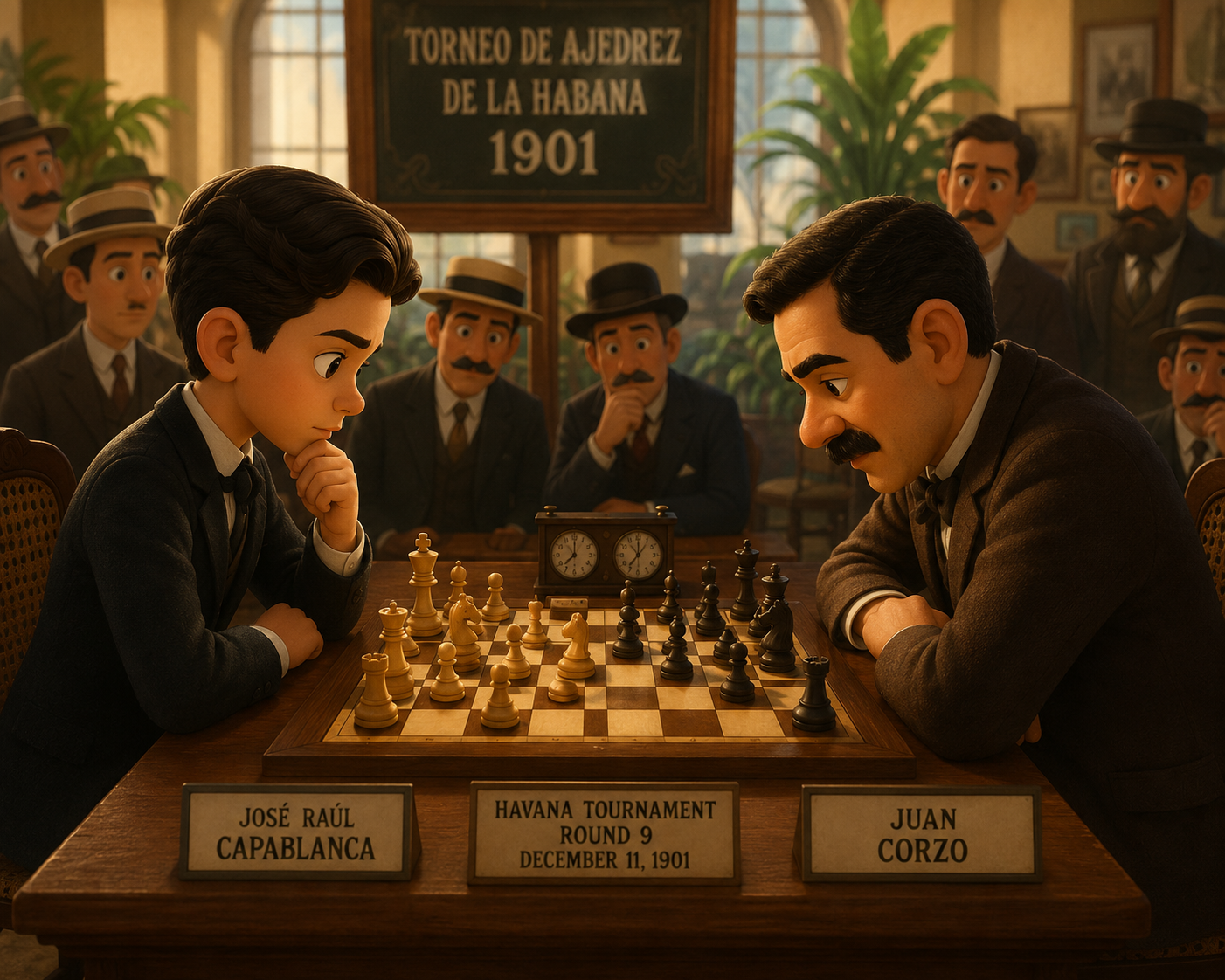
Illustration of Capablanca and Corzo in Havana, 1901. It is a drawing, not a photograph, and the sign in it is part of the drawing.
The Game and Why It Matters
On December 11, 1901, a 13-year-old José Raúl Capablanca sat down against Juan Corzo, the champion of Cuba. It was game 9 of a match between them, played in Havana. Capablanca won the match.
Corzo played the Dutch Defense, answering 1.d4 with 1...f5. Capablanca offered a pawn with 2.e4, which is called the Staunton Gambit. Instead of hunting for a knockout, he steered the game toward an ending, the last part of a game, when most of the pieces are gone. That is where he was strongest for the rest of his life.
There is no brilliant sacrifice in this game. There are about forty moves of patient work, and a king that walks from one side of the board to the other. Our engine, Stockfish 17.1 searching to depth 18 to 22, agrees with the result but not with every compliment this game usually gets. We say where below.
The Opening: A Pawn Offered
1.d4 f5 2.e4 fxe4 3.Nc3 Nf6 4.Bg5 c6
Corzo takes the pawn and then plays c6, holding the center and getting ready for d5.
 8
8


 7
7

 2
2 1a
1a d
d efgh
efghAfter 4...c6, White to move. Black is a pawn ahead. White has two pieces out and Black has one, so White is ahead in development.
5.Bxf6 exf6
Capablanca gives up his bishop for a knight. In return, Black's pawns on f6 and f7 are now doubled, meaning two pawns of the same color on the same file. Doubled pawns cannot guard each other, and that weakness lasts all game.
Our engine is not impressed by this trade on its own. It rates the position as level after it. The point is what kind of position Capablanca was steering for.
6.Nxe4 d5 7.Ng3 Qe7+ 8.Qe2 Qxe2+ 9.Bxe2
White wins the pawn back, and the queens come off on move 8. Many young players avoid that. Capablanca invited it.
Every Piece Improves
9...Bd6 10.Nf3 O-O 11.O-O Bg4 12.h3 Bxf3 13.Bxf3 Bxg3 14.fxg3
Both sides trade pieces. White's pawns on g2 and g3 are now doubled too. In exchange, White's f-file has no white pawn on it, so his rook has a road. Black still has a pawn on f6, so the file is only half open.
14...Nd7 15.Rfe1 Rae8
Now look at the e-file: neither side has a pawn on it, so it is fully open. Both players put a rook there, which is the right idea.
16.Kf1 f5
Capablanca starts walking his king toward the middle. With the queens gone, that is safe, and a king in the middle is a fighting piece.
721aefAfter 16...f5, White to move. Black has gained space, but the pawn on f5 will need watching for the rest of the game.
17.Rxe8 Rxe8 18.Re1 Rxe1+ 19.Kxe1 Nf6
Every rook is gone. What is left is a bishop against a knight, with seven pawns each.
72eAfter 19.Kxe1, Black to move. Level material, level position. Our engine calls it equal. It looks like a draw.
The Endgame Begins
20.Kd2 Ne4+ 21.Ke3 Nd6 22.Be2 Kf7 23.Kf4 Kf6
Both kings march in. The position is still balanced. The difference is that Capablanca has a plan and keeps asking questions.
24.h4 g6
A useful move. It takes the g5 square away from Black's pawn in one sense: if Black ever plays g5 with check, White can answer hxg5. To be exact, 24...g5+ was still legal here, and so were several quiet moves. Our engine rates 24...g6 and three other moves as about equal. So g6 was sensible, not forced.
25.g4 h6 26.g5+ hxg5+ 27.hxg5+ Ke7
The h-pawns disappear. Now no pawn of either color stands on the h-file, so it is wide open, and both sides still have three pawns on the queenside and two on the kingside. Neither side has a majority anywhere. What White does have is a pawn on g5 cramping Black and a king ready to go hunting.
28.g4 fxg4 29.Bd3
72After 29.Bd3, Black to move. The bishop points at the pawn on g6, which no black pawn guards. White's king is ready to take on g4.
29...Nf5 30.Kxg4 Nxd4
Corzo takes a pawn and goes one point up. Capablanca does not panic.
31.Bxg6
The bishop takes the loose pawn back. Material is level again, 7 points each, and Black's king side is bare.
32.Kh5 Ne6 33.Kh6 Kf8 34.Bf5
The white king climbs to h6, which looks strange until you see what it does: it guards the square g6, and it will hold the pawn that lands there.
The Pawn That Freezes a Knight
34...Ng7 35.Bc8 b6 36.g6
72After 36.g6, Black to move. The pawn on g6 is a passed pawn: no black pawn can block it or capture it on its way to g8. It is guarded by the white king on h6, not by another pawn.
This is the move most books point to, and the pawn really does decide the game. Two honest notes, though. First, our engine already had White close to three pawns ahead several moves earlier, so the ending was not still level at this point. Second, the engine's own first choice here was 36.Kh7, and it rates 36.g6 a fraction lower. The move is strong and human. It is not the only path.
From here Black's knight has one job: stop the pawn. A piece that can only sit still is barely a piece at all.
36...d4 37.b3 Kg8 38.a4
74After 38.a4, Black to move. Capablanca fixes his own queenside before doing anything else. The knight on g7 still cannot leave the g-pawn.
38...Kf8 39.Bg4 Ne8 40.Kh7 Ng7 41.Kh6 Ne8 42.Be2 Ng7 43.Bc4 Ne8 44.Kg5
The bishop shuffles while the king changes plan and heads for the other wing. Our engine marks 44.Kg5 as the one real slip of the endgame: White's edge drops from about four and a half pawns to about two. It is still winning. Nobody plays a perfect endgame, not even Capablanca.
44...Ke7 45.Kf5 Ng7+ 46.Ke5
74After 46.Ke5, Black to move. Three jobs at once: the king attacks the pawns in the middle, the bishop watches the diagonal leading to g8, and the g-pawn holds the knight in place.
The King Goes Hunting
46...Nh5 47.Be2 Ng7 48.Kd5 Ne8 49.Kc6 Ng7 50.Kb7
The king walks into Black's camp. From b7 it attacks the pawn on a7 and the pawn on b6 at the same time.
50...Kd6 51.Kxa7 Kc7 52.Ka6 Ne8 53.Bf3 Ng7 54.Bd5 Ne8 55.Bf7 Ng7 56.Kb5 Nf5 57.a5
Now there are threats on both wings. Black cannot hold the queenside and the g-pawn at once.
57...Nd6+ 58.Ka6 bxa5
Black takes, which our engine agrees is the best try. It was not the only legal move, and it does not save the game.
59.g7
65Final position after 59.g7. The pawn is one step from becoming a queen. We checked every black reply: none of them stops it.
The pawn reaches g7 and cannot be stopped. The game score ends here with a win for White.
What Actually Decided It
The plan, not a trick. Capablanca traded into an ending he understood, kept his king moving forward, made a passed pawn that tied one black piece to one square, and then attacked on the other side of the board where Black could no longer defend.
Three things are worth copying:
- Trade into the ending you want. Those doubled f-pawns from move 5 mattered more and more as pieces came off.
- Walk your king up the board. From move 16 the white king went f1, e1, d2, e3, f4, g4, h5, h6 and h7. Then it turned around and crossed to g5, f5, e5, d5, c6 and b7, taking a pawn on a7 on move 51.
- A passed pawn is worth more than the square it stands on. The g-pawn never promoted until the last move, and it still decided the game, because it turned Black's knight into a guard.
One more lesson, from the engine rather than from the old books: this game is usually called flawless. It was not. Our run flags 44.Kg5 as a real slip, and it prefers a different move at 36. Capablanca was 13, he was playing the champion of Cuba, and he still won a long ending by understanding it better. That is more useful to copy than perfection.