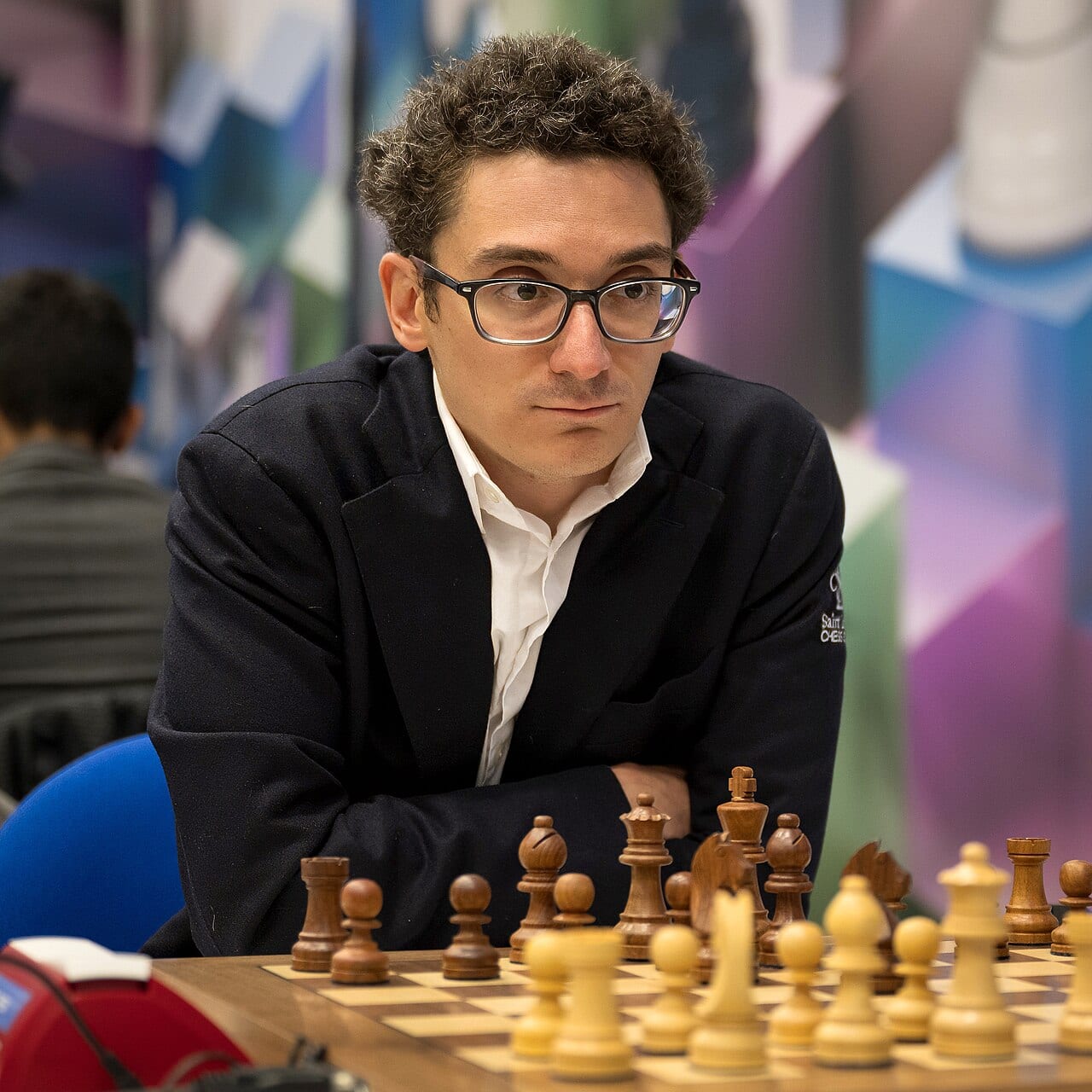
Photo: Frans Peeters / Wikimedia Commons (CC BY-SA 2.0)
On his sixth move, Fabiano Caruana pushed a pawn to b4 and offered it to Wesley So. So looked at the board for almost 20 minutes before he answered. The game ended in a draw by repetition after 38 moves, two and a half hours after it began.
That result matters more for So than for anyone. He started Round 9 of the 2026 U.S. Championship in Saint Louis on Monday one point ahead of Caruana, and he finished it one point ahead: 6.5 points to 5.5, with two rounds left.
Here is how the game went, what So said about it afterwards, what you can learn from it, and what the numbers say about the title race.
The surprise: the Dubov Gambit
The game began as an Italian Game, also called the Giuoco Piano: 1.e4 e5 2.Nf3 Nc6 3.Bc4 Bc5 4.c3 Nf6 5.d4 exd4. Then Caruana played 6.b4. This line is known as the Dubov Gambit. A gambit is an opening where one side gives away material, usually a pawn, to get quick play.
 8


 7


 2
 1abc
 d
 eh
After 6.b4. The pawn on b4 attacks the bishop on c5. Black to move.
The pawn on b4 attacks the black bishop. Black's bishop can go to b6, d6, e7 or f8, or take the pawn with 6...Bxb4. So chose 6...Be7. That one move took him 19 minutes and 44 seconds, the second-longest think of the game. After it, So had about 73 minutes on his clock and Caruana about 93.
So was honest about that moment after the game. "I didn't expect this move at all," he said. "I was just cursing myself." In the end, he said, he told himself: "Let me just try to play some chess. I was just trying to calculate."
Caruana kept pushing his pawns forward: 7.e5 Ne4 8.b5 Na5 9.Bd5 Nxc3 10.Nxc3 dxc3.
87521acdehAfter 10...dxc3. Black is two pawns ahead. White's pawns on b5 and e5 take space, and Black's king is still in the middle.
Count the pawns. Black has eight and White has six, so Caruana was two pawns down. What did he get for them? His pawns on b5 and e5 take away good squares from Black's pieces, the black knight sits on the edge at a5, and Black's king has not castled yet.
Was it enough? Our Stockfish 17.1 engine, at depth 20, still liked Black by about three-quarters of a pawn after 11.O-O. Gambits are often like that. The engine says the pawns are worth more, but the player who has them still has to defend for many moves against a well-prepared opponent.
So hands the pawns back
The game went on 11...a6 12.a4 c6 13.Be4 Nc4 14.bxa6 Rxa6 15.Qd4. Look at what the knight on c4 can do now.
641acfgAfter 15.Qd4. Black to move. From d2, the knight would attack the rook on f1, the knight on f3 and the bishop on e4.
So played 15...Nd2. A knight that attacks two or more pieces at once is making a fork, and this one hit three: the rook on f1, the knight on f3 and the bishop on e4. Caruana answered with 16.Nxd2 cxd2 17.Bxd2, and the knights were gone. So had given back the pawn on c3. He was still one pawn up.
Our engine did not love this. It preferred 15...b5. At depth 24, that move kept Black about three-quarters of a pawn ahead. After 15...Nd2, the engine called the position close to level. It was the biggest change in the engine's numbers in the whole game.
So explained the idea himself after the game. He looked at 15...b5 first, but thought it weakened his position, so he chose to "trade some pieces and hope that you don't get checkmated." For a player who leads the tournament and has Black against the defending champion, a safe, level game is a good result. By then So had used a lot of time. After move 15 he had 45 minutes left. Caruana had 96.
So also said that after the game, Caruana told him he had hoped 11...a6 would be hard to find. Our engine agrees with So's choice: 11...a6 was its top move at depth 20.
A rule worth knowing: en passant
After 17...O-O 18.Bd3 Ra8, Caruana thought for 26 minutes, the longest think of the game, and played 19.Bf4. So answered with 19...d5, moving his d-pawn two squares.
841afgAfter 19...d5. White to move. The pawn on e5 can take the d5 pawn as if it had moved only one square, landing on d6.
This is the moment to learn en passant, a French phrase that means "in passing". When a pawn moves two squares from its starting square and lands right beside an enemy pawn, that enemy pawn may capture it as if it had moved only one square. The capture is only allowed on the very next move.
Caruana took the chance: 20.exd6. Now the material was equal. So had given back his second pawn, but his pieces could breathe. Our engine rated the position exactly level, 0.00.
The ending: one rook each
The queens and dark-squared bishops came off with 20...Bf6 21.Be5 Bxe5 22.Qxe5 Qf6 23.Qxf6 gxf6. Later the last bishops were traded too, and each side took a pawn: White the pawn on d5, Black the pawn on d6. After 32.Rxb7 Rxa5, this was left on the board.
5gAfter 32...Rxa5. One rook each and three pawns each, all on the same side of the board. White to move.
Each side has a rook and three pawns, and all six pawns are on the kingside. Endings like this are very often drawn, because neither side has a passed pawn, a pawn that no enemy pawn can stop. Our engine rated it 0.00.
So's rook then started giving checks: 33.Kf2 Kg7 34.Kf3 Ra3+ 35.Kf2 Ra2+ 36.Kf3 Ra3+ 37.Kf2 Ra2+ 38.Kf3 Ra3+.
3The final position, after 38...Ra3+. The same position appeared for the third time, so the game was drawn.
When the same position appears three times with the same player to move, the game can be called a draw. This is called threefold repetition. The game ended at 2:43 p.m. Saint Louis time, two hours and 32 minutes after it started.
The game in numbers
We ran our Stockfish 17.1 engine at depth 20 over every move.
- Average loss per move: Caruana 6.5 centipawns, So 6.1. A centipawn is one hundredth of a pawn. Both players lost less than a tenth of a pawn per move on average, which shows how accurate the game was.
- Moves within a tenth of a pawn of the engine's choice: Caruana 31 of 38, So 32 of 38.
- The biggest swing: 15...Nd2, worth 0.93 of a pawn in the engine's eyes.
- The two longest thinks: Caruana's 19.Bf4 (26 minutes) and So's 6...Be7 (19 minutes, 44 seconds).
- Clocks at the end: Caruana had 40 minutes left, So 26.
A shuffle in the world top five
The draw also moved the world rankings, but only on the unofficial live rating list, which changes after every rated game. The official FIDE list comes out at the start of each month.
Caruana came to Saint Louis rated 2784, the top seed. On Monday evening, his live rating stood at 2781.3, and he slipped to fifth in the world. The player who passed him was Nodirbek Abdusattorov, who beat Balázs Csonka on Monday at the European Chess Club Cup in Budva, Montenegro, and moved to 2781.4. That is a gap of one tenth of a point.
So is right behind them. His live rating was 2778.0, sixth in the world, eight points more than the 2770 he started the event with.
Want to see the official numbers for yourself? Our FIDE ratings page shows the official FIDE lists for classical, rapid and blitz chess. You can sort the rankings by country, age and gender, to see the top 100 players from the United States, the best juniors, or the strongest women and girls. You can also search for any FIDE-rated player by name.
The title race
Here is the table after Round 9:
- Wesley So 6.5
- Fabiano Caruana 5.5, Grigoriy Oparin 5.5
- Awonder Liang 5, Jeffery Xiong 5, Andy Woodward 5
- Abhimanyu Mishra 4.5
- Levon Aronian 4
- Hans Niemann 3.5, Ray Robson 3.5, Sam Shankland 3.5
- Sam Sevian 2.5
So is the only player in the field who has not lost a game. He has four wins and five draws.
Who is doing better than expected? Ratings let you work out how many points a player "should" score. The Elo formula gives each player an expected score for every game, based on the difference in ratings. Add those up over the games played, and you can compare them with the real score. Using the ratings listed for this event:
- So was expected to score about 5.7 from his nine games. He has 6.5, about 0.8 more.
- Caruana, the top-rated player at 2784, was expected to score about 5.8. He has 5.5, about 0.3 less.
- Oparin, rated 2638, was expected to score about 3.7. He has 5.5, about 1.8 more than his rating predicts, the biggest gap in the field.
- Woodward, the lowest-rated player at 2619, was expected to score about 3.6. He has 5, about 1.4 more.
How the games have gone. Of the 54 games played so far, White won 17, Black won 7, and 30 were drawn. White has scored 59% of the points. Round 9 had five draws and one win, Oparin's.
What So needs
Here are the last two rounds for the top two:
- Tuesday, Round 10: So (White) against Niemann. Xiong (White) against Caruana.
- Wednesday, Round 11: Sevian (White) against So. Caruana (White) against Liang.
If players tie for first, they play a playoff on Thursday, 22 October, starting with rapid games of 15 minutes each plus 10 seconds a move.
- If So scores 1.5 from his last two games, he finishes on 8 and wins the title outright. Nobody else can reach 8.
- If So scores 1, he finishes on 7.5. Nobody can pass him. Caruana or Oparin could tie him, but only by winning both of their last two games.
- If So scores 0.5 or less, more players can catch him, and Caruana could pass him by winning both games.
How the other games ended
The last games of Round 9 finished more than two hours after Caruana and So shook hands.
- Grigoriy Oparin beat Sam Shankland in 78 moves, the only decisive game of the round. Oparin moved into a tie for second with Caruana.
- Ray Robson and Awonder Liang drew in 47 moves. Liang is now a point and a half behind So.
- Hans Niemann and Sam Sevian drew in 83 moves.
- Abhimanyu Mishra and Levon Aronian drew in 43 moves, after Aronian had been better by about a pawn on our engine.
- Andy Woodward and Jeffery Xiong had drawn earlier in the day.
So's own view, two rounds from the end: "It's a big confidence booster for sure."
What to take away
- A gambit is a trade. Caruana gave two pawns for space and fast play. Count what you get, not only what you give.
- Giving material back can be smart. So returned both pawns to swap pieces and reach a level game. Leading a tournament changes which risks are worth taking.
- Know en passant. If your opponent's pawn jumps two squares and lands next to yours, you have one move to take it.
- Rook endings with all the pawns on one side are usually draws. Checks from behind, and a repetition, finished this one.
In the women's section on Monday, Carissa Yip turned a defense into a win over Anna Sargsyan.
Before the round we looked at what this game could mean for the title. The day before, So beat Andy Woodward in a pawn ending to take his one-point lead.
Related Stories
tournaments • 2026-10-19
One Pawn Push Saves the Game: Carissa Yip Turns Defense into a Win over Anna Sargsyan
tournaments • 2026-10-19
Let the Queen Go: Megan Paragua Wins with a Pawn That Could Not Be Stopped
tournaments • 2026-10-18
One Point, Three Games: What Caruana vs So Means for the U.S. Championship
tournaments • 2026-10-18