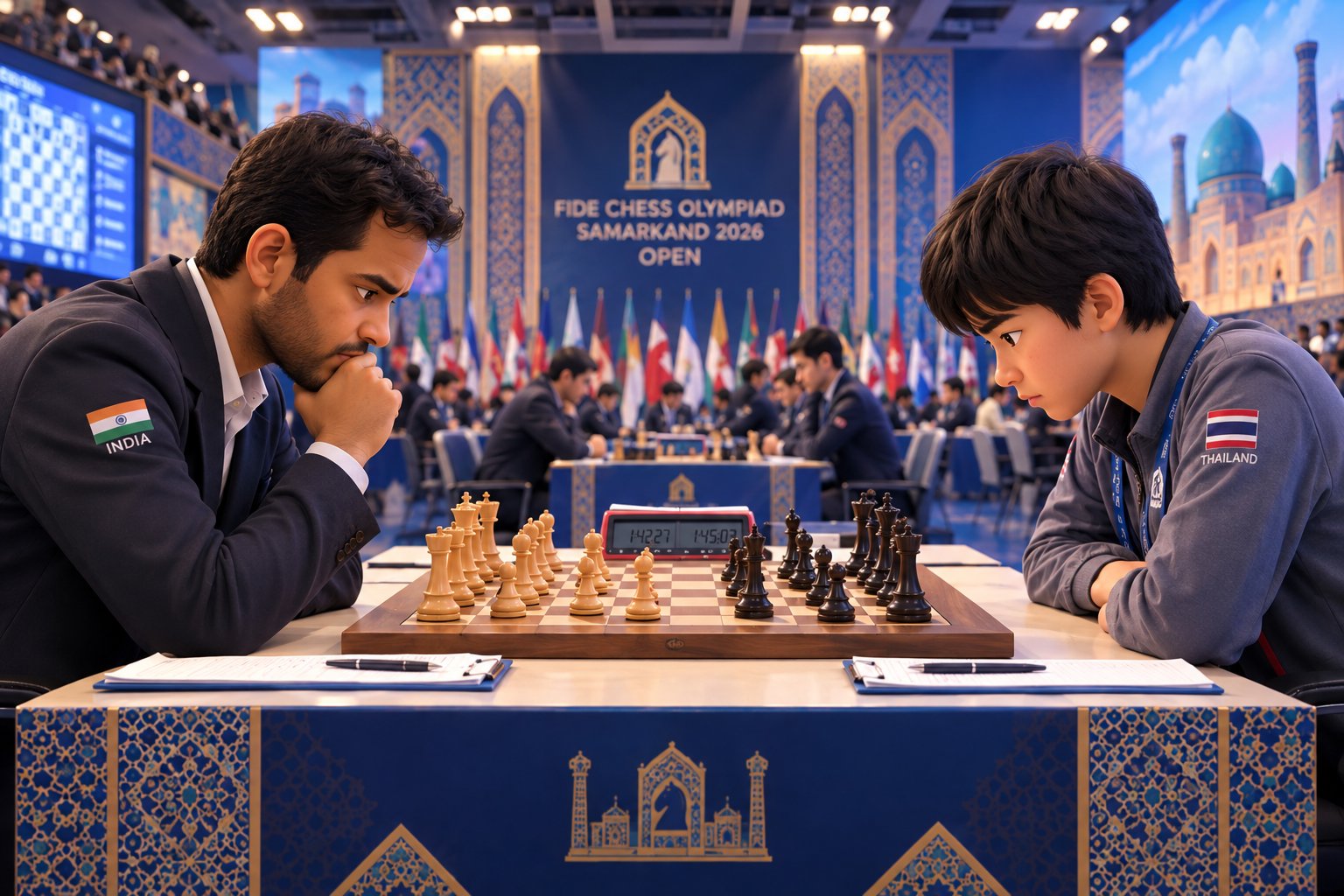
Illustration. Not a photograph of this game. The players, clock times and pieces on the board shown are not from the match.
Arjun Erigaisi is rated 2759. Prin Laohawirapap is rated 2363. In chess, a rating is a number that estimates how strong a player is, and the gap here was 396 points. By the standard rating formula, the higher-rated player in that gap is expected to score about 91 points out of every 100.
On the first day of the 2026 Chess Olympiad in Samarkand, Prin won.
Arjun Erigaisi 0-1 Prin Laohawirapap 46th FIDE Chess Olympiad, Samarkand 2026 · Open Section, Round 1 · 16 September 2026 White: Erigaisi, India (2759) · Black: Laohawirapap, Thailand (2363) · Opening: Colle System
India still won the match 3-1, because Nihal Sarin, D Gukesh and Vidit Gujrathi all won their games. But this game is the one worth studying, and not only because of the rating gap. For much of it, White was the one with the better position. The story is how that advantage disappeared.
The opening: a solid house
1.d4 Nf6 2.Nf3 d5 3.e3 c5 4.c3 e6 5.Nbd2 Nbd7 6.Bd3 Be7 7.O-O O-O
This setup is called the Colle System. White builds a small, sturdy shape in the centre: pawns on d4, e3 and c3, knights on f3 and d2, a bishop on d3, and the king tucked away by castling. It is not flashy. It has one big idea, which is to push the e-pawn forward to e4 when the moment is right.
The opening does not give White a large edge, and for the first fifteen moves nobody had one. Stockfish 17.1, a strong chess engine looking about ten moves ahead (a search depth of 20), rates the position as level all the way through move 15.
The pawn storm
8.Ne5 Nxe5 9.dxe5 Nd7 10.f4 g6
White traded a knight and put a pawn on e5, then supported it with a second pawn on f4. Later came 18.f5 and 19.f6. Look at where the pawns ended up.
 8
8


 6
6


 2
2
 1abf
1abf g
gPosition after 19...Bf8. White's pawn on f6 takes the squares e7 and g7 away from Black.
The pawn on f6 is called a wedge. It sits right next to the black king, and it controls e7 and g7, two squares Black's pieces would love to use. The king cannot step to g7 at all. This is what a space advantage looks like. Nothing is being captured, but Black's pieces are running out of places to stand.
By the engine's numbers, White was usually somewhat better over the next twenty moves, somewhere between a third of a pawn and a pawn and a half.
The counter-punch: a pawn on d3
Prin did not sit and wait. On the other side of the board he pushed his own pawns.
13...a6 14.Nf3 b5 15.e4 Nb4 16.Bb1 c4 and later 27...Nd3 28.Bxd3 Rxd3 29.Rxd3 cxd3
6fgPosition after 29...cxd3. Black's pawn on d3 sits deep in White's position, and no white piece attacks it.
Look at that pawn on d3. It has marched far into White's side of the board, and none of White's pieces can attack it. Players call this a thorn. A pawn that far advanced is dangerous because it ties White's pieces to guarding the squares in front of it, and because if White is careless, it can run further.
The engine's best move for White on move 28 was 28.h4, which keeps White about one pawn ahead. Taking the knight with 28.Bxd3 let the black pawn land on d3, and that swings the engine's view to slightly better for Black. Compared with 28.h4, that is a drop of about one and a half pawns from one trade.
It did not last, and Prin was not perfect either. The engine marks his 31...h5 as the weakest move of that stretch, and it handed White the better position again.
The slide
Here is the engine's view of the game after each of these moves. Positive numbers mean White is better, and one pawn is roughly one hundred points.
- 15...Nb4: level, about +0.1
- 31...h5: White ahead by about 1.1
- 42...Rd4: White ahead by about 3.0
- 43.Rg3: White ahead by about 2.2
- 47.Nf3: level, 0.0
- 50.Qg7: Black ahead by about 5.5
At move 40 the engine's first choice was the quiet 40.Rg3, a little better than the 40.Qh7 that was played. That is a small step, not a mistake. At move 42, White was about three pawns ahead. That is a very large advantage, the kind a top grandmaster expects to turn into a win. Then three moves gave it away.
43.Rg3 was the first. The engine's top choice was 43.Qg5, which keeps White about three pawns ahead. The rook move was still good for White, but it gave up a little under a pawn. (The numbers for moves White did not play come from a slightly deeper search, to depth 22.)
47.Nf3 was the second, and the bigger one.
6Position before 47.Nf3. White to move. The knight on d2 can capture the rook on e4.
Black's rook sits on e4, where it took a pawn two moves earlier. White's knight on d2 can capture that rook, and the engine's first choice is exactly that: 47.Nxe4. After 47...Qxe4 48.Rc3+ White has won a rook for a knight, and the engine keeps White about 1.4 pawns ahead.
Instead White played 47.Nf3. That is a legal move, but it lets Black play 47...Re2+ 48.Kh3 Bxf3 49.Rxf3 Qe1, and the game is level. The rook was attacked by the knight, and the knight walked away from it.
The lesson is simple. When you are winning, trade into a clearly better position when you can. A knight for a rook is a bargain, and it removes your opponent's most active piece.
The last mistake: the queen goes hunting
After 49...Qe1, the position was balanced, and there was still a lot of chess to play. Then came the move that ended the game.
50.Qg7
34Position after 50.Qg7. Black to move. White's king on h3 has only a rook and a pawn close by.
White's queen went to g7, where it attacks the pawn on f7. Now look at the white king on h3. Around it there is a rook on f3, a pawn on h4, and not much else. Black's queen and rook were both aimed at that side of the board.
After 50.Qg7, Black had five checking moves to choose from. Prin played 50...Qh1+. The game went 51.Kg4 Re4+ 52.Rf4 Qd1+ 53.Kg3 Qg1+ 54.Kh3 Re3+, and White's king was hunted with check after check. The engine sees a forced win for Black from here.
The better move was the quiet one: 50.Qf4. It keeps the queen near the king, and the engine calls the position level. Winning a pawn is not a bad idea by itself. The trouble was the timing, with the king short of defenders.
A queen is the best attacking piece on the board, and also one of the best defenders. On move 50, White's queen was needed at home.
What to take from this game
- A space advantage is real, but it has to be cashed in. The f6 wedge was still on the board at move 54, and White never turned it into a win. Cramped positions still have counterplay, and Prin found it.
- A far-advanced pawn is a thorn. The pawn on d3 stayed there until move 46, when White finally took it with 46.Rxd3+.
- When you are winning, look for the good trade. 47.Nxe4 gave a knight for a rook. The knight step gave back about a pawn and a half.
- Before you go pawn hunting, check your own king. Count the defenders. If it is only a rook and a pawn, keep the queen home.
- Nobody is too strong to lose. The engine's numbers show Erigaisi ahead by three pawns at move 42. The 396-point rating gap is a statistic about the past. What happens on the board is decided one move at a time, and that goes for both players.
Prin did not play a perfect game, and neither did his opponent. But at the moment that mattered he found the strongest move. The engine agrees with 45...Rxe4 as its first choice, and when White gave him chances later, he took them.
Losing a better position late in a long game happens at every level of chess, and it does not make a player weak. Erigaisi is one of the strongest players in the world, and this was 54 moves of decisions.
More from the 2026 Chess Olympiad in Samarkand: Wei Yi's Windmill at the Samarkand Olympiad from Round 4, and Wesley So's Queen Offer at the Samarkand Olympiad from Round 3.