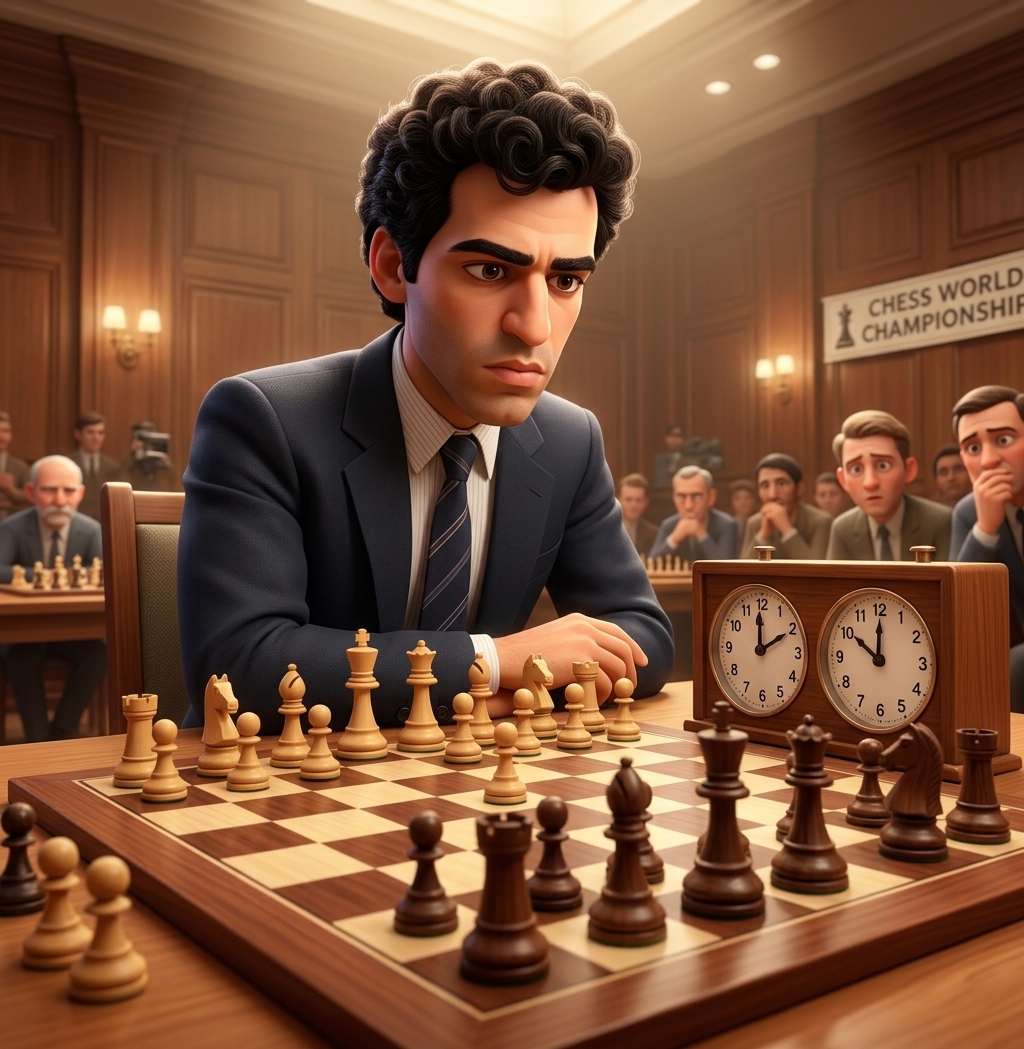
Illustration of Garry Kasparov at the chessboard. This is not a real picture of him, and the board shown is not a position from a real game.
Let us start with a puzzle. White has just lost a rook. Black's pawn took it on d4, so White is behind in material. It is White's move, and there are three checks to choose from: Nc6+, Qxd4+ and Re7+. Only one of them keeps the attack alive. Keep it in mind: you will meet the answer in the game below.
 8
8
 7
7 6
6

 5
5
 3
3
 b
b e
eWhite to move. Black's pawn has just taken a white rook on d4. White has three checks: Nc6+, Qxd4+ and Re7+. Find the only good one.
The player with the white pieces was Garry Kasparov. He became world champion at 22, the youngest there had ever been.
A Boy from Baku
Garry Kasparov was born on 13 April 1963 in Baku, in Azerbaijan, which was then part of the Soviet Union. As a boy he was sent to the Young Pioneer Palace in Baku, a club for children, to learn chess.
He rose fast. He became an International Master in 1979 and a grandmaster in 1980, according to the world chess federation, FIDE. A grandmaster holds the highest title a player can earn, and the road to it is long. In 1979 he won a strong tournament in Banja Luka, in what is now Bosnia and Herzegovina, even though he did not yet have an official rating. In 1980 he won the World Junior Championship ahead of Nigel Short, according to ChessBase. That same year, at 17, he scored 9.5 points out of 12 on board four for the winning Soviet team at the Chess Olympiad in Malta.
Climbing to the Top
- In 1984 Kasparov played Anatoly Karpov for the world title. Karpov had been champion since 1975. Their first match began on 10 September 1984 and was stopped after 48 games with no winner.
- A new match, limited to 24 games, was played in Moscow in 1985. On 9 November 1985 Kasparov won the 24th game and the match, 13-11.
- He was 22, and he became the youngest world champion there had ever been, and the 13th in history.
- His own website says he defended the title five times. He lost a match to Vladimir Kramnik in 2000. In March 2005, after winning a big tournament in Linares, Spain, he stopped playing professional chess.
The Game: Garry Kasparov vs. Veselin Topalov, Wijk aan Zee 1999
Garry Kasparov 1-0 Veselin Topalov Hoogovens tournament, Wijk aan Zee, Netherlands, 1999 · Round 4 White: Garry Kasparov · Black: Veselin Topalov
Topalov was rated 2700, one of the best players in the world. This game is famous enough to have its own name, "Kasparov's Immortal". It is a lesson in how to attack a king that seems to be safe.
1.e4 d6 2.d4 Nf6 3.Nc3 g6 4.Be3 Bg7 5.Qd2 c6 6.f3 b5 7.Nge2 Nbd7 8.Bh6 Bxh6 9.Qxh6 Bb7 10.a3 e5 11.O-O-O Qe7 12.Kb1 a6 13.Nc1 O-O-O 14.Nb3 exd4 15.Rxd4 c5 16.Rd1 Nb6 17.g3 Kb8 18.Na5 Ba8 19.Bh3 d5 20.Qf4+ Ka7 21.Rhe1 d4 22.Nd5 Nbxd5 23.exd5 Qd6
Black chose the Pirc Defence: Black lets White build a big pawn center, then attacks it. Kasparov built his center with pawns on e4 and d4. Then both players castled on the queen's side, which tucks the king into the corner near the a-file. Kasparov's king went to b1. Topalov's went to c8, and later to b8 and a7. Both kings now stood on the same side of the board, and the fight was there too.
87653bdeAfter 23...Qd6, White to move. The black pawn on d4 is guarded by the pawn on c5. If a white rook takes it, the pawn on c5 takes the rook.
Now comes the great move.
24.Rxd4!!
Kasparov gave up a rook for a pawn. This is a sacrifice: giving away material on purpose to get something else. The capture pulls the black pawn away from c5, where it had been shielding the black king on a7 from the diagonal that runs from d4.
Our own Stockfish 17.1 Lite check at depth 22 says the sacrifice was sound but not winning by force. It rates the position about even after 24.Rxd4, and it says Black's best reply was 24...Kb6, stepping the king away from the danger. Topalov took the rook instead.
24...cxd4
This is the puzzle position from the start of the article. Did you find the answer?
25.Re7+!!
Of the three checks, this is the only good one. Our engine rates the next best move, 25.Qxd4+, almost three pawns worse for White. The rook goes to e7 with check. Black could take it with the queen, 25...Qxe7, or move the king. After the queen takes, White plays 26.Qxd4+, and Black has only two legal replies. Both lose by force to checkmate: 26...Kb8 27.Qb6+ Bb7 28.Nc6+ Ka8 29.Qa7#, or 26...Qc5 27.Qxc5+ Kb8 28.Qb6+ Bb7 29.Qxb7#. So Topalov moved his king.
25...Kb6 26.Qxd4+ Kxa5 27.b4+ Ka4
8653bAfter 25...Kb6, White to move. The black king has stepped up to b6 and now attacks the knight on a5. The white queen on f4 can take the pawn on d4, and that is check along the diagonal.
Count what has happened. White has given up a rook. Black's king has taken a knight and has been pulled from a7 to a4, into the middle of the board. A king that walks out there has left its shelter behind.
8643bAfter 27...Ka4, White to move. The black king stands on a4, far from its rooks. Kasparov played 28.Qc3. Our engine prefers 28.Ra7.
Here is the honest part. Kasparov played 28.Qc3, and our engine at depth 22 prefers 28.Ra7. It rates White's edge at about three and a half pawns after 28.Ra7, and at under one pawn after Kasparov's move. Even Kasparov missed a better move. He still had the better game, and he went on to win.
28...Qxd5 29.Ra7 Bb7 30.Rxb7 Qc4 31.Qxf6 Kxa3 32.Qxa6+ Kxb4 33.c3+ Kxc3 34.Qa1+ Kd2 35.Qb2+ Kd1
bdAfter 35...Kd1, White to move. The black king has walked from a7 to d1 in eight moves. Count the points: White has 20, Black has 23.
Black's king made eight moves, from a7 to d1, and White gave check again and again. Count the material as a beginner would: a pawn is 1 point, a knight or bishop is 3, a rook is 5 and a queen is 9. White has 20 points and Black has 23, so White is behind. But the black king is on d1, right next to White's pieces. Now Kasparov plays a very quiet move.
36.Bf1!!
The bishop steps back and attacks the black queen on c4. Taking it loses at once. If Black takes the bishop with 36...Qxf1, White plays 37.Qc2+ Ke1 38.Re7+ Qe2 39.Qxe2#, checkmate. Our engine finds 36.Bf1 to be the only good move: its next two choices, 36.Qa3 and 36.Ra7, are rated far worse for White.
36...Rd2 37.Rd7!
bdfAfter 37.Rd7, Black to move. The black rook on d2 is pinned: the king on d1 stands behind it, so the rook can move only along the d-file. If Black did nothing, White would play Qxd2, checkmate.
A pin means a piece cannot move without exposing a more valuable piece behind it. Black's rook on d2 is pinned to its king, and White threatens Qxd2#. Black has no time to save the queen and the rook both.
37...Rxd7 38.Bxc4 bxc4 39.Qxh8
The bishop takes the queen, and then White's queen takes the rook on h8. After the trades White has 12 points against Black's 9, and the black king is still exposed. The rest is simple.
39...Rd3 40.Qa8 c3 41.Qa4+ Ke1 42.f4 f5 43.Kc1 Rd2 44.Qa7
The game score ends here with 1-0 to Kasparov. It does not record how the game ended, so all we know is that Kasparov won.
What to Learn from This Game
- When you sacrifice, plan the next check. Kasparov did not just give up a rook. After 24...cxd4 he had a follow-up, 25.Re7+, and if Black took the rook the game would end in checkmate. Before you give something up, ask yourself: what is my next check?
- A quiet move can beat a check. 36.Bf1 was not a check and not a capture, yet it was the only good move. When the checks run out, look for a quiet move that takes squares away.
- A great player can miss a better move and still win. Kasparov's 28.Qc3 was not the engine's choice, but the king was still exposed and the attack went on. And if you are the player on the other side, remember 24...Kb6: you are allowed to say no to a sacrifice.
Related Stories
legends • 2026-09-28
The Magician from Riga: Mikhail Tal
tournaments • 2026-09-27
The Last-Day Win: Madaminov Beats Dehtiarov as Uzbekistan Win the Samarkand Olympiad
tournaments • 2026-09-24
The Bishop Move That Opened the Door: Svane Beats Vokhidov at the Samarkand Olympiad
legends • 2026-09-22