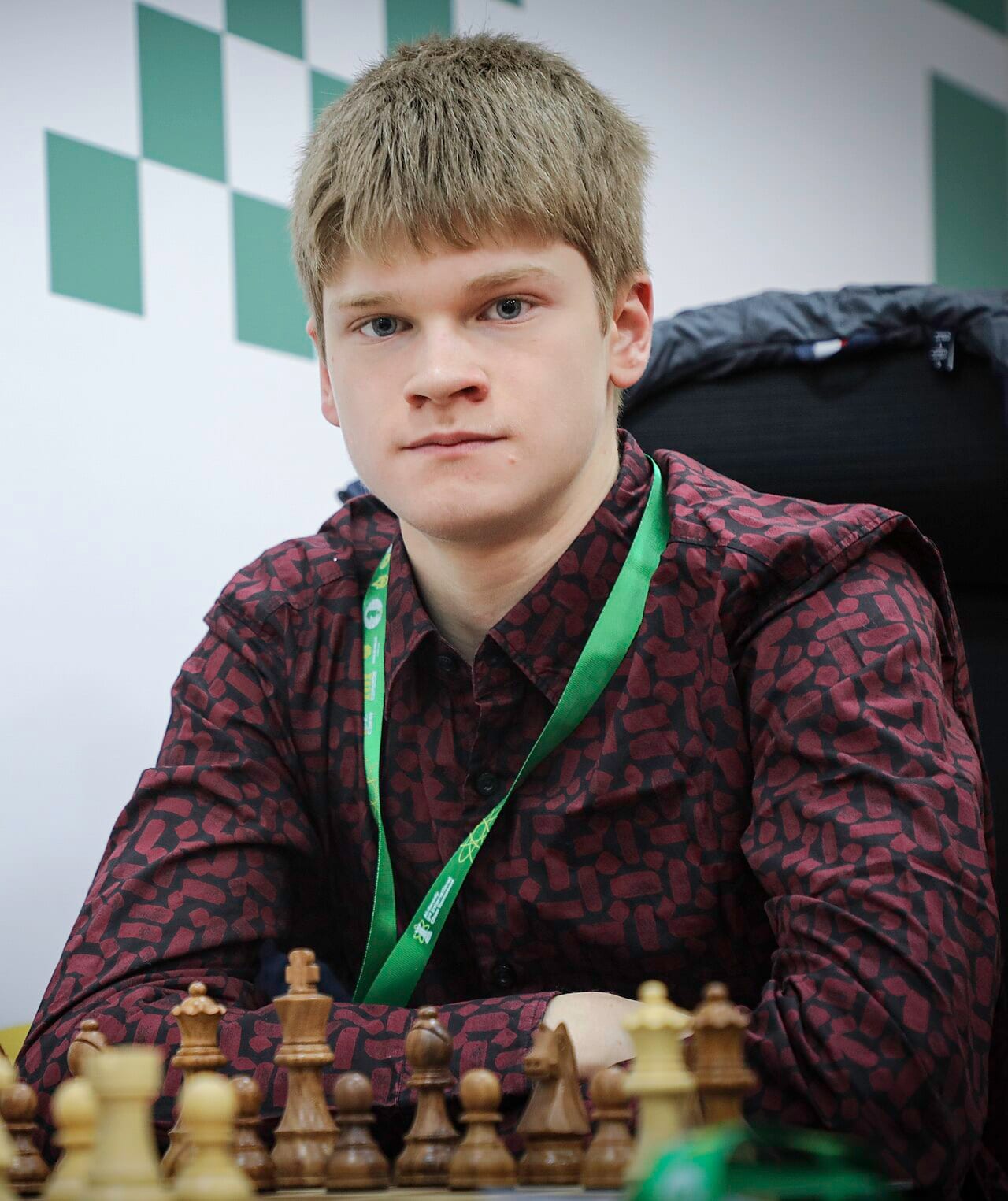
Photo: TheBoburshokh / Wikimedia Commons (CC0)
Black is in check from the white knight on d7, and there is only one legal move: the king goes to f7. Then White plays Bg6, and it is checkmate. Erigaisi resigned here.
 8
8


 6
6 5
5


 1ae
1ae g
gFinal position, after 30.Nd7+, with Black to move. Black's only legal move is 30...Kf7, and then 31.Bg6 is checkmate.
Here is the surprising part. In this position, White has less material than Black. White was behind in material for most of the attack. What White had instead were active pieces: pieces pointing at the enemy king.
Volodar Murzin 1-0 Arjun Erigaisi Tata Steel India Rapid 2026, Kolkata · Round 9 · Rapid, 15 minutes plus 10 seconds a move White: Volodar Murzin (2603) · Black: Arjun Erigaisi (2746)
Pieces out, and aimed
The game began with 1.d4 and 3.Bg5, a Torre Attack.
1.d4 Nf6 2.Nf3 g6 3.Bg5 Bg7 4.Nbd2 O-O 5.e4 d5 6.exd5 Qxd5 7.Bc4 Qd6 8.O-O a6 9.c3 b5 10.Bd3 Bb7 11.a4 b4 12.Nc4 Qd5 13.Re1 Nc6 14.Qe2 Rfe8 15.Nce5
White's pieces all came toward the centre and the kingside: knights on e5 and f3, bishops on g5 and d3, a rook on the e-file and the queen on e2. Our own Stockfish 17.1 run, at depth 20, gave White more than a pawn by now.
Black grabs, White attacks
15...bxc3
8641aegPosition after 15...bxc3, with White to move. Black has taken a pawn, but the black queen on d5 is standing where a white bishop can attack it.
Black took a pawn. Our engine still rated White a little over a pawn better after this move, and preferred 15...Qe6, moving the queen to safety first. The bigger jump came on the next move, when 16.Bc4 took White to about two and a half pawns.
16.Bc4
The bishop attacks the black queen. And once the queen moves away, the same diagonal leads straight to f7, the pawn next to the black king.
16...Nxd4 17.Qf1 Nxf3+ 18.gxf3 Qc5
Black won another pawn on d4 and traded a knight on f3, while White's bishops and knight stayed aimed at the black king.
The sacrifice on f7
19.Bxf7+
8641aefgPosition after 19.Bxf7+, with Black to move. The bishop takes the pawn next to the king with check. Black has two legal moves: Kh8 and Kf8.
The bishop took the f7 pawn with check. At the start of every game, f7 is protected only by the king, which makes it a favourite target. Now the black king had to move to the corner or to f8.
19...Kh8 20.b4 Qb6 21.a5 Qb5 22.Bc4 Qxb4 23.Qh3
White kept offering pawns to bring more pieces in. The white queen swung over to h3, facing the black king.
23...Nh5 24.Nf7+ Kg8 25.Qe6 h6 26.Ne5+ Kh8 27.Qxg6
8651aegPosition after 27.Qxg6, with Black to move. The white queen, knight and both bishops are all close to the black king.
The white queen took the g6 pawn. Now the queen, the knight and both bishops were all near the black king, while Black's queen on b4 and rook on a8 were far away on the queenside.
27...Bxf3
Black took another pawn. With 1 minute and 39 seconds left, it was the last mistake. The engine's choice was 27...Qxc4, and after 27...Bxf3 it rated White more than thirteen pawns better. Murzin had 101 seconds on his own clock, so both players were playing almost on instinct. After 28.Bd3 Kg8 our engine found a forced checkmate for White.
28.Bd3 Kg8 29.Qh7+ Kf8 30.Nd7+
And we are back at the top of the article. 30...Kf7 is forced, and 31.Bg6 is mate.
What this game teaches
1. Active pieces can be worth more than material. White was down material for most of the attack, but White's pieces were all aimed at the black king.
2. Grabbing pawns can cost time. 15...bxc3 and the captures after it won material, but gave White the moves needed to attack.
3. f7 (and f2) is a weak point. At the start it is guarded only by the king. 19.Bxf7+ used that.
4. Count attackers near the king. At the end White had four pieces near the black king and Black had almost no defenders. That is when attacks work.