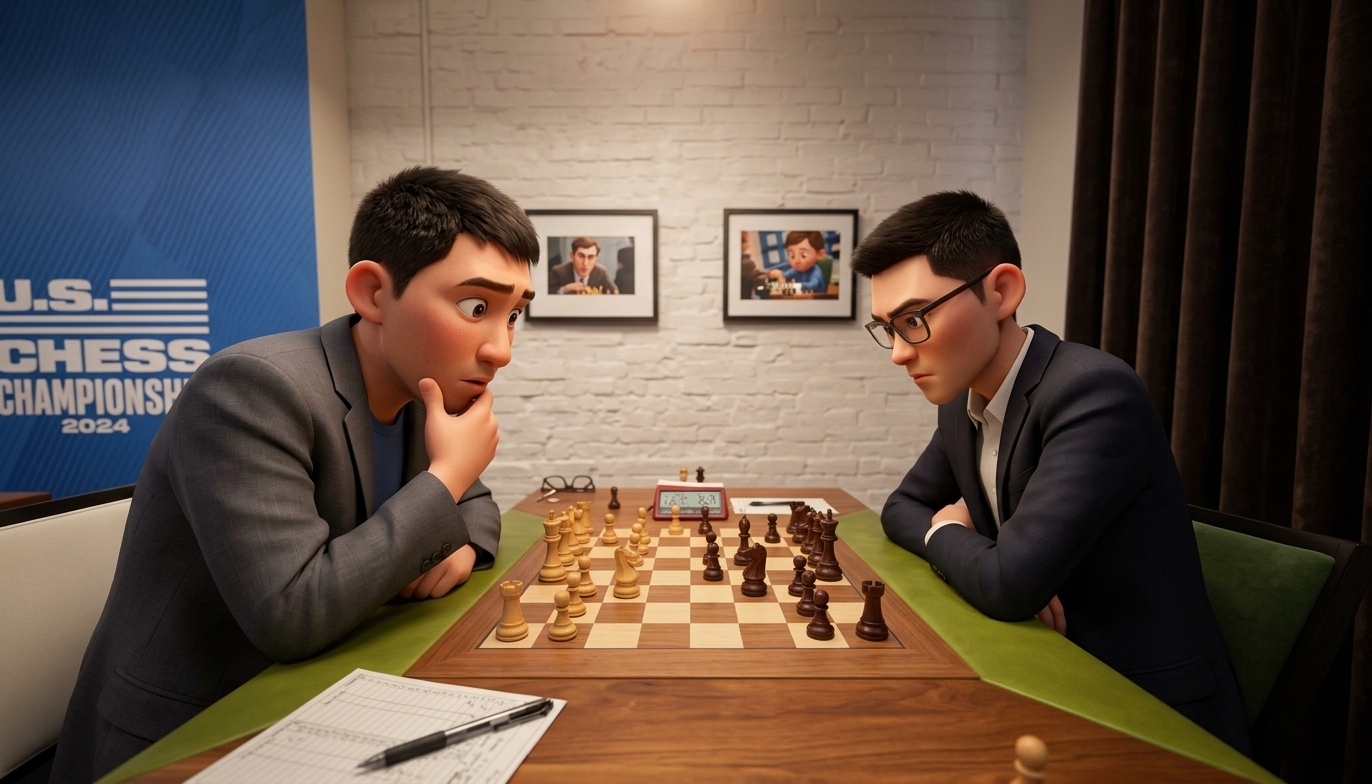
Illustration of Wesley So and Jeffery Xiong at the chessboard. This is not a real picture of the players. The board, the clock and the banner shown are not from this game.
Let us start with a puzzle from the game. It is White to move. One white knight move attacks both black rooks at the same time. Can you find it? The answer is at the end.


 5
5
 4
4

 1aef
1aef g
gWhite to move, after 21...Nxf4. One knight move attacks both black rooks. Find it.
Wesley So 1-0 Jeffery Xiong 2026 U.S. Chess Championship, Saint Louis · Round 2 · 10 October 2026 White: GM Wesley So · Black: GM Jeffery Xiong
Round 2 in Saint Louis
The U.S. Chess Championship is a round robin at the Saint Louis Chess Club: 12 players, each meeting every other player once over 11 rounds. Both players won in round 1. So beat Sam Shankland, and Xiong beat Sam Sevian.
After this game, Wesley So and Awonder Liang share first place with 2 points from 2 games. Fabiano Caruana is half a point behind them.
This was a long game with two different stories. On move 22, So's knight won a rook with a fork, a move that attacks two pieces at once. That fork is the main lesson of this article. But a fork does not end a game by itself. From move 19 to move 28, Xiong was the one pressing, and the game was decided later.
The Game: So v Xiong
The opening: a quiet start
1.e4 e5 2.Bc4 Nf6 3.d3 c6 4.Nf3 d5 5.Bb3 a5 6.a4 Bb4+ 7.c3 Bd6 8.exd5 cxd5
So chose the Bishop's Opening, with the bishop coming out to c4 on move 2. Black built a pawn pair in the centre, on d5 and e5.
9.Bg5 Be6 10.Na3 Nbd7 11.Nb5 Bb8 12.O-O O-O 13.d4 e4 14.Nd2 h6 15.Bh4 Bf4 16.Re1 Re8 17.c4 Bg4 18.Qc2 Rc8 19.Bg3 Nh5
On move 13, Black's e-pawn jumped to e4 and pushed the white knight back to d2. White's 17.c4 attacked Black's pawn on d5. After 19.Bg3, our Stockfish 17.1 check at depth 20 rated Black slightly better, by close to one pawn.
Move 22: a fork, and an attack instead
20.Nf1 Be6 21.Bxf4 Nxf4 22.Nd6
This is the puzzle from the start of the article. The white knight jumped to d6. From there it attacked both black rooks, on c8 and e8, at the same time. No black piece could take the knight on d6, so one rook was going to be lost.
22...Bh3 23.g3 Ne6 24.Qc3 Qf6 25.Nxe8 Rxe8
One rook was going to fall, so Xiong did not spend a move on the rooks. Our engine's first choice was 22...Qg5, lining the queen up with the knight on f4 against the pawn on g2. Xiong chose a different attacking move. The bishop went to h3, close to the white king, and the knight and queen came to e6 and f6. White took the rook on e8, and Black took back. So had won a rook for a knight. Winning a rook for a bishop or a knight is called winning the exchange.
541aefgPosition after 25...Rxe8, with White to move. White has an extra exchange, but Black's bishop on h3, queen on f6 and knights are aimed at the white king.
Here is the surprise. Even with a rook against a knight, White was not better. Our engine still rated Black slightly better. Black's pieces were all pointing at the white king, and the pawn on e4 took the d3 and f3 squares away from White's pieces.
Moves 26 to 30: Black takes the rook back
26.Rad1 Ng5 27.Nd2 Bg4 28.Qe3 Nc5
On move 28, our engine gave Black an edge of about one pawn. Its choices were 28...Qf5 or 28...Nh3+, keeping the pressure on. After 28...Nc5 that edge was gone, and the position was level.
29.Bc2 Bxd1 30.Rxd1
Black's bishop took the white rook on d1, and White took back. Material was now level again: Black had won back the exchange.
30...Nce6
54dgPosition after 30...Nce6, with White to move. White can take on d5, and then the white pawn will attack the knight on e6.
This move turned the game. Look at the black knight on e6 and the white pawn on c4. After 31.cxd5, a white pawn lands on d5 and attacks the knight. Our engine had White about one pawn better after this move. Its choices for Black were 30...Na6 or 30...Nd7, where the knight is not in a pawn's path.
Moves 31 to 37: White wins a pawn and trades queens
31.cxd5 Nxd4 32.Nxe4 Ngf3+
White took on d5 and then on e4, and was a pawn ahead. Our engine liked 32...Nxe4 for Black. The check with the other knight let White's advantage grow to about two pawns.
33.Kg2 Qe5 34.Bb1 f5 35.Nd2 Qxe3 36.fxe3 Nxd2 37.Rxd2
The queens came off the board. After 36.fxe3, both black knights were under attack. The white pawn on e3 hit the knight on d4, and the knight on d2 and the king on g2 both hit the knight on f3. The two black knights were only guarding each other. Xiong traded one of them with 36...Nxd2, and after 37.Rxd2 the other one had to move away.
White still had one extra pawn, and a passed pawn on d5, a pawn with no enemy pawn in front of it on its own file or on the files next to it.
The finish
37...Nb3 38.Rc2 b6 39.Rc7 Nc5 40.Bxf5 Rxe3
The white rook reached c7, on Black's second row. The bishop took the pawn on f5, so White was two pawns ahead. Black's rook then took the pawn on e3.
41.Bg6 Kf8
54Final position, after 41...Kf8, with White to move. The bishop on g6 guards e8, and the rook on c7 is ready to check.
The white bishop on g6 now guarded the e8 square, and White had a threat: 42.Rc8+ Ke7 43.Re8+. The king cannot take the rook on e8, because the bishop guards it, and after the king moves, 44.Rxe3 wins the black rook. The game ended there, 1-0.
So said afterwards that he was "just trying to survive the entire game," and that the win came after Xiong got low on time and made a mistake.
What to Learn
1. Look for forks. On move 22, the two black rooks stood a knight's jump apart from d6. When two enemy pieces are on squares your knight can hit from one spot, check whether that spot is safe.
2. An attack can be worth more than the exchange. The fork cost Black a rook for a knight on move 25, and our engine still rated Black better. Pieces that point at the king can be worth more than a pawn or two on the scoreboard.
3. Check every square where your pieces land. After 30...Nce6, the knight stood where a white pawn could attack it with 31.cxd5. Before you move a piece, look for enemy pawns that can reach it.
4. Pieces that only guard each other are easy targets. After 36.fxe3, each black knight was guarding the other, and White attacked both. Black had to trade one away and move the other.
Puzzle answer: 22.Nd6. The knight attacks the rooks on c8 and e8 at the same time, and no black piece can take it. Black can save only one rook.
Related Stories
tournaments • 2026-10-10
One Square Away: Megan Paragua Beats Carissa Yip in Round 2
tournaments • 2026-10-09
Eight Squares for One Queen: Rachael Li Beats Irina Krush on Her Debut
tournaments • 2026-10-09
A Queen Far From Home: Awonder Liang Beats Hans Niemann in Round 1
legends • 2026-10-05