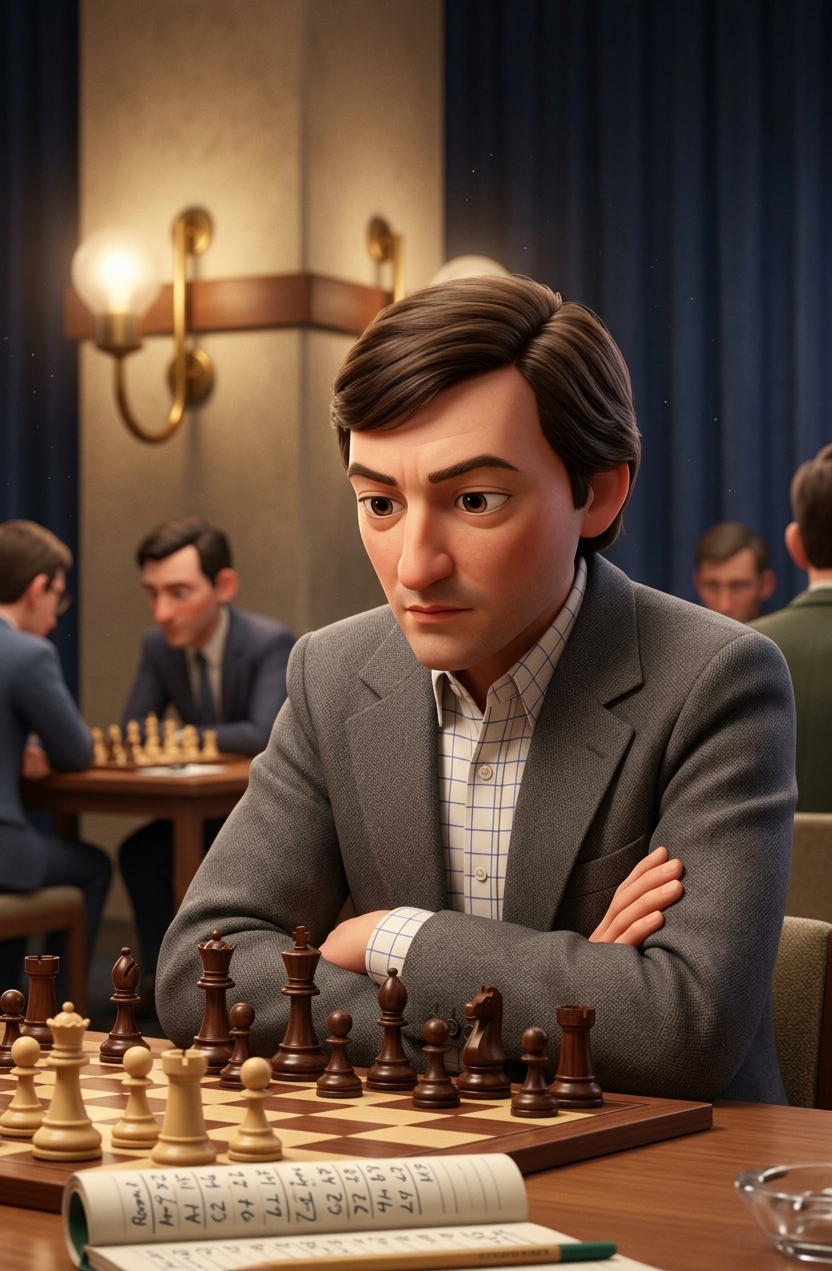
Illustration of Anatoly Karpov at the chessboard. This is not a real picture of him, and the board shown is not a position from a real game.
Let us start with a puzzle. It is White's move in the position below. Nothing is attacked, and there is no capture to make. White wants a quiet move that makes Black's position worse for the rest of the game. Look at the empty square a7, right in front of Black's rook. You will meet this position in the game below.
 8
8


 2
2 be
be g
gWhite to move. White's bishop is on e3, a rook is on a2, and Black's rook is on a8. Can you find a quiet bishop move that ties Black up?
The player with White was Anatoly Karpov. The player with Black was Wolfgang Unzicker. They met at the Chess Olympiad in Nice, France, in 1974.
A Boy from the Ural Mountains
Anatoly Karpov was born on 23 May 1951 in Zlatoust, a town in the Ural Mountains of the Soviet Union. He learned to play chess when he was four, and by 11 he was a candidate master. At 12 he was accepted into the chess school run by Mikhail Botvinnik, a former world champion.
Climbing to the Top
- In 1969 he won the World Junior Championship, scoring 10 points out of 11 in the final without losing a game.
- In 1970 he became a grandmaster.
- In 1975 he became the 12th world champion. Bobby Fischer, the champion, did not play the title match, and Karpov was given the title.
- He defended the title twice against Viktor Korchnoi, in 1978 and 1981.
- In 1985 he lost the title to Garry Kasparov, and they played three more title matches after that.
- In 1993 he won the FIDE world title again, and he held it until 1999.
The Game: Anatoly Karpov vs. Wolfgang Unzicker, Nice 1974
Anatoly Karpov 1-0 Wolfgang Unzicker Chess Olympiad · Nice 1974 White: Anatoly Karpov · Black: Wolfgang Unzicker
A closed center
The game began as a Ruy Lopez, also called the Spanish Game, one of the oldest openings. On move 13 White pushed his pawn to d5 and the center locked.
1.e4 e5 2.Nf3 Nc6 3.Bb5 a6 4.Ba4 Nf6 5.O-O Be7 6.Re1 b5 7.Bb3 d6 8.c3 O-O 9.h3 Na5 10.Bc2 c5 11.d4 Qc7 12.Nbd2 Nc6 13.d5 Nd8
8621acdegPosition after 13...Nd8, with White to move. The pawns on d5 and e4 for White, and d6 and e5 for Black, have locked the center. Black's knight has gone back to d8.
When the center is locked like this, the pieces cannot rush through the middle. The fight moves to the sides of the board. Karpov opened the a-file and pushed his b-pawn.
14.a4 Rb8 15.axb5 axb5 16.b4 Nb7 17.Nf1 Bd7 18.Be3 Ra8 19.Qd2 Rfc8 20.Bd3 g6 21.Ng3 Bf8 22.Ra2 c4 23.Bb1 Qd8
For the first 30 moves our own Stockfish 17.1 run, at depth 22, had White a little better, by less than one pawn. Nobody made a big mistake. Now comes the puzzle.
The bishop in the corner
24.Ba7
872begPosition after 24.Ba7, with Black to move. White's bishop sits on a7, right under Black's rook on a8. White's rook on a2 guards the bishop.
The answer to the puzzle is 24.Ba7, and it was our engine's first choice too. The bishop goes deep into Black's half of the board, to the square right below Black's rook.
Black's rook on a8 can take the bishop, but White's rook on a2 is guarding it. After 24...Rxa7 25.Rxa7, Black would have given a rook for a bishop, which is a bad trade. So the bishop stays. From a7 it watches b8 and b6, so Black's rook cannot use those squares, and the a-file belongs to White.
Nothing was captured. The bishop simply took squares away from Black for the rest of the game.
A second front
24...Ne8 25.Bc2 Nc7 26.Rea1 Qe7 27.Bb1 Be8 28.Ne2 Nd8 29.Nh2 Bg7 30.f4 f6 31.f5
8721abgPosition after 31.f5, with Black to move. White's pawn on f5 pushes into Black's half of the board on the kingside. White's bishop still sits on a7.
With Black tied down on the queenside, Karpov started a second plan on the other side. He pushed his f-pawn to f4 and then f5, which gained space next to Black's king. Black now had to defend on both sides of the board.
After 31...g5 our engine had White ahead by about two pawns. Its first choice for Black was 31...Nf7.
The squeeze
31...g5 32.Bc2 Bf7 33.Ng3 Nb7 34.Bd1 h6 35.Bh5 Qe8 36.Qd1 Nd8 37.Ra3 Kf8 38.R1a2 Kg8 39.Ng4 Kf8 40.Ne3 Kg8
Look at Black's moves from 37 to 40: Kf8, Kg8, Kf8, Kg8. Black's king walked back and forth because Black had nothing useful to do. Meanwhile Karpov moved his pieces to better squares one at a time. By move 35 our engine had White ahead by about three pawns, and no pawn had been captured since move 15.
41.Bxf7+ Nxf7 42.Qh5 Nd8 43.Qg6
8732gPosition after 43.Qg6, with Black to move. White's queen sits on g6, two squares from Black's king on g8. White's knights on e3 and g3 are ready to join, and the bishop is still on a7.
Karpov traded his bishop for Black's bishop on f7 and then brought his queen all the way to g6, two squares from Black's king. Our engine had White ahead by almost four pawns. Records of the game differ on the last moves, but all of them agree that Karpov won.
What to Learn from This Game
- Quiet moves can be the strongest moves. 24.Ba7 captured nothing, but it took away squares from Black for the rest of the game.
- A guarded piece in the enemy camp is hard to remove. Taking the bishop on a7 would have cost Black a rook for a bishop.
- When the center is locked, play on the sides. Karpov played on the queenside first and then on the kingside.
- Make your opponent defend in two places. Black could not hold the queenside and the kingside at the same time.
A Position to Try
872begThe position after 24.Ba7 again, with Black to move. Black can take the bishop with 24...Rxa7. Count what each side has after 25.Rxa7. Is it a good trade for Black?
After 24...Rxa7 25.Rxa7, Black has given a rook, worth about five pawns, for a bishop, worth about three. That is why Unzicker left the bishop alone and played 24...Ne8 instead.
A Champion Who Made Small Gains
Anatoly Karpov became world champion at 23 and played for the title in two different decades. In this game he won no material for 40 moves. He put one bishop on one square, made his pieces a little better every move, and waited until Black had nothing left to do.
Related Stories
legends • 2026-10-05
Black's King Takes a Long Walk: Wei Yi's Famous Attack at 16
legends • 2026-10-04
Three in a Row on the c-File: Alexander Alekhine and the Gun
legends • 2026-10-04
Nineteen Seconds on the Clock: Divya Deshmukh Wins the World Cup
legends • 2026-10-03