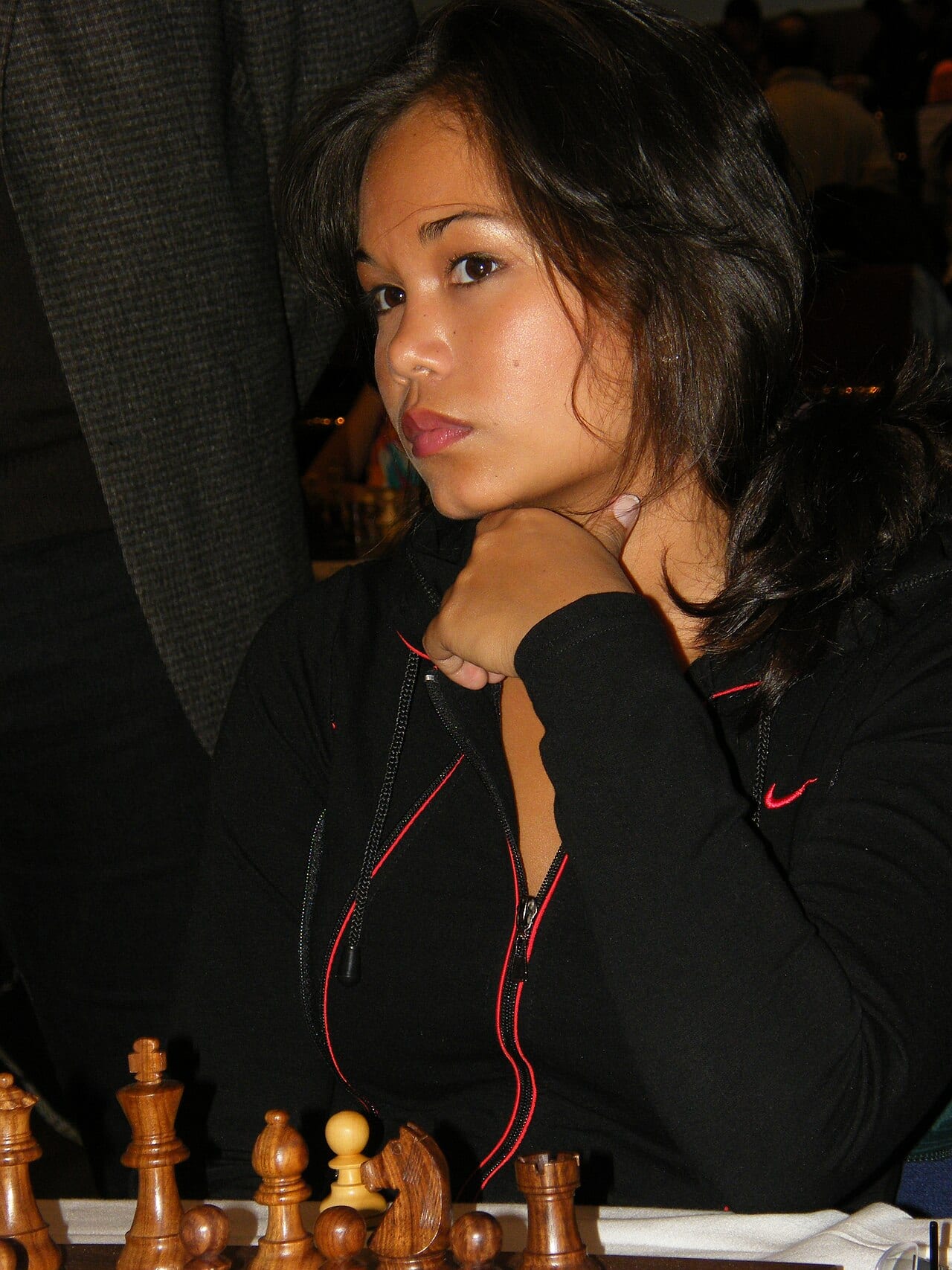
Photo: Frank Hoppe / Wikimedia Commons (Public domain)
In February 2000, at an open tournament in Málaga, Spain, a 13-year-old girl sat down with the white pieces against the Russian grandmaster Vladimir Epishin, who had been one of Anatoly Karpov's helpers. Late in the game she was worse. Then one quiet queen move set a trap, and a knight jump won the game.
Her name was Arianne Caoili. Here is her story, that game, and five more of her early games you can study.
From Manila to the World
Arianne Caoili was born on December 22, 1986, in Manila, the Philippines. Her family moved to Australia in 1989, and she began playing chess at six.
She traveled widely as a girl. She played in the World Youth Championships, the world championships for children, in 1996, 1998 and 2001. In 1998, at 11, she played for the Philippines at the Women's Chess Olympiad, a team event where countries play each other, and she played again in 2000.
- In December 2000 she won the Asian Girls Under-16 Championship in Bagac, in the Philippines.
- In 2001 she earned the titles of Woman FIDE Master and Woman International Master.
- In October 2002 she reached her highest rating, 2309.
The Game: Arianne Caoili vs. Vladimir Epishin, Málaga 2000
Arianne Caoili 1-0 Vladimir Epishin Málaga Open, Spain · Round 4 · February 28, 2000 White: Arianne Caoili, age 13 · Black: Vladimir Epishin
1.d4 Nf6 2.Nf3 b6 3.c4 e6 4.g3 Ba6 5.b3 Bb7 6.Bg2 Bb4+ 7.Bd2 a5 8.O-O O-O 9.a3 Be7 10.Nc3 d5 11.cxd5 exd5 12.Qc2 Re8 13.Rfc1 Na6 14.Bf4 Qd7 15.Na4 Bd6 16.Bxd6 Qxd6
A calm opening. For the first 30 moves our Stockfish 16 check rates the game close to level.
17.e3 h6 18.Nb2 c5 19.Nh4 Rac8 20.Nc4 Qe6 21.Qf5 cxd4 22.exd4 Qc6 23.Rc2 b5 24.Ne3 Qd6 25.Rxc8 Bxc8 26.Qd3 Nc7
27.Nhf5 Qb6 28.Rc1 b4 29.a4 g6 30.Nh4 Kg7 31.Nf3 Ba6 32.Qc2 Ne6 33.Qd1 Bb7 34.Bh3 Ne4 35.Bxe6 Rxe6 36.Ne5 Nc3
Now Epishin's pieces are more active. His knight has jumped into c3, where it attacks the white queen, and our engine rates Black clearly better, by about two pawns.


 5
5
 4
4
 c
c d
d g
gAfter 36...Nc3, White to move. The black knight on c3 attacks the queen on d1. Black is better. White's queen has to move, but where?
The Trap
37.Qg4
The queen moves to g4. It looks like it just runs away. But look at what it does now: the queen joins White's knights on e3 and e5 near the black king on g7. The d4 pawn is left unprotected.
54cgAfter 37.Qg4, Black to move. The pawn on d4 looks free. Our engine says Black should play 37...Bc8 instead, and stay well ahead. What is wrong with taking the pawn?
37...Qxd4
Epishin takes the pawn.
38.Nf5+
54cgFinal position after 38.Nf5+, Black to move. The knight on f5 checks the king on g7 and attacks the queen on d4 at the same time. Black must move the king, and then White takes the queen.
This is a fork: one piece attacking two things at once. The knight jumps to f5, gives check to the king on g7, and at the same time attacks the black queen on d4. Black has to answer the check with a king move, and then the knight takes the queen. The official game score ends here with White's win.
Our engine went from rating Black clearly better to rating White more than five pawns ahead in a single move. Caoili had kept her position together for 37 moves, and one mistake by her opponent was enough.
Five More Caoili Games to Study
These five games are from 1998 to 2001, when she was 11 to 14. Set each one up on a board, or play through it on your computer, and look for the idea in the note. The engine numbers come from our own Stockfish 16, searching to depth 16 or 18.
- Arianne Caoili vs. Tatiana Kosintseva, World Under-12 Girls Championship, Oropesa del Mar, 1998 (1-0). Kosintseva later became a grandmaster. Our engine rates Caoili better from about move 22, and she keeps the advantage all the way to the end. In the final position she has a queen and a rook against a rook and a knight.
- Arianne Caoili vs. Tana Holusova, youth event, Paris, 1998 (1-0). A short attack. In the final position, White's queen on h5 and bishop on g6 are aimed at h7, and Qxh7 would be checkmate. Black resigned.
- Monika Tsiganova vs. Arianne Caoili, Women's Olympiad, Istanbul, November 7, 2000 (0-1). Played for the Philippines, at 13. Our engine rates White better early on, but after the queens come off, Caoili's rook and pawns outlast White's bishop in a long endgame. Our engine rates Black clearly better in the final position.
- Arianne Caoili vs. Enkhbaatar Enkhjargal, Asian Girls Under-16 Championship, Bagac, December 11, 2000 (1-0). From the championship she won. Our engine rates White better from about move 8. Between moves 26 and 31 the same position came up three times, so a draw could have been claimed. Caoili played on with 32.g4 and won.
- Arianne Caoili vs. Kateryna Areshchenko, World Youth Championship, Oropesa del Mar, October 25, 2001 (1-0). After 8...b6, which our engine rates as a mistake, 10.Nxf6+ takes a pawn with check. Black answers with 10...Ke7, and the king can no longer castle. White's queen, knights and bishop then chase it, and the game is over in 25 moves.
87 21afg
21afgCaoili vs. Holusova, Paris 1998, final position, White to move. The queen on h5 and the bishop on g6 both aim at h7. Qxh7 is checkmate.
Champion, Singer, Adviser
In 2004 Caoili switched federations to play for Australia, and she played for Australia at five Women's Olympiads. In 2009 she won the London Chess Classic women's tournament with 8 points out of 9, and won the Oceania women's championship.
Chess was only part of her life. She was a runner-up on the Australian television show Dancing with the Stars, worked as a consultant, studied for a doctorate in Germany, released a music EP in 2018, and advised an Armenian prime minister. In 2017 she married the grandmaster Levon Aronian, whom she had first met at the 1996 World Youth Championships. She died in 2020, at 33, after a car accident in Armenia.
What Arianne Caoili Can Teach You
- Keep fighting when you are worse. Against Epishin, she was behind for several moves and still won.
- Look for forks before every move. A knight near the enemy king often has a check that also hits something else.
- A free pawn is not always free. Epishin took one and lost his queen.
- When you are better, do not settle for a draw. Against Enkhjargal, she found a new plan instead of repeating moves.
- A king that cannot castle is a target, as against Areshchenko.
- Chess can sit beside other interests. She also danced, sang and studied.
A Habit to Practice
Set up the position after 37.Qg4 as Black. Look for every white check before you decide on a move. Once you have found 38.Nf5+, try the same habit in your own games: before you take a pawn, list your opponent's checks.
Related Stories
legends • 2026-10-13
The $64,000 Prize Nobody Has Ever Won
legends • 2026-10-05
The Bishop in the Corner: How Anatoly Karpov Squeezed a Grandmaster
legends • 2026-10-05
Black's King Takes a Long Walk: Wei Yi's Famous Attack at 16
legends • 2026-10-04