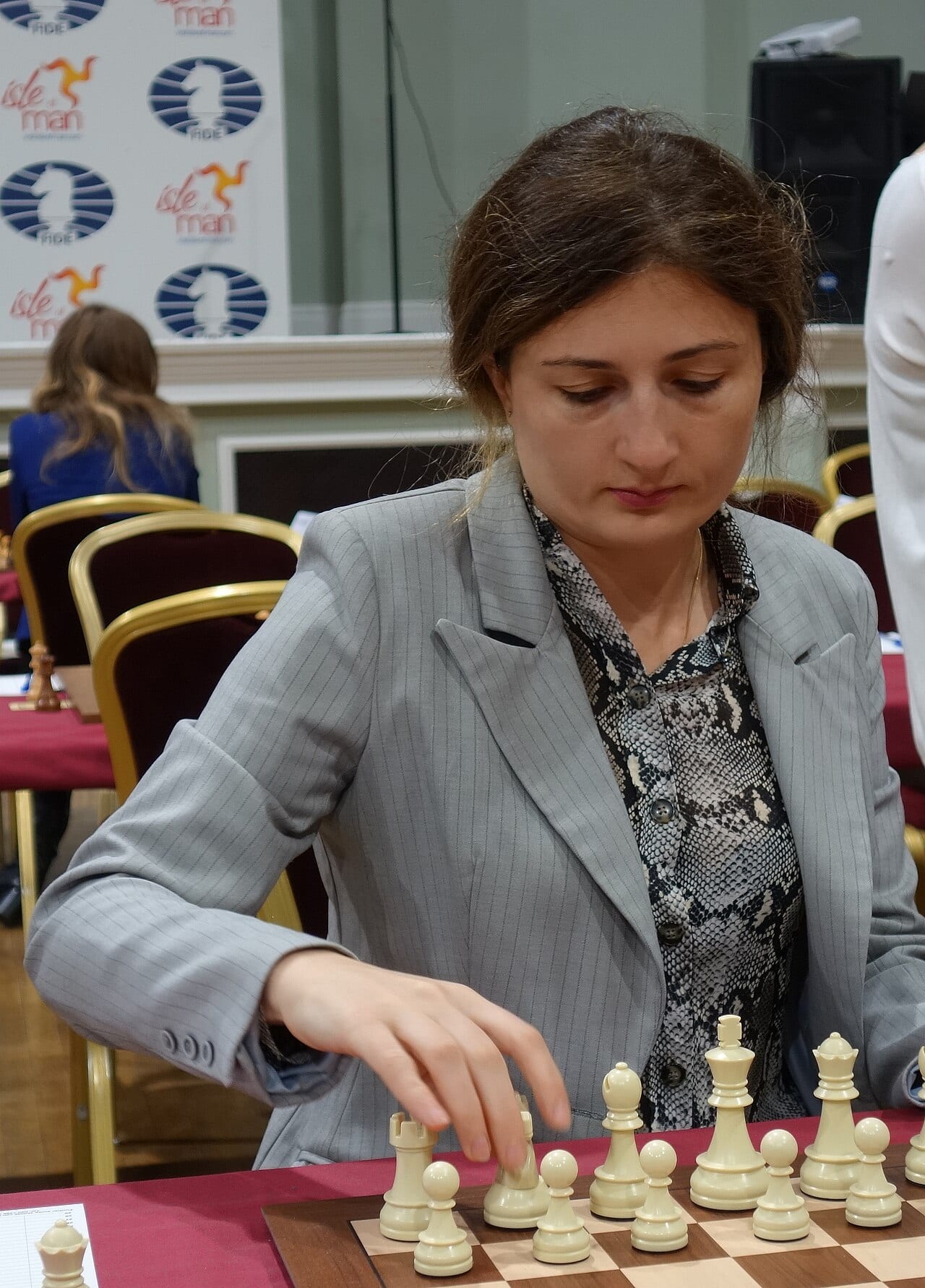
Photo: Stefan64 / Wikimedia Commons (CC BY-SA 3.0)
Look at the white knight on c4 and the black rook on c8. If the knight could jump to b6, it would attack the rook and the square d5 at the same time. Right now the black bishop is sitting on d5, guarded by the king.


 5
5
 4
4


Position after 38...g4, with White to move. The rook on d4 can take the bishop on d5. If the black king takes back, the knight jumps to b6 with check and attacks the rook on c8.
This was the last round of the European Women's Rapid Championship, and the game was about to be decided by a knight fork hiding behind a capture.
Nino Batsiashvili 1-0 Alexandra Kosteniuk European Women's Rapid Championship 2025, Monte Carlo · Round 11 (final round) · Rapid, 15 minutes plus 10 seconds a move White: Nino Batsiashvili (2396) · Black: Alexandra Kosteniuk (2436)
According to FIDE, Batsiashvili won the title.
The opening
The game began as a Nimzo-Indian Defence, where Black pins the knight on c3 early with the bishop.
1.d4 Nf6 2.c4 e6 3.Nc3 Bb4 4.Nf3 b6 5.e3 Bb7 6.Bd3 O-O 7.O-O c5 8.Re1 d5 9.cxd5 exd5 10.dxc5 bxc5
After the trades in the centre, Black had two pawns side by side on c5 and d5. Pawns like these are called hanging pawns. They control a lot of squares, but they can also become targets.
Black's pawns become targets
11.Bd2 Nbd7 12.Rc1 Ba5 13.Na4 Bxd2 14.Qxd2 Rc8 15.b4 Ne4 16.Qb2 c4 17.Bxe4 dxe4 18.Ne5 Nxe5 19.Qxe5 Re8 20.Qf4 a5 21.Red1 Qc7 22.Qxc7 Rxc7
542cdgPosition after 22...Rxc7, with White to move. The queens are gone. Black's pawns on c4 and e4 are far from home. No black pawn can protect c4, and only the f-pawn, from f5, could protect e4.
The hanging pawns had moved forward to c4 and e4. The pawn on c4 has no black pawn on the b-file or the d-file beside it, so no pawn can ever protect it. A pawn like that is called an isolated pawn. The pawn on e4 is not much safer: the only pawn that could ever guard it is the one on f7, and only after marching to f5. Far-advanced pawns that are hard to protect are easy targets in an endgame.
Our own Stockfish 16 run, at depth 18, rated White about two pawns better after the queen trade. It marked 21...Qc7, which offered that trade, as a clear inaccuracy.
23.b5
542cdgPosition after 23...Bc8, with White to move. White's b-pawn is passed: no black pawn on the a, b or c files can stop it.
Now White also had a passed pawn on b5, a pawn with no enemy pawns in front of it or on the files next to it.
A lead slips away
White kept the advantage for a long time. After 36...Ke6 our engine rated White about three pawns better. Then, with a little over three minutes on her clock, White took a pawn.
37.Nxc4
The engine's evaluation dropped from about three pawns to about a third of a pawn. In a rapid game, with ten seconds added per move, these swings happen. The knight now stood on c4, and that would matter in two moves.
37...Rc8 38.Kb3
54Position after 38.Kb3, with Black to move. White is threatening Rxd5, and if Kxd5, then Nb6+ forks the king and the rook on c8.
Here White had a threat. Can you spot it? The rook takes the bishop on d5. If the king takes back, the knight jumps to b6 with check and also attacks the rook on c8. That is a fork, one piece attacking two at once.
Our engine's first choice for Black was 38...Rc7, moving the rook off c8, so the fork would no longer hit anything. That kept the game level.
The move that lost
38...g4
Kosteniuk had 46 seconds left. The pawn move did nothing about the threat.
39.Rxd5
54A line that was not played: 39...Kxd5 40.Nb6+. The knight gives check and attacks the rook on c8, so Black loses the rook next move.
White took the bishop. Taking back with 39...Kxd5 runs straight into 40.Nb6+, and the rook on c8 is lost. So Black was simply a piece down, and Kosteniuk resigned.
What this game teaches
1. Advanced pawns can turn into weak pawns. Black's pawns on c4 and e4 looked active, but they were hard to protect, and they became targets in the endgame.
2. Before trading queens, check the endgame you get. 21...Qc7 offered the trade, and our engine liked White's endgame by about two pawns.
3. Look for forks hiding behind captures. Rxd5 and Kxd5 are just a trade, until you see that the king on d5 and the rook on c8 are both a knight's jump from b6.
4. When your opponent has a threat, deal with it first. 38...Rc7 would have taken the rook off the fork square. 38...g4 ignored the threat.
5. Advantages come and go in rapid chess. White's lead fell from about three pawns to almost nothing on move 37, and came straight back two moves later. Keep looking for chances until the game is over.
Related Stories
Story • 2026-10-16
Alice Lee at 17: Defend First, Then Win
tournaments • 2026-10-16
The King That Went the Wrong Way: So Beats Robson to Lead the U.S. Championship
Story • 2026-10-15
The Pawn That Waited 44 Moves: Megan Paragua at 13
tournaments • 2026-10-13