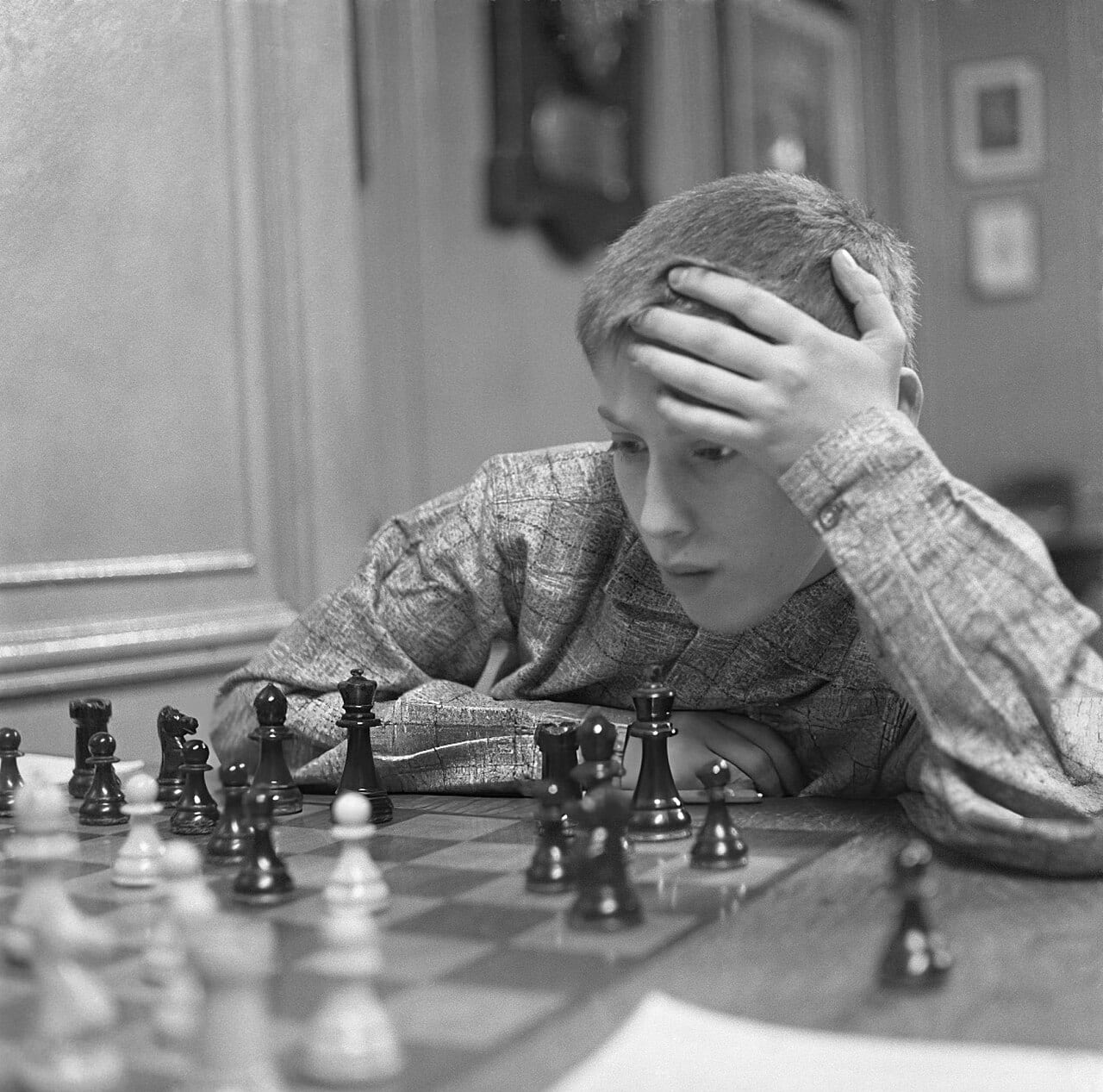
Photo: United Press / Wikimedia Commons (Public domain)
In March 1949, a six-year-old boy and his older sister opened a chess set their family had bought at a candy store. There was no teacher, just the instructions in the box. The two of them learned the moves together. Before long his sister Joan lost interest, and their mother was too busy to play. So the boy kept going by himself. He played many of his first games against himself, making a move for White and then a move for Black.
That boy was Bobby Fischer. Twenty-three years later he became world champion. Here is his story, the game that made him famous at 13, and five more of his early games you can study.
A Boy Looking for Opponents
In 1950 the family moved to Brooklyn, in New York. Bobby was so wrapped up in chess that his mother, Regina, worried he spent too much time alone. In November 1950 she sent a postcard to a Brooklyn newspaper, asking to place an ad to find other children his age who played chess.
The paper did not run the ad. It passed her card to Hermann Helms, a well-known chess writer, who told her about a simultaneous exhibition coming up. In a simultaneous exhibition, or "simul", one strong player walks from board to board and plays many people at once. On January 17, 1951, seven-year-old Bobby sat down in that simul against Max Pavey, a former champion of Scotland. He lost, but he held on long enough to draw a crowd.
Finding a Teacher
One person watching was Carmine Nigro, the president of the Brooklyn Chess Club. Nigro was impressed, brought Bobby to the club and started teaching him. Years later Fischer wrote about him in his 1959 book, Bobby Fischer's Games of Chess: "Mr. Nigro was possibly not the best player in the world, but he was a very good teacher. Meeting him was probably a decisive factor in my going ahead with chess."
In 1955, at 12, Bobby joined the Manhattan Chess Club. In 1956 he began visiting the home of John "Jack" Collins, a chess master who taught children. Collins later said he did not really teach Fischer, so "mentor" may be the better word. Bobby played thousands of fast games there against strong players and read the books in Collins's big chess library.
The Year Everything Changed
In May 1956, the United States Chess Federation's rating list put Fischer at 1726. That is the rating of a good club player, not a star. Then came an amazing year.
- In July 1956 he won the US Junior Championship in Philadelphia, at 13. He is still the youngest player ever to win it.
- In October 1956 he was invited to the Rosenwald tournament in New York, for the 12 players considered the best in the country. He finished in the lower half, but one of his games won the brilliancy prize, a prize for the most beautiful game of the event.
- In May 1957 the federation ranked him a Master, the youngest player to reach that level up to that time.
- In the US Championship of 1957-58, two months before his 15th birthday, he took first place with eight wins and five draws. That made him the youngest US champion ever, and it also made him an International Master.
- Later in 1958 he became a grandmaster, chess's highest title, at 15 years, 6 months and 1 day. No one had ever done it younger.
In 1972 he beat Boris Spassky in Reykjavík, Iceland, to become world champion.
The game that first made people outside New York notice him is below.
The Game: Donald Byrne vs. Bobby Fischer, New York 1956
Donald Byrne 0-1 Bobby Fischer Rosenwald Trophy tournament, Marshall Chess Club, New York · October 17, 1956 White: Donald Byrne · Black: Bobby Fischer, age 13
Donald Byrne was one of the leading American masters. In the magazine Chess Review, the master Hans Kmoch called this "The Game of the Century", and the name stuck.
1.Nf3 Nf6 2.c4 g6 3.Nc3 Bg7 4.d4 O-O 5.Bf4 d5 6.Qb3 dxc4 7.Qxc4 c6 8.e4 Nbd7 9.Rd1 Nb6 10.Qc5 Bg4 11.Bg5
Fischer has castled and his king is safe. Byrne has moved his queen three times and has not castled yet. Keep an eye on the white king on e1. It will matter later.
 8
8

 7
7


 2
2 d
d efh
efhAfter 11.Bg5, Black to move. The white king is still in the middle, on e1. Fischer's next move puts a knight where a pawn can take it.
11...Na4
A knight jump to the edge of the board, where the white knight on c3 can take it. It looks like a mistake. But if 12.Nxa4, then 12...Nxe4 takes the pawn in the middle, and from e4 the knight attacks both Byrne's queen on c5 and his bishop on g5. Our Stockfish 16 check rates 11...Na4 as Fischer's best move by a wide margin. It is the first sign that Fischer is looking at the white king, not at counting pieces.
12.Qa3 Nxc3 13.bxc3 Nxe4 14.Bxe7 Qb6 15.Bc4 Nxc3 16.Bc5 Rfe8+ 17.Kf1
Fischer is now a pawn ahead. He has also given check with his rook. Byrne had six ways to answer it, and he chose to step his king to f1. That means White can never castle in this game. Now look at Fischer's queen on b6. The white bishop on c5 attacks it.
8732dfhAfter 17.Kf1, Black to move. The white bishop on c5 attacks Fischer's queen on b6. Most players would move the queen. Fischer did something else.
17...Be6
This is the famous move. Fischer does not save his queen. He puts his bishop on e6, where it attacks the white bishop on c4. If it takes on c4, it will give check to the king on f1. Our engine agrees: 17...Be6 is Black's best move. Byrne took the queen.
18.Bxb6
Our engine thinks this made things worse for White. Declining with 18.Qxc3 kept White about two pawns behind. After 18.Bxb6, the engine rates White more than five pawns behind. How can taking a queen be a mistake? Watch what happens next.
8732dfhAfter 18.Bxb6, Black to move. Fischer has no queen. But look at the white king on f1 and the black bishop and knight close to it.
The Windmill
18...Bxc4+ 19.Kg1 Ne2+ 20.Kf1 Nxd4+ 21.Kg1 Ne2+ 22.Kf1 Nc3+ 23.Kg1 axb6
Chess players call this a windmill: a piece keeps giving check, and each time the king steps away, it grabs something else. Fischer's knight hops back and forth giving check. After 19...Ne2+ and 21...Ne2+, the white king had only one legal square, f1. Between the checks, the knight took the pawn on d4 and got back to c3. When the checks stopped, Fischer took the bishop on b6 with his pawn.
832dghAfter 23...axb6, White to move. Fischer gave up his queen and has taken back two bishops and a pawn. The knight on c3 attacks the rook on d1.
Count the material. Fischer gave up a queen, worth nine points. He has taken two bishops and a pawn, seven points. Add the pawn he had already won, and he is just one point behind. But his knight now attacks the rook on d1, and White's rook on h1 is stuck in the corner because the king blocks it. A few moves later Fischer won that rook too:
24.Qb4 Ra4 25.Qxb6 Nxd1 26.h3 Rxa2 27.Kh2 Nxf2 28.Re1 Rxe1 29.Qd8+ Bf8 30.Nxe1
Now Fischer has a rook, two bishops, a knight and five pawns. Byrne has a queen, a knight and two pawns. By the usual point count, that is 19 against 14.
The Queen Cannot Stop Three Pieces
The rest is a lesson in teamwork. A queen is the strongest piece, but alone it can only give checks. Fischer's rook, bishops and knight work together and hunt the white king.
30...Bd5 31.Nf3 Ne4 32.Qb8 b5 33.h4 h5 34.Ne5 Kg7 35.Kg1 Bc5+ 36.Kf1 Ng3+ 37.Ke1 Bb4+ 38.Kd1 Bb3+ 39.Kc1 Ne2+ 40.Kb1 Nc3+ 41.Kc1 Rc2#
cFinal position after 41...Rc2, checkmate. The rook gives check and covers b2 and d2. The knight on c3 covers b1 and d1. The bishop on b3 guards the rook, so the king cannot take it.
Checkmate, with a rook, two bishops and a knight all taking part. Look at how the checks drove the white king from g1 all the way across the board to c1.
Five More Fischer Games to Study
These five games come from the next 15 months, when Fischer went from a junior champion to US champion. Set each one up on a board, or play through it on your computer, and look for the idea in the note. The engine numbers come from our own Stockfish 16, searching to depth 20.
- C. Grossguth vs. Bobby Fischer, US Junior Championship, Philadelphia, 1956 (0-1). From the event that made Fischer, at 13, the youngest US Junior champion. White pushes his kingside pawns with 11.g4 and 12.g5. Fischer answers in the center: 12...d4 is a pawn fork, one pawn attacking two pieces at once, the knight on c3 and the bishop on e3. Our engine picks it as Black's best move. White takes the knight on f6, Fischer takes the bishop with 14...dxe3, and after the queens come off our engine rates Black about a pawn and a half ahead. Fischer went on to win the endgame.
- Sidney Bernstein vs. Bobby Fischer, Canadian Open, Montreal, 1956 (0-1). Bernstein, a strong master, gives up a rook for a pawn with 15.Rxh6 to open up Fischer's king. Our engine rates that as a mistake, but only if Black finds the right answer. Of Fischer's choices, 15...Bxh6, simply taking the rook, is the only one our engine likes. Fischer took it, blocked the check with 16...Bg7, and went on to win.
- Donald Byrne vs. Bobby Fischer, US Open, Cleveland, 1957 (0-1). A second win over Byrne, the year Fischer became the youngest US Open champion. For most of the game our engine gives White a small edge. Then 36.Rd1 lets Fischer's knight jump away with check. Look at the diagram below.
- Bobby Fischer vs. James Sherwin, US Championship, New York, 1957-58 (1-0). Fischer's rook grabs the pawn next to Black's king with 30.Rxf7, our engine's first choice. Sherwin counterattacks with 30...Rc1+, which our engine rates as a big mistake. The game ends with 36.Be6, and our engine finds a forced checkmate in five moves from there.
- Bobby Fischer vs. Arthur Bisguier, US Championship, New York, 1957-58 (1-0). Bisguier was the defending US champion. Before the event, according to Fischer's biographer Frank Brady, he predicted Fischer would "finish slightly over the center mark". Watch 37.Nxb6: the knight takes the pawn in front of Black's king, and after 37...Nxb6 38.Rxb6+ the rook takes back with check and the king is out in the open. The game ends with 41.Qxa3, taking Black's rook.
8dfhByrne vs. Fischer, Cleveland 1957, after 36.Rd1, Black to move. Look at the black queen on d5 and the white king on h1. Only the black knight on f3 stands between them. What happens if the knight moves with check?
The answer is 36...Nd4+. When the knight moves, the queen on d5 gives check along the diagonal to h1. That is a discovered check: the piece that moves is not the piece that gives check. Byrne blocked with 37.Rf3, and our engine already finds a forced checkmate for Black from there.
Why Fischer Still Matters
Fischer did not have a famous coach from the start. He had a candy-store chess set, a sister who learned the moves with him, a club president who spotted him in a simul, and thousands of games at the Collins house. What stands out is how much he played and studied, and how fast that turned a 1726-rated boy into the US champion in less than two years.
What Fischer Can Teach You
- Castle early. In the Game of the Century, Fischer's king was safe and Byrne's was not, and that is where the whole attack came from.
- Count what you get, not only what you give. Fischer gave a queen and got back a rook, two bishops and three pawns.
- Learn the windmill and the discovered check. Both come from a piece moving out of the way of another piece.
- When someone sacrifices against you, check whether you can simply take it. Against Bernstein, taking the rook was the best move.
- Pieces that work together beat one strong piece that works alone.
- Find people to play. Fischer's mother wrote to a newspaper, and that led him to his first teacher.
A Habit to Practice
Before every move in your next game, look at the two kings. Ask: which one is safer, and can any of my pieces move out of the way to give a check? That second question is how you find discovered checks and windmills.
Then play through the Game of the Century slowly. At move 17, cover the rest and try to guess Fischer's move before you look.
Related Stories
legends • 2026-10-13
The $64,000 Prize Nobody Has Ever Won
legends • 2026-10-05
The Bishop in the Corner: How Anatoly Karpov Squeezed a Grandmaster
legends • 2026-10-05
Black's King Takes a Long Walk: Wei Yi's Famous Attack at 16
legends • 2026-10-04