An 11-year-old sat down with the black pieces in Budva, Montenegro, on Friday, 23 October, and only a win would do. Bodhana Sivanandan beat WIM Viktoria Johansson of Sweden in 32 moves. With that win she completed the requirements for the International Master title, at 11 years, 7 months and 16 days.
No girl had ever done it so young. The old record belonged to Judit Polgar, the highest-rated woman in chess history, who qualified at 12 in 1988. It had stood for 38 years.
Afterwards, Bodhana was already thinking about the next step. "Hopefully I'm able to get grandmaster soon as well," she said.
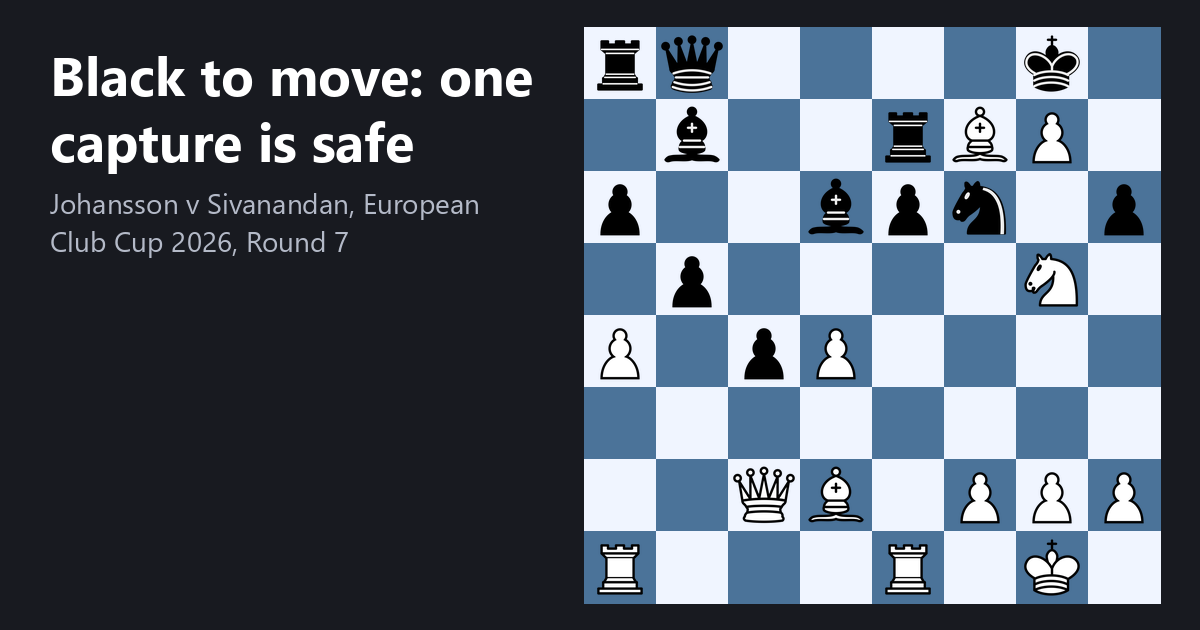
Try the puzzle above first. It comes from her record game, and the answer is further down.
What the International Master title is
FIDE, the International Chess Federation, gives titles for results in serious tournament games. International Master, or IM for short, is the second-highest title in chess, one step below Grandmaster.
The IM title is open to everyone, boys and girls, men and women. There are also titles only for women, such as Woman International Master (WIM). This record is for the open title, against the same bar as every other player.
To qualify, a player needs two things:
- Three IM norms. A norm is one tournament where you score well enough against strong, titled opponents.
- A rating of at least 2400. A rating is a number that goes up when you win and down when you lose.
FIDE still has to confirm the title formally, as it does for every new title. That is why we say she completed the requirements.
How she got here
Bodhana was born on 7 March 2015 in London and lives in Harrow, in north-west London. She found a chess set at home during the Covid lockdown, when she was five.
The records came quickly:
- At nine, she played for England at the 2024 Chess Olympiad in Budapest. She was the youngest person ever chosen to represent England in any sport.
- At ten, at the 2025 British Championships in Liverpool, she beat Grandmaster Peter Wells. That made her the youngest girl ever to beat a grandmaster in a classical game, which means a slow game with plenty of time to think.
- Later in 2025, at the European Club Cup, she beat former Women's World Champion Mariya Muzychuk.
- In August 2026, she became the youngest British Women's Champion ever, winning a playoff in Coventry.
Then came the three norms, all in about three months. The first was at the Dole Open in France in July, where she beat Grandmaster Marc'Andria Maurizzi, rated 2628. The second came at the Chess Olympiad in Samarkand in September, where she played on England's top board in every round. At the same Olympiad she also completed the requirements for the Woman Grandmaster title, the youngest player ever to do so.
The third norm was waiting in Budva.
Seven rounds in Budva
The 2026 European Club Cup for Women ran from 17 to 23 October. Bodhana played on top board for the English team She Plays To Win Lionesses A, so in every match she played the other team's board-one player. Each player had 90 minutes for the first 40 moves, then 30 more minutes, plus 30 seconds for every move.
- Round 1: lost in 77 moves to Aleksandra Goryachkina (2536), the top-rated player in the section
- Round 2: beat Sri Darshini T (2191)
- Round 3: beat Olga Badelka (2408) with Black
- Round 4: drew in 85 moves with Nino Batsiashvili (2459)
- Round 5: beat Ena Cvitan (2308)
- Round 6: beat Arina Budiak (1709)
- Round 7: beat Viktoria Johansson (2034) with Black
That is five wins, one draw and one loss: 5.5 points out of 7. Her rating climbed from 2382 to 2406, past the 2400 mark. Her team won the last match 4-0 and finished 11th of 22 teams, one place above where it started on the ranking list.
The Game: Johansson vs Sivanandan, Round 7
The game opened 1.d4 d5 2.c4 c6 3.Nf3 Nf6 4.Qc2 dxc4 5.e3 b5. This is the Slav Defence, where Black supports the d5 pawn with the c-pawn. White offered the c4 pawn, and Black took it, then held on to it with b5.
 8


 7

 2

 1ab
 c
 efh
After 5...b5. Black has taken a pawn and protects it with the b-pawn.
Both sides then got their pieces out and castled: 6.a4 a6 7.Be2 e6 8.O-O Be7 9.Nbd2 Bb7 10.b3 cxb3 11.Nxb3 Nbd7 12.Bd2 O-O 13.Rfc1 Qb8. Black was still a pawn up. Even so, our Stockfish 17.1 check at depth 18 rated the game as close, within about half a pawn either way, for the first 15 moves.
White went for the attack with 14.e4 c5 15.e5 c4 16.Nc5 Bxc5 17.exf6 Bd6 18.fxg7 Re8. A lot happened fast. Each side took a piece, and White won back the pawn. Now a white pawn stood on g7, right next to the black king. Our Stockfish check at depth 18 now gave Black an edge of more than a pawn.
Then White played 19.Ng5, with a dangerous threat.
8641acgAfter 19.Ng5, Black to move. White threatens Qxh7 checkmate. Can you see why?
Look at the white queen on c2. Her diagonal runs all the way to h7. If the queen takes on h7, the knight on g5 protects her, and the pawn on g7 covers f8 and h8. That would be checkmate.
Bodhana had the answer. She played 19...Nf6, and the knight now guards h7. The threat was gone, and our Stockfish check at depth 22 put Black about one and a half pawns ahead.
White kept trying: 20.Bh5 Re7 21.Re1 Bf4 22.Bb4 Bd6 23.Bd2 h6. The pawn on h6 attacked the knight on g5. Instead of retreating, White gave up a bishop with check: 24.Bxf7+. That is the puzzle position at the top of this article.
The puzzle: two captures, only one safe
Black is in check, and has exactly two legal moves. The king can take the pawn on g7, or the rook can take the bishop on f7. The king cannot take on f7, because the knight on g5 guards that square.
Bodhana chose 24...Rxf7. Why not 24...Kxg7? Because after 25.Qg6+ the king must go to h8 or f8. If it goes to h8, 26.Qxf6 is checkmate. If it goes to f8, 26.Qxh6 is checkmate. Our Stockfish check at depth 22 finds that mate in two, while 24...Rxf7 keeps Black about one and a half pawns ahead.
The game went on 25.Nxf7 Kxf7.
8641aegAfter 25...Kxf7. White has an extra rook and an extra pawn. Black has an extra bishop and knight. Count the points and they are level.
The finish: queen and bishop on one diagonal
White took a pawn, and Black took one back with check: 26.Bxh6 Bxh2+ 27.Kh1 Qd6 28.Qe2 Qd5.
8641aehAfter 28...Qd5. The queen and the bishop on b7 stand on the same long diagonal. Black threatens Qxg2 checkmate.
Look at the long diagonal from b7 to g2. The black queen sits in front, and the bishop on b7 backs her up. If the queen takes on g2, the bishop protects her, and the white king cannot take the bishop on h2 either. That would be checkmate. White blocked the diagonal with 29.f3. Our Stockfish check at depth 22 now gave Black more than four pawns.
The end came quickly: 29...Bg3 30.Kg1 Bxe1 31.Rxe1 Qxd4+ 32.Be3 Qd3. Black's bishop took a rook, the queen took a pawn with check, and then hit the white queen and bishop at the same time.
864egThe final position. White resigned. Black is a knight ahead, and the queen on d3 attacks the white queen and bishop.
White resigned. Bodhana did all of this in time trouble: after each of her last six moves she had less than a minute and a half on her clock, and only the 30 seconds added after every move kept her going.
What to Learn from This Game
- Look for your opponent's threat first. After 19.Ng5, White threatened checkmate on h7. Before you make your own plan, ask: what does my opponent want to do next? Bodhana found 19...Nf6, a calm move that stopped it.
- When you are in check, list every legal move. After 24.Bxf7+, Black had only two choices. One kept the edge, and the other lost to mate in two. When there are only a few moves, check each one.
- Line up your queen and bishop. On the long diagonal, the bishop behind the queen made Qxg2 a checkmate threat. Two pieces on one line are stronger than two pieces apart.
- A bad start does not end a tournament. Bodhana lost in Round 1, then scored 5.5 out of 6. The round after a loss matters more than the loss.
Puzzle answer
24...Rxf7. The rook takes the bishop. The other legal move, 24...Kxg7, loses to 25.Qg6+ and mate on the next move.
What comes next
Bodhana is now the seventh-youngest player ever, boy or girl, to qualify for the IM title. She is exactly one month older than Javokhir Sindarov was when he qualified in 2017. Gukesh Dommaraju was about two months older than her in 2018. Next month, those two play each other for the World Championship.
Her next tournament is the FIDE Swiss at the London Chess Classic. Her goal is the grandmaster title.
Her week in Budva began with a long fight against the top seed: read how Goryachkina beat her with a knight fork in Round 1.
Related Stories
tournaments • 2026-10-26
Clutch Chess: Where a Win on Thursday Counts Triple
tournaments • 2026-10-22
Two Pieces Attacked at Once: Wesley So Beats Caruana in the Playoff and Wins His Fourth U.S. Title
tournaments • 2026-10-21
A Long King Walk and a Missed En Passant: Harikrishna Beats Yu Yangyi in 103 Moves
tournaments • 2026-10-21