Rachael Li is the 2026 U.S. Women's Champion. On Wednesday in Saint Louis, she drew Anna Zatonskih in the last round and finished with 8.5 points out of 11. Alice Lee won her own last game and finished on 8, just half a point behind.
Li is 16 years old, and this was her first U.S. Women's Championship. She won it outright, so there is no playoff on Thursday. First place is worth $35,000.
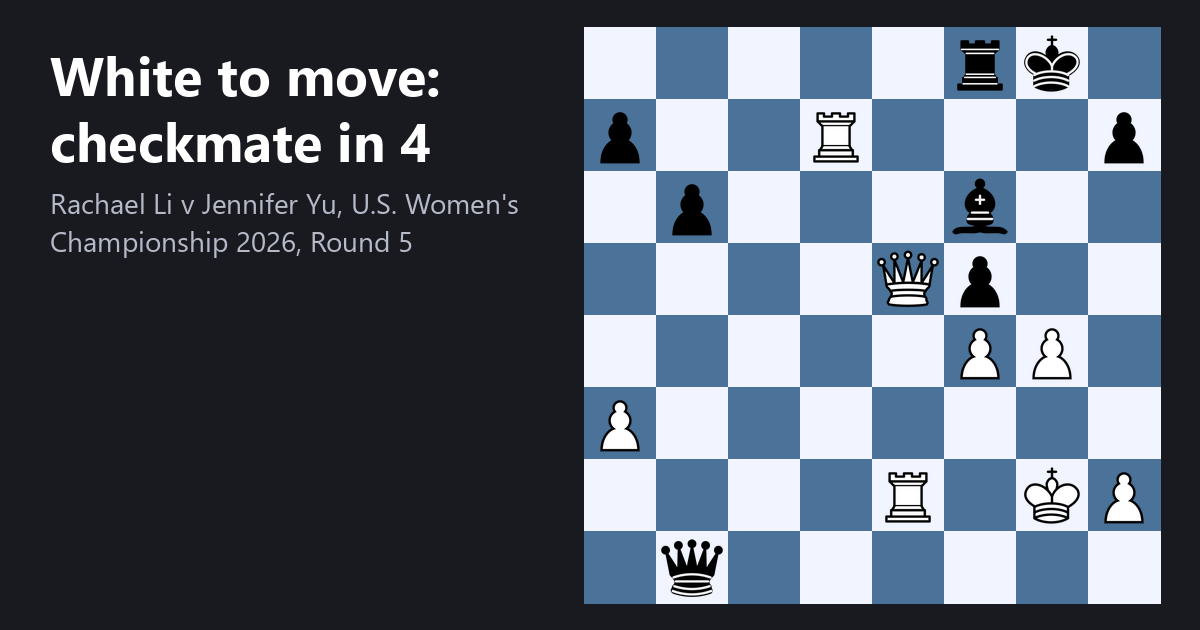
Her score: seven wins, three draws and one loss. Here is how she did it, and what you can learn from her games. Try the puzzle above first. It comes from her Round 5 game, and the answer is further down.
Eleven rounds
- Round 1: beat Irina Krush
- Round 2: lost to Thalia Cervantes Landeiro
- Round 3: beat Anna Sargsyan
- Round 4: drew with Carissa Yip
- Round 5: beat Jennifer Yu
- Round 6: beat Alice Lee
- Round 7: beat Megan Paragua
- Round 8: drew with Tatev Abrahamyan
- Round 9: beat Nazi Paikidze
- Round 10: beat Rose Atwell
- Round 11: drew with Anna Zatonskih
Look at Round 2. Li lost early, and then won six of her next eight games. Her Round 9 win over Paikidze lasted 88 moves and more than five hours.
After her Round 10 win, Li talked about how she was handling the pressure. "I just feel like every game is just a game that I'm practicing for something like another tournament in the future," she said. She called the feeling "kind of just chill."
She also said she would not go for a draw at the first chance. "I'm going to keep playing as I was playing before like all these other previous games. I feel like nothing has really changed."
The Game: the draw that won the title
Li had the black pieces against Zatonskih, a former U.S. Women's Champion. A win or a draw would make Li the champion. Lee's game finished first: she beat Sargsyan about 24 minutes before Li's game ended. Once Lee had won, Li needed at least a draw.
The game began 1.d4 Nf6 2.Nf3 e6 3.c4 d5 4.g3 Bb4+ 5.Bd2 Be7 6.Bg2 O-O 7.O-O c6 8.Qc2 Nbd7. Both players got their kings safe by castling early.
Then something funny happened. Li's knight jumped to h5 to attack the white bishop, and the bishop stepped back. The knight went back to f6, and the bishop came back to f4. They did it twice: 9.Bf4 a5 10.Rc1 Nh5 11.Bd2 Nhf6 12.Bf4 Nh5 13.Bd2 Nhf6.
 8


 5

 2


 1abc
 g
After 13...Nhf6. This exact position, with White to move, has now appeared twice.
There is a rule in chess called threefold repetition. If the same position appears three times, with the same player to move, the game can be called a draw. One more 14.Bf4 Nh5 15.Bd2 Nhf6, and the game could have been drawn after only 15 moves. That draw would have made Li the champion.
Zatonskih did not let that happen. In a video recorded during the round, she said, "I repeated my position twice." She said that repeating the position might be unfair to Alice Lee, who was still fighting for first place. So she played 14.a3 and kept the game going.
A real fight
The game turned into a long, careful battle: 14...b6 15.cxd5 cxd5 16.Bf4 Ba6 17.Nc3 Rc8 18.Qa4 Rc4. Li's rook landed on c4, in White's half of the board.
After 19.Qd1 b5 20.e3 Qb6 21.Bf1 Rc6 22.a4 b4 23.Nb5 Rfc8, Li had both of her rooks on the open c-file. An open file is a column with no pawns on it, and rooks love open files.
Then the pieces started to come off the board: 24.Rxc6 Rxc6 25.Rc1 Bd8 26.Ne5 Nxe5 27.Bxe5 Nd7 28.g4 Nxe5 29.dxe5 Bxb5 30.Bxb5 Rxc1 31.Qxc1 Qc7 32.Qxc7 Bxc7.
Our Stockfish 17.1 engine, at depth 20, saw the game as close to even the whole way. Neither side was ever more than half a pawn better.
Bishops of opposite colors
After 33.f4 Bb6 34.Kf2 d4 35.Kf3 dxe3 36.b3 Kf8 37.h3 Ke7, each player had one bishop, a king and some pawns. Li had won a pawn: her pawn on e3 had pushed deep into White's side.
The kings came to the middle, as they should in an ending: 38.Bd3 h6 39.Bb5 Ba7 40.Ke4 f6 41.Bc4 fxe5 42.fxe5 g5 43.Be2.
754After 43.Be2. Black has six pawns and White has five. White's bishop moves on light squares and Black's bishop moves on dark squares. Black to move.
This kind of ending has a name: bishops of opposite colors. White's bishop lives on the light squares. Black's bishop lives on the dark squares. They can never attack each other, and they can never guard the same squares.
Look at the white bishop on e2. It stands right in front of Li's pawn on e3, so that pawn cannot move. Li's dark-squared bishop can never chase it away, because e2 is a light square. Being a pawn up was not enough to win.
That is why these endings so often end in a draw, even when one side has an extra pawn.
The third time
The players moved their kings and bishops back and forth: 43...Bb6 44.Kd3 Bc7 45.Kd4 Bb8 46.Ke4 Bc7 47.Kd4 Bb8 48.Ke4 Bc7 49.Kd4 Bb8.
54The final position, after 49...Bb8. It is the third time this position has appeared with White to move, so the game is a draw.
This position had now appeared three times, with White to move each time. Threefold repetition, the same rule from move 13, ended the game in a draw after 49 moves and almost three and a half hours.
The draw gave Li 8.5 points. Lee had 8. Nobody else could reach Li, and she was the champion.
What to Learn from Her Wins
Li did not win the title with draws. She won it with seven wins. Here are two moments from them.
The in-between move (Round 5 against Jennifer Yu)
Against Yu, Li's bishop on g2 was just taken by Black's bishop: 19...Bxg2.
8731acdgAfter 19...Bxg2. Black's bishop has just taken on g2. White to move.
The natural move is to take the bishop back right away. Li did something better. First she played 20.Qxe6+, taking a pawn with check. Black had to deal with the check, and Yu moved her king with 20...Kh8. Only then did Li take the bishop back with 21.Kxg2.
A move like 20.Qxe6+ is called an in-between move. Before you make the "normal" move, ask: is there a check or a capture I can play first? Here, our engine rated 20.Qxe6+ about one and a half pawns better than taking the bishop at once.
The puzzle answer
Later in the same game, Li found a checkmate. This is the position at the top of the page.
The answer is 35.Qe6+. Yu answered 35...Kh8, and then 36.Qxf6+ took the bishop with check. Yu resigned here, because every reply loses:
- 36...Kg8 37.Qg7 is checkmate.
- 36...Rxf6 37.Re8+ Rf8 38.Rxf8 is checkmate.
That last idea is called a back-rank mate. The black king on h8 has no safe square: its own pawn blocks h7, the white rook on d7 guards g7, and a white rook gives check along the back row.
The knight fork (Round 3 against Anna Sargsyan)
Against Sargsyan, Li found a fork. A fork is when one piece attacks two pieces at once.
75egAfter 30...Rc5. The black rooks stand on b8 and c5. White to move.
Li played 31.Na6. From a6, the knight attacks both black rooks, on b8 and on c5. Black cannot save both. Sargsyan took Li's bishop with 31...Rxa5, and Li took a rook with 32.Nxb8. A rook is worth more than a bishop, so Li came out ahead. Our engine rated 31.Na6 as the best move in the position, more than a pawn better than any other. Sargsyan resigned a few moves later.
Remember
- Know threefold repetition. The same position three times, with the same side to move, can end the game in a draw. Zatonskih avoided it on move 14. It ended the game on move 49.
- Bishops of opposite colors often draw. Even a pawn up, it is hard to win when the bishops live on different colored squares.
- Look for an in-between move. Before you take back, check if there is a check or capture to play first.
- Watch your back row. A king with no escape square can be mated by a single rook.
- Knights love forks. Before each move, check which squares your knight could jump to, and what it would attack there.
- Losing one game is not the end. Li lost in Round 2 and still won the title.
Read more about Li's tournament: her first-round win over Irina Krush, her story and her win over Alice Lee, and her Round 10 win over Rose Atwell.
In the open section the same day, Samuel Sevian beat Wesley So, and Caruana forced a playoff.
Related Stories
tournaments • 2026-10-26
Clutch Chess: Where a Win on Thursday Counts Triple
tournaments • 2026-10-24
Bodhana Sivanandan Qualifies for International Master at 11, Breaking Judit Polgar's Record
tournaments • 2026-10-22
Two Pieces Attacked at Once: Wesley So Beats Caruana in the Playoff and Wins His Fourth U.S. Title
tournaments • 2026-10-21