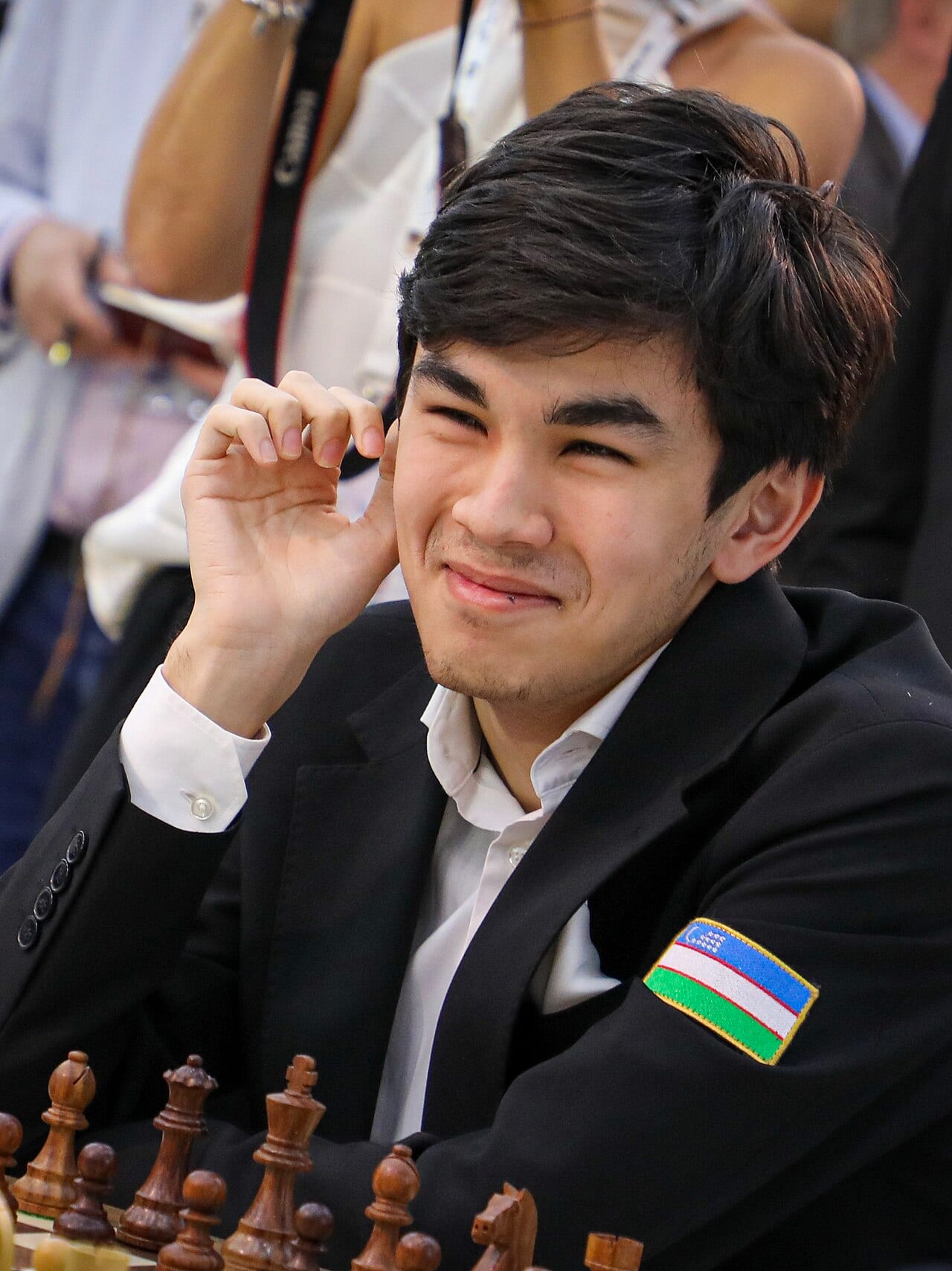
Photo: TheBoburshokh / Wikimedia Commons (CC BY 4.0)
On Tuesday in Saint Louis, a win is worth one point. On Thursday, the same win in the same tournament is worth three.
That is the whole idea behind Clutch Chess: Champions Showdown, which starts on Tuesday, October 27 at the Saint Louis Chess Club and finishes on Thursday, October 29. Play begins at noon Central Time each day, which is 1 p.m. in New York. You can watch it on the club's YouTube channel and its Twitch channel.
Four players are in the field: Fabiano Caruana, Hikaru Nakamura, Praggnanandhaa Rameshbabu and Javokhir Sindarov. Magnus Carlsen, who won this event last year, is not playing.
How the three days work
Each day is a double round robin. That means every player meets each of the other three twice, once with the white pieces and once with the black pieces. Six games a day, 18 games each across the three days.
The games are rapid chess. Each player gets 10 minutes for the whole game, plus five seconds added to the clock after every move, starting from move one. That is enough time to think, and not enough time to think twice.
Then comes the part that changes how the players behave.
| Result | Tuesday | Wednesday | Thursday | |---|---:|---:|---:| | Win | 1 point | 2 points | 3 points | | Draw | 0.5 points | 1 point | 1 point | | Loss | 0 | 0 | 0 |
The cash follows the same ladder. A win pays a bonus of $1,000 on Tuesday, $2,000 on Wednesday and $3,000 on Thursday, inside a total prize fund of $425,000. Money set aside for drawn games goes into the Champion's Jackpot, which the tournament winner takes on top of the first prize. If two or more players finish level at the top, a playoff decides it.
Two more rules keep the players honest. Nobody is allowed to offer a draw until Black has finished 60 moves, so a quick handshake after 12 moves is not an option. And if two players tie for first, they bid in secret for the black pieces: each writes down how little time they are willing to play Black with, up to 10 minutes. The lower bid gets Black and that much time, the other player gets White and the full 10 minutes, and a draw counts as a win for Black.
Look at Thursday again. A win is three points and a draw is one. On that day, two draws are worth less than one win, so a player who is two points behind can get it back with one win. A safe draw with the black pieces, which is a sensible result on most days of most tournaments, pays only a third of what a win pays.
So the leader cannot sit on a lead, and the player in last place still has a way back.
Four players, four ideas worth stealing
Javokhir Sindarov
Sindarov won the Candidates Tournament in April, which makes him the challenger for the world title. He plays Gukesh Dommaraju for the World Championship in Geneva, with the games running from November 24 to December 12, so these three days come less than a month before that match.
Here is how he beat Praggnanandhaa at that Candidates. White to move.
 8

 7


 2f
 g
Sindarov against Praggnanandhaa, Candidates 2026, round 10, after 22...Bd7. White to move. The black bishop on d7 has one defender: the queen on e7.
Count the defenders before you count the pieces. The bishop on d7 is guarded by the queen, and by nothing else. Sindarov played 23.Rf7, offering a rook to the queen. The queen took it, a second rook took back, and after a run of checks the white queen collected the undefended bishop. The idea is called removing the defender: you do not attack the piece you want, you attack the piece guarding it. We looked at the whole game in Sindarov's rook offer on f7.
Praggnanandhaa Rameshbabu
Praggnanandhaa won the 2026 Grand Chess Tour in August, in this same city, beating Caruana 15-13 in the final after trailing by six points going into the last day. Leading him by two points on the last day is not a comfortable place to be.
Here he is attacking from the other side of the board, against Nikita Vitiugov at the Olympiad. Black to move.
864
 2bh
Vitiugov against Praggnanandhaa, Chess Olympiad 2026, round 7, before 21...Na3+. Black to move. The pawns on a4 and b4 and the knight on c4 are all sitting next to the pawns that shelter the white king on b1.
The two kings had castled on opposite sides, so both players could push pawns at the enemy king without opening their own. Praggnanandhaa got there first with 21...Na3+, a knight check that cracked the shelter. The full game is in Praggnanandhaa wins the castling race.
Hikaru Nakamura
Nakamura played in the first Clutch Chess: Champions Showdown last year, and quick time controls suit him. His idea here is a classic: get the rooks to the seventh row.
752gNakamura against Caruana, Candidates 2026, round 8, after 31.Rdd7. Both players have two rooks on the far side. White's are on a7 and d7, Black's are on a2 and b2. Black to move.
Both sides have two rooks on the opponent's second row, which looks even. Look at what they hit. The rook on d7 attacks the pawn on g7, right next to the black king, and the rook on a7 attacks the pawn on a5. Black's rooks have the pawn on f2, and the white king is guarding it. Caruana took that pawn with 31...Rxf2, and Nakamura replied 32.Rxg7+, taking with check. White's rooks were doing the heavier work, and he ground the endgame down. The game is here: Nakamura's rooks on the seventh row.
Fabiano Caruana
Caruana comes to this event days after losing the U.S. Championship playoff to Wesley So. He is a five-time U.S. champion, and he is dangerous in long forcing lines, where each move is a check or a capture.
874 2bdh
Caruana against Matthias Bluebaum, Candidates 2026, round 5, after 25...Qxc4. White to move. The black pawn on f6 is guarded by the bishop on e5, and that bishop is also blocking the e-file between the white queen on e2 and the square e8.
One black piece is doing two jobs here. Caruana played 26.Nxf6+, and when the bishop took back it stopped blocking the e-file, the column of squares the white queen was waiting on. The queen came to e8 with check, and the game ended in checkmate by a pawn. The story is in Checkmated by a pawn.
What to learn
- Count the defenders, not just the attackers. A piece with one defender is a target. Take the defender away and the piece falls.
- A draw is a result, not a decision you make in advance. In this tournament the same draw is worth half a point on Tuesday and one point on Thursday, while a win triples. The scoring tells the players when a safe move stops being the good move.
- When the kings castle on opposite sides, speed beats material. A pawn or a piece is worth giving up if your attack arrives one move sooner.
- Rooks belong on the seventh row, where they hit pawns that cannot run and cage the enemy king.
- Watch the clock as a resource. With 10 minutes and five seconds a move, the player who spends six minutes on one choice has to play the next five moves on feel.
Now try it
Rapid chess is calculation under a ticking clock, and you can train exactly that. Open the puzzle trainer, give yourself one minute a position, and say your answer out loud before you move. Look at the forcing moves first: the checks, the captures and the moves that attack something.
Then try the puzzle sprint and see how your accuracy holds up when the clock is the opponent.
Read next
Caruana arrives in Saint Louis straight from a playoff he lost by half a point: Wesley So beats Caruana in the playoff and wins his fourth U.S. title.
Related Stories
tournaments • 2026-10-24
Bodhana Sivanandan Qualifies for International Master at 11, Breaking Judit Polgar's Record
tournaments • 2026-10-22
Two Pieces Attacked at Once: Wesley So Beats Caruana in the Playoff and Wins His Fourth U.S. Title
tournaments • 2026-10-21
A Long King Walk and a Missed En Passant: Harikrishna Beats Yu Yangyi in 103 Moves
tournaments • 2026-10-21