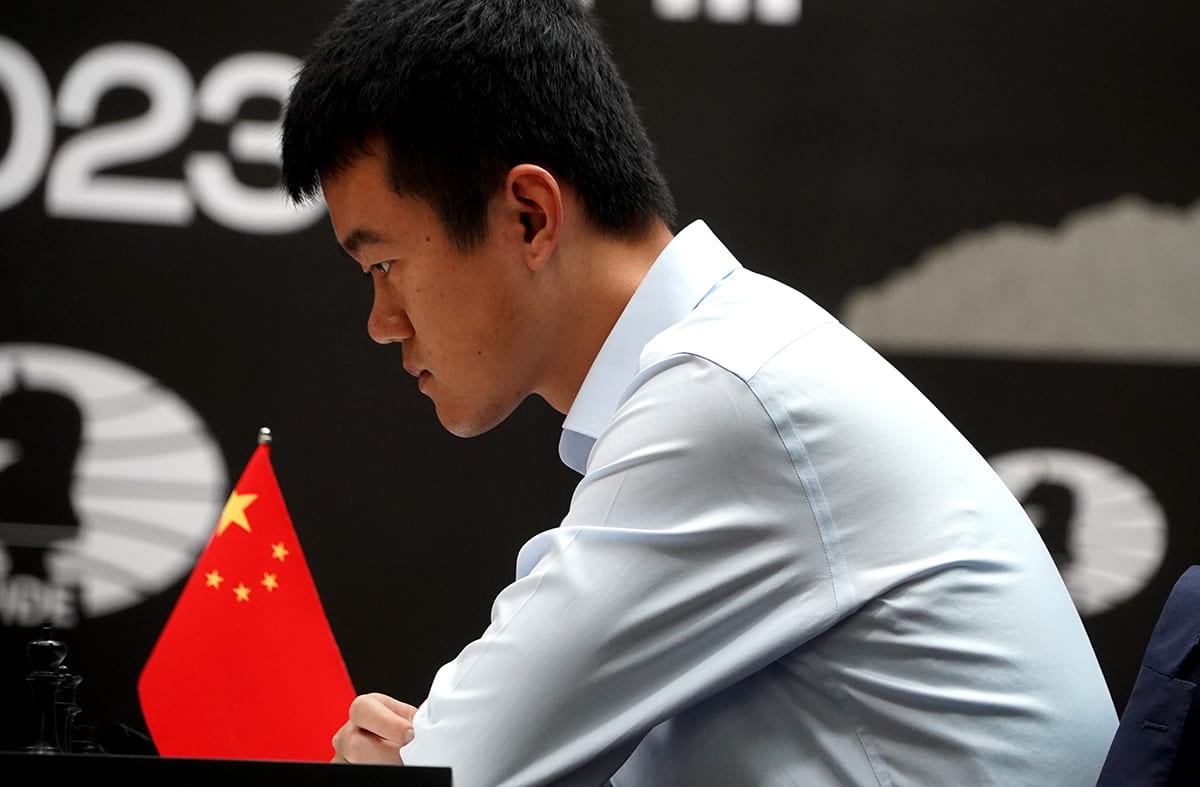
Photo: Eteri Kublashvili, ruchess.ru / Wikimedia Commons (CC BY-SA 3.0)
On 30 April 2023, in a hotel in Astana, Ding Liren had a simple way to stay safe. He could move his king back to g8 and keep repeating moves. The last rapid game of the World Championship would be drawn, and the title would be decided by blitz. Ding did not repeat. He put his rook in front of his king, and 22 moves later he was the 17th world champion.
Game 1 of the next title match, Gukesh against Javokhir Sindarov, is on 24 November in Geneva. Before it starts, here is the game that made Ding champion, and the two ideas in it that young players can use. It is the next stop in our run-up series after Kramnik's win over Kasparov in 2000.
How it came to a tiebreak
Magnus Carlsen chose not to defend his title, so the match was between Ian Nepomniachtchi and Ding, the top two from the 2022 Candidates Tournament. Fourteen classical games ended 7-7. Nepomniachtchi won games 2, 5 and 7, and Ding won back each time, in games 4, 6 and 12.
So they played four rapid games, with 25 minutes each plus 10 seconds a move. The first three were drawn. A draw in the fourth would have sent the match to blitz games. Nepomniachtchi had White.
The game: Nepomniachtchi vs. Ding, rapid game 4
Ian Nepomniachtchi 0-1 Ding Liren World Championship 2023, Astana · Rapid tiebreak, game 4 White: Nepomniachtchi · Black: Ding
This is the Spanish Game, also called the Ruy Lopez, where White's bishop goes to b5 on move 3. White's bishop then went on a long trip, from b5 to a4, b3, a2 and finally b1.
Ding pushed his e-pawn and gave it away. After , the black knight jumped to d3, deep in White's camp. White traded it off at once.
Nepomniachtchi had been a pawn up after . By , Ding had won back two pawns and was a pawn ahead himself. Both sides had a queen, a rook and a bishop.
The choice: repeat, or play on
White's queen gave check from e4, then d5, then e4 again. If Black's king kept going to g8 and h7, the same positions would keep coming back. When the same position appears three times, a player can claim a draw.
After 46.Qe4+, Black to move. 46...Kg8 would go back to the position after 44...Kg8. Black can also block the check with the rook on g6.
Our engine, Stockfish 17.1 at depth 22, rates 46...Kg8, 46...Kh8 and all about level. So the choice was not about one move being much better. It was about whether the game went on. Ding played .
After 46...Rg6, White to move. The rook on g6 is pinned: the white queen on e4, the rook and the black king on h7 stand on one diagonal, so the rook cannot leave it.
A pin means a piece cannot move, or should not move, because a more valuable piece stands behind it. Here the king is behind the rook, so the pin is total. Blocking a check with a piece that then gets pinned is often risky, because the pinned piece cannot help anywhere else. What Black had in return was an extra pawn and a passed c-pawn. A passed pawn is a pawn with no enemy pawn in front of it, or on either side, to stop it.
The pawn starts to run
Clocks were running low. After Nepomniachtchi had 2 minutes 24 seconds, and after Ding had 1 minute 16. After , our engine finds one strong move for Black, and it is a big one: , worth about two and a half pawns. The next best move is worth about a third of a pawn.
After 48.h4, Black to move. Find the queen move that helps the c-pawn run. Hint: put the queen next to the pawn's path.
This is the first idea to learn. The queen moved next to the pawn. From d3 it guards c4, c3 and c2, the squares the pawn has to cross. The game's clock times show Ding had 76 seconds before this move and 84 after it, with 10 seconds added for the move. He played it in about two seconds.
The rooks came off, and now Ding had two passed pawns, on a3 and c3. Two passed pawns far apart are hard to stop. White's queen and bishop now had to watch both of them at once.
After 67.f4, Black to move. The c-pawn is one step from queening on c1, and only the bishop on e3 guards that square.
The finish
This is the second idea to learn. White's bishop on e3 was the only piece guarding c1. Ding first pushed his a-pawn to a2. If White ignored it, the pawn would make a new queen on a1. Nepomniachtchi took it with his queen, which left the centre and went all the way to a2.
Then took a pawn and attacked the bishop on e3. If White takes back with 69.Bxf4, the black queen on f5 takes on f4 with check, and the c-pawn queens next. This is called removing the defender: you attack, or take, the one piece that guards a key square.
After 68...Bxf4, White to move. The black bishop attacks the bishop on e3, which guards c1. Our engine finds a forced mate for Black.
Nepomniachtchi resigned. Ding had won the rapid tiebreak 2.5-1.5 and the World Championship. He was the first Chinese player to win the title.
What Ding Liren Can Teach You
- A repetition is a choice, not a duty. If the position is about level and you have something extra, like a passed pawn, you can play on.
- Help your passed pawn with your queen. Put the queen next to the squares the pawn must cross.
- Two passed pawns far apart stretch the defence. When the defender takes one, the other runs.
- Remove the defender. Find the one piece guarding the key square, and attack it.
What came next
Ding held the title until December 2024, when Gukesh beat him 7.5-6.5 in Singapore. Now Gukesh defends it against Sindarov. You can read our Game 1 preview for what to watch on Tuesday.