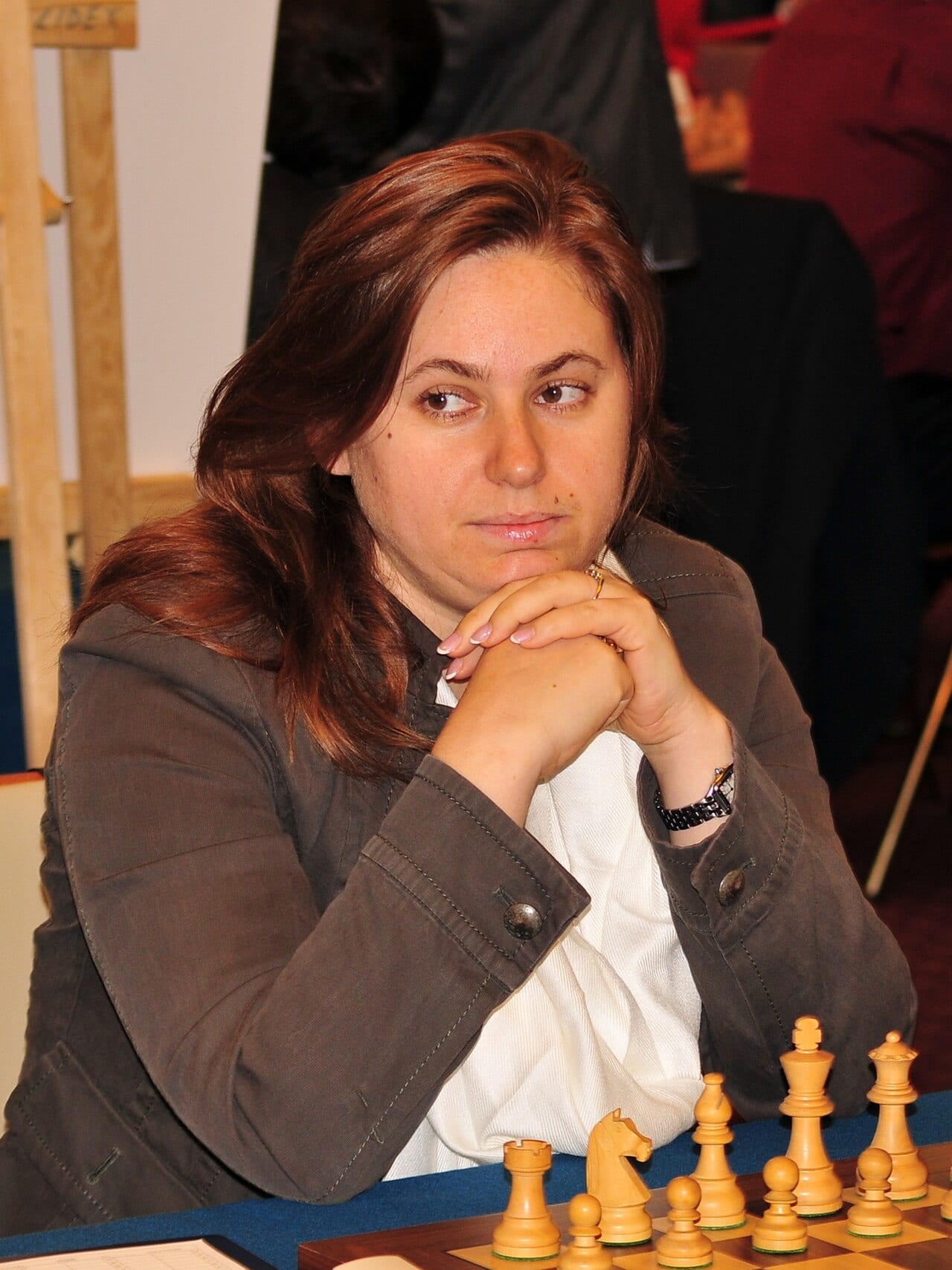
Photo: Przemysław Jahr / Wikimedia Commons (CC BY-SA 3.0)
On 9 September 2002, in Moscow, Garry Kasparov sat down with the black pieces against Judit Polgar. He was the highest-rated player in the world. She had never beaten him. Forty-two moves later she had.
You may already know how Polgar grew up. Our story of her childhood tells how her parents taught her at home and how she won an Olympiad gold medal at 12. This story starts where that one ends. It covers her years at the top, and two games from them: the win over Kasparov, and a rook sacrifice in Budapest that attacking players can learn from.
The woman in the top 10
In December 1991, at 15, Polgar became a grandmaster, the highest title in chess. From then on she played in the strongest tournaments she could enter, against men, and she rarely played in women's events.
Here is what she did there:
- She was the top-rated woman in the world from January 1989 until she retired in 2014.
- She reached the world top 10, which no other woman has done, and in July 2005 her rating peaked at 2735. She is the one woman ever rated above 2700.
- In 2005 she played in the FIDE World Championship in San Luis, Argentina, an eight-player event. She was the first woman to play in the final stage of a World Championship. The winner was Veselin Topalov, and you can read about him in his own story.
- She beat 11 players who were, or had been, world champions, in classical or rapid chess. That list includes Kasparov, Anatoly Karpov, Viswanathan Anand and Magnus Carlsen.
On 13 August 2014 she announced that she was retiring from competitive chess. In the March 2015 rating list Hou Yifan passed her as the top-rated woman. You can read how Hou grew up in her childhood story.
Game one: beating the world number one
Judit Polgar 1-0 Garry Kasparov Russia v the Rest of the World, Moscow, round 5 · 9 September 2002 White: Polgar · Black: Kasparov
This was a team match. Ten players from Russia played ten from the rest of the world, and the time control was rapid: 25 minutes for each player, plus 10 seconds for every move. Polgar played for the World team.
Kasparov chose the Berlin Defense, a way of meeting the Ruy Lopez (the bishop move ) where the queens often come off early. That is what happened here. After eight moves there are no queens on the board, and Black's king stands on d8.
After 8...Kxd8, White to move. The queens are gone. Black's king has moved, so Black can never castle. Our engine calls the position close to level.
This ending looks quiet, and our engine, Stockfish 17.1 at depth 22, calls it close to level. But look at the two kings. White has castled and is safe. Black's king has moved, so it can never castle, and it has to stay near the middle. Polgar's plan for the next 20 moves was to open lines and point her rooks at it.
Kasparov opened the h-file with and used it for his rook. Polgar answered by bringing her king to g3, close to her pawns, and her rooks to the d-file and the e-file. By move 29 every bishop and knight had been traded. Only rooks and pawns were left, a rook ending.
After 29...cxd6, White to move. The black pawn on d6 is already attacked by the rook on d2. After 30.Re6 a second rook attacks it, and only the king on d7 defends it.
Here is the lesson of the whole game. Count attackers and defenders. Two white rooks can hit the pawn on d6, and one black king guards it. Two beats one.
Polgar won the pawn with check. Our engine likes much more than slower moves, about two pawns for White against about half a pawn for 30.f4. Then she lined both rooks up on the d-file. Kasparov's rooks went hunting for checks on the h-file, and Polgar's king calmly walked up the board to e4 and back to e3.
After 39...Rxf5, White to move. Both white rooks stand on the seventh rank, the row next to Black's king. The pawns on a7 and g7 cannot run away.
Two rooks on the seventh rank are one of the strongest things you can have in a rook ending. Players call them "pigs" because they gobble up the pawns on that row. Watch them eat.
The g7 pawn is gone, and the a7 pawn is attacked with nothing to guard it. Our engine gives White more than five pawns. Here the game ended, and Polgar had won. Her win also helped the World team: they won the whole match 52-48.
Game two: the rook on h7
Judit Polgar 1-0 Ferenc Berkes Hunguest Hotels tournament, Budapest, round 7 · 18 April 2003 White: Polgar · Black: Ferenc Berkes
This game is the opposite of the first. It is short and sharp, and the black king is in check by move 12. Berkes, a Hungarian grandmaster, answered with the French Defense, 1...e6.
e6 2.d4 d5 3.Nc3 Nf6 4.Bg5 dxe4 5.Nxe4 Be7 6.Bxf6 Bxf6 7.Nf3 O-O 8.Qd2 Nd7 9.O-O-O Be7 10.Bd3 b6 11.Neg5 h6 12.Bh7+ Kh8 13.Be4 hxg5
Polgar castled on the queenside (9.O-O-O), so her king went to c1 and her rooks could charge at the other king. When the two kings sit on opposite sides, both players usually throw their pawns at the enemy king. Then on move 13 Black took the knight on g5. White is a whole knight down. The bishop on e4 is attacking the rook on a8. What would you do?
 8


 7


 2

 c
 dh
After 13...hxg5, White to move. White is a knight down. The bishop on e4 attacks the rook on a8, but taking it with 14.Bxa8 lets Black play 14...g4.
14.g4
The greedy move is 14.Bxa8. Then Black plays 14...g4, the knight on f3 is attacked, and our engine has Black ahead by almost two pawns. Polgar's 14.g4 stops that pawn dead. The g5 pawn can no longer move forward, and White's h-pawn can now come to h4 to open the h-file. Our engine gives 14.g4 an edge of about one and a half pawns for White, while the next moves it looks at leave Black better.
14...Rb8 15.h4 g6 16.hxg5+ Kg7 17.Qf4 Bb7
The h-file is open now, and White's queen has come to f4. Black's king has run to g7. Now look at the h-file. The white rook on h1 sees all the way up to h8.
72cdhAfter 17...Bb7, White to move. The rook on h1 runs up the open h-file. The queen on f4 can reach h2 in one move.
18.Rh7+
A rook sacrifice. The rook goes to h7 with check, where the king can take it. Why give it away? Because when the king takes, the queen jumps to h2 with check, and the other rook comes to h1. Our engine rates 18.Rh7+ at about three pawns for White. Its next choice, 18.Bxb7, is only level.
18...Kxh7 19.Qh2+ Kg8 20.Rh1
72chAfter 20.Rh1, Black to move. White threatens Qh7 checkmate. Of all Black's moves, only 20...Bxg5+ stops a mate on the next move.
Count the material: White is a knight and a rook down. But the queen and rook are both on the h-file. White threatens 21.Qh7 checkmate, and every Black move except 20...Bxg5+ lets White mate on the very next move.
20...Bxg5+ 21.Nxg5 Qxg5+ 22.f4 Qxf4+ 23.Qxf4 Bxe4 24.Qxe4
Black gave back a bishop and then the queen. When the dust settled, both sides had the same amount of material. But the black king was still open, and White's queen and rook were ready to keep attacking. Our engine gives White more than three pawns, and that is where the game ended, a win for Polgar.
What Judit Polgar Can Teach You
- A king that cannot castle is a target, even with the queens gone. Polgar spent 20 moves opening lines toward Kasparov's king.
- Count attackers and defenders. Two rooks against one defender won the d6 pawn.
- Put your rooks on the seventh rank. From there they eat the pawns that cannot run.
- Do not grab material if it opens a door for your opponent. 14.Bxa8 lets Black's g-pawn attack, and 14.g4 shuts it.
- Open files lead to the king. Polgar opened the h-file, then gave a rook so her queen could use it.
- Before you sacrifice, look at what the other side must do next. After 20.Rh1, Black had one move that stopped mate.
What came next
Polgar kept playing top events for more than ten years after these games. Today the women's game has a new generation of champions. Read about the US women's champion in our story on Rachael Li and about the WR Women's Tour in our report on Kateryna Lagno's win. And meet the five-time women's world champion in the story of Ju Wenjun.