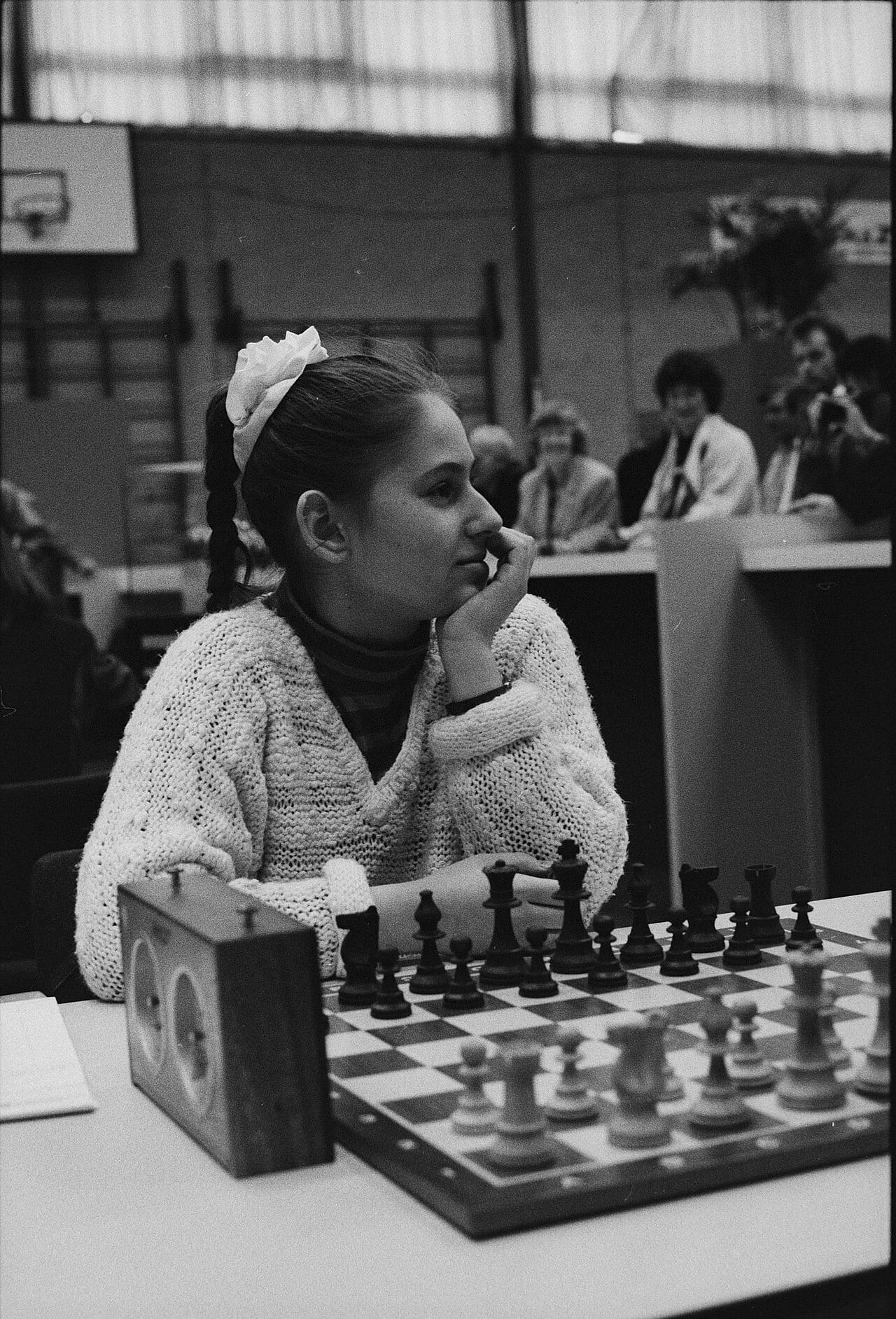
Photo: Fotoburo De Boer / Wikimedia Commons (CC0)
When Judit Polgar was five, she played a game against a family friend without looking at the board, and won. The friend joked: "You are good at chess, but I'm a good cook." Judit answered: "Do you cook without looking at the stove?"
To her, playing without seeing the board was normal. In her family, chess was not a hobby. It was the main subject of school.
Judit grew up to be the youngest grandmaster in history at the time, and the world's top-rated woman for 26 years in a row. Here is her story, the game that made the chess world notice her at 12, and five more of her early games you can study.
The Experiment
Judit was born on July 23, 1976, in Budapest, Hungary. Her father, László Polgár, had a theory: "Geniuses are made, not born." He believed any healthy child could do amazing things if trained in one subject from a very young age. He and his wife Klára taught their three daughters at home, and the subject they chose was chess.
All three daughters became very strong players. Susan, the oldest, became a grandmaster. Sofia became an International Master. Judit, the youngest, became the strongest of them. Her father also believed girls should play against boys and men, not only in women's events. That caused arguments with Hungary's chess federation at the time.
The family did not do it alone. The sisters also worked with professional trainers, including the Hungarian champion Tibor Florian and the grandmasters Pal Benko and Alexander Chernin. And the talent was not magic. Her sister Susan once said, "Judit was a slow starter, but very hard-working."
A Girl Among the Grown-Ups
Judit started playing in tournaments at six. At nine she flew to the United States for the New York Open, played in the section for unrated players, won her first seven games, and finished first. A reporter asked if she would be world champion one day. She answered, "I will try."
Then the wins started getting bigger:
- In January 1987, at 10, she beat Dolfi Drimer, an International Master, in Adelaide, Australia.
- At 11 she beat her first grandmaster, Lev Gutman.
- In 1988 she won the under-12 boys' section of the World Youth Festival in Romania, and earned the International Master title at 12. Bobby Fischer and Garry Kasparov had both been 14.
The Olympiad at Thessaloniki
In November 1988, Judit, her two sisters and Ildikó Mádl played for Hungary in the women's section of the Chess Olympiad, a team event where countries play each other. Before the event, Eduard Gufeld, a Soviet grandmaster who coached the Soviet women's team, said the tournament would show "if the Hungarian sisters are geniuses or just women".
Hungary won the gold medal. It was the first time any team other than the Soviet Union had won the women's Olympiad. Judit, 12, played second board and scored 12½ points out of 13, the best score of the whole event. One of her games won the brilliancy prize, according to the grandmaster Robert Byrne's chess column in The New York Times. That is the game below.
The Game: Judit Polgar vs. Pavlina Chilingirova, Thessaloniki 1988
Judit Polgar 1-0 Pavlina Chilingirova Chess Olympiad, women's section, Thessaloniki · Round 10 · November 23, 1988 White: Judit Polgar, Hungary, age 12 · Black: Pavlina Chilingirova, Bulgaria
Her opponent was an experienced Bulgarian player. Some sources list her as Pavlina Angelova, the name she used in earlier years.
1.e4 c5 2.Nf3 Nc6 3.Bb5 g6 4.O-O Bg7 5.c3 e5 6.d4 exd4 7.cxd4 Nxd4 8.Nxd4 cxd4 9.e5 Ne7 10.Bg5 O-O 11.Qxd4 Nc6 12.Qh4 Qb6 13.Nc3 Bxe5
Black has won a pawn. But look at where that bishop came from. It used to stand on g7, right in front of the black king, guarding the dark squares around it, like f6 and h6. Now it has left.
 8
8

 7
7


 2
2 1af
1af g
gAfter 13...Bxe5, White to move. The black bishop has left g7. The dark squares around the black king, f6, g7 and h6, now have no bishop to guard them. White's queen on h4 and bishop on g5 point right at them.
14.Rae1
Polgar brings her last rook into the game. It attacks the bishop on e5. It also leaves her own bishop on b5 and knight on c3 under attack. Our Stockfish 16 check rates 14.Rae1 as White's best move, and says White is now clearly better, even though pieces are about to fall.
14...Bxc3 15.bxc3 Qxb5
Count the material. Polgar has lost a bishop and a knight, and taken one bishop back. She is a piece and a pawn behind. But Black's dark-squared bishop is gone for good.
872efgAfter 15...Qxb5, White to move. White is a piece and a pawn behind. Black has no bishop left to guard the dark squares near the king. Where can the white queen go?
16.Qh6
The queen jumps to h6, next to the black king. It attacks g7, h7 and f8. Now White threatens to play Bf6 and then Qg7, which would be checkmate. Our engine confirms it: if Black could pass here, White would mate in three moves.
872efgAfter 16.Qh6, Black to move. The white queen and the bishop on g5 work together on the dark squares. White threatens Bf6 followed by Qg7, checkmate.
Black's best try was 16...Qxg5, giving back material. Our engine still rates White far ahead after that. Chilingirova played 16...Qf5, which lets White finish at once.
16...Qf5
872efgAfter 16...Qf5, White to move. White can force checkmate in three moves. Find it before you read on. Hint: look at the rook on f8 and the rook on e1.
17.Qxf8+
Polgar gives up her queen. Black has only one legal reply, 17...Kxf8. Then 18.Bh6+ is check, and again Black has only one move, 18...Kg8. Then 19.Re8 is checkmate: the rook checks along the back row, the bishop on h6 covers g7, and Black's own pawns on f7 and h7 block the other squares.
The official game score ends with 17.Qxf8+ and White's win. The mate that follows is forced, and our engine confirms it.
Five More Polgar Games to Study
These five games cover the four years from her first big win to the grandmaster title. Set each one up on a board, or play through it on your computer, and look for the idea in the note. The engine numbers come from our own Stockfish 16, searching to depth 20.
- Judit Polgar vs. Dolfi Drimer, Adelaide, January 1987 (1-0). Her first win over an International Master, at 10. It is a long fight, and at move 40 our engine calls it level. Then Drimer's king comes under attack. Watch the queen and rook work together with 46.Rh8+, 47.Qg5+ and 48.Qxh5+, and how Polgar keeps her advantage for another 14 moves until 62.Qb4.
- Judit Polgar vs. Lev Gutman, Brussels, 1987 (1-0). Her first win over a grandmaster, at 11. This is a good game for learning to stay calm. Our engine rates Gutman slightly better for part of the middlegame. Polgar keeps her pieces pointed at his king, gets her queen behind it with 28.Qh8+, and after 29...Ne6 our engine turns to White. The game ends with 37.Bxe6.
- Judit Polgar vs. Keith Arkell, London, October 22, 1988 (1-0). Played in London in the month she completed her International Master title. Arkell was rated 65 points higher. Follow Polgar's d-pawn: 22.d5, 26.d6 and 32.d7. After Black's 26...e6, no black pawn can stop it, so it is a passed pawn, and it ties Black's pieces down for the rest of the game. See the diagram below.
- Xie Jun vs. Judit Polgar, Thessaloniki Olympiad, 1988 (0-1). Xie Jun became Women's World Champion three years later. Polgar leaves her king in the middle on e7 and puts both rooks on the open h-file with 18...Rh4 and 19...Rah8. After 22.Qf2 our engine rates Black clearly better. Later, 30...Rxh3+ and 31...Qxf4 swap a rook for a rook and a pawn, and Polgar's queen outplays White's rook and knight.
- Judit Polgar vs. Gyula Sax, Hungarian Championship, 1991 (1-0). From the December 1991 championship where she earned the grandmaster title. By move 25 Polgar has a queen against Sax's rook and bishop. Her queen starts collecting pawns with 25.Qxf7+. By the end, her three queenside pawns on a4, b4 and c4 are all passed, and Black has no pawns on that side to stop them.
7641adgPolgar vs. Arkell, London 1988, after 32.d7, Black to move. The white pawn on d7 is one step from becoming a queen. Black's rook has to sit on d8 to block it, and the knight on c6 has to guard that square.
Grandmaster at 15
In December 1991, at the Hungarian Championship, Judit earned the grandmaster title at 15 years and 4 months. That broke Bobby Fischer's record by about a month. In January 1989, at 12, she had already been the top-rated woman in the world.
She went on to reach number 8 in the world rankings in January 2004. She beat 11 current or former world champions in classical or rapid chess, including Garry Kasparov, Anatoly Karpov and Magnus Carlsen, and in 2002 became the only woman to beat a reigning world number one, when she beat Kasparov. She retired from competitive chess in 2014.
What Judit Polgar Can Teach You
- Hard work beats "natural talent". Her own sister called her a slow starter.
- When your opponent's bishop leaves the king, look at the squares it used to guard.
- Material is not everything. Against Chilingirova, she was a piece and a pawn behind and still won quickly.
- A queen sacrifice is just a calculation. Count the checks and the forced replies before you give up your queen.
- Push a passed pawn. Against Arkell, one pawn on d7 kept two black pieces busy.
- Play strong opponents. Judit played against men from the start, and that is how she got strong.
A Habit to Practice
Set up the position after 16...Qf5 and find the checkmate in three moves on your own. Then ask the key question for every attack: which squares next to the enemy king are weak, and which of my pieces can reach them?
Related Stories
legends • 2026-10-13
The $64,000 Prize Nobody Has Ever Won
legends • 2026-10-05
The Bishop in the Corner: How Anatoly Karpov Squeezed a Grandmaster
legends • 2026-10-05
Black's King Takes a Long Walk: Wei Yi's Famous Attack at 16
legends • 2026-10-04