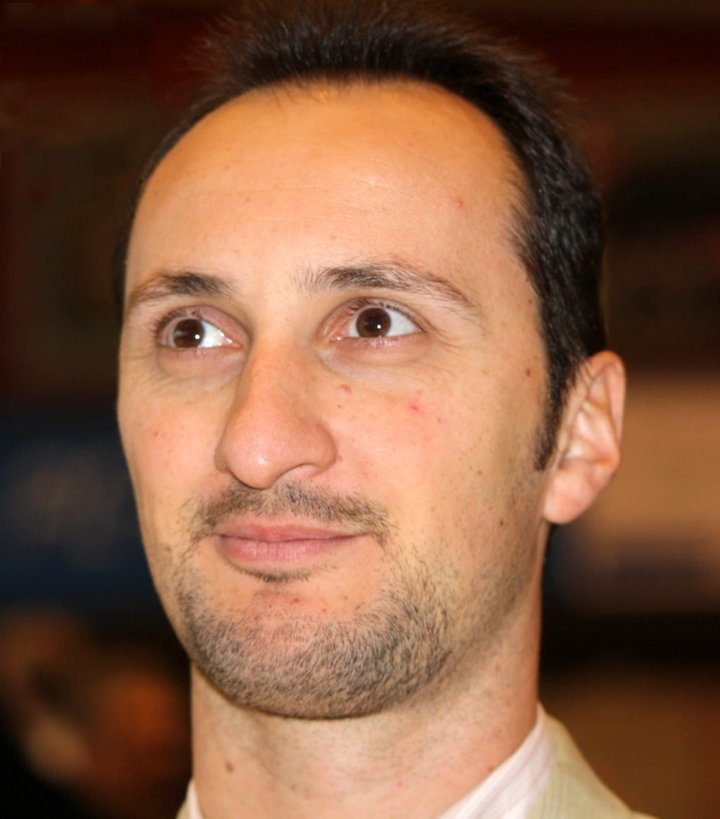
Photo: Veselin_Topalov.jpg : Georgios Souleidis derivative work: Joyborg ( talk ) / Wikimedia Commons (CC BY 2.0)
On 21 May 2005, in Sofia, Veselin Topalov gave away a knight on move 18 and a rook on move 19. By move 30 he had won the game. The man he beat was a former world champion, and the lead of the tournament was at stake.
That is the Topalov style in one story. He liked to attack, and he trusted his calculation. Tomorrow the World Championship match between Gukesh and Sindarov continues with Game 3, and our Game 2 report tells you where it stands. While you wait, here is the life of a man who played for the world title twice, and two of his games you can learn from.
A champion from Ruse
Topalov was born in Ruse, a city in Bulgaria, in 1975. He was a fast starter. In 1989 he won the World Under-14 Championship in Puerto Rico, and in 1990 he took the silver medal at the World Under-16 Championship in Singapore. He became a grandmaster in 1992.
At the 1994 Olympiad in Moscow, a team event, he played first board for Bulgaria and beat Garry Kasparov. You can read how Kasparov himself grew up in his childhood story.
His big year was 2005. In March he shared first place at the Linares tournament with Kasparov and beat him in the last round (the second game in this article). In May he won the M-Tel Masters in Sofia by a full point (the first game). In the autumn he played in the FIDE World Championship in San Luis, Argentina, an eight-player tournament in which everyone played everyone twice. He scored 6½ out of 7 in the first half and finished as the FIDE World Champion.
In 2006 he played Vladimir Kramnik in Elista, Russia, a match meant to join the two world titles into one. Kramnik won it, and Kramnik is the player Kasparov faced in our story of the 2000 title match. In 2010 Topalov played for the title again, against Viswanathan Anand in Sofia. He won Game 1 with a sharp attack, and the match came down to the last game. Anand won Game 12 with Black and kept his title. You can read about him in Anand's childhood story.
Topalov kept playing for years after that. In 2026 he beat Kasparov again, in a Chess960 match called Clutch Chess: The Legends. In Chess960 the pieces start on shuffled squares, so memorized openings matter much less.
Game one: the knight and the rook
Topalov 1-0 Ponomariov M-Tel Masters, Sofia, round 9 · 21 May 2005 White: Topalov · Black: Ruslan Ponomariov
Ponomariov was a former FIDE world champion, and he had beaten Topalov in the first half of the tournament. Topalov had White, and the game became a Queen's Indian Defense, an opening where Black puts a bishop on a6 to attack White's c4 pawn.
The move was a novelty, which means a new move in that position. From here White's pieces head for the black king. The bishop on b1 is the quiet key, because it points down the long diagonal toward h7. Our engine, Stockfish 17.1 at depth 22, thinks was Black's mistake. With 15...Nd7 White's edge stays under a pawn, at about three quarters. After it is more than two pawns.
Next, White put the queen in front of the bishop on c2, so both pieces point at h7. Two pieces on one line like this are called a battery. Ponomariov answered with a pawn move that attacks White's rook.
After 17...d4, White to move. The black pawn on d4 attacks the rook on c3. The queen on c2 and the bishop on b1 both point at h7.
What would you do? Move the rook is the natural reply. Topalov did the opposite.
The knight steps to g5, and Black takes it with the h-pawn. White takes back with the h-pawn, so the h-file is open for the rook on h1. Then Black takes the rook on c3. Count the material: White has given up a knight and a rook for one pawn, which is seven points down if you count pawns as one, knights as three and rooks as five. Our engine still gives White an edge of more than three pawns. Why? The pawn on g5 attacks the black bishop on f6, the open h-file points at the king, and the bishop on a6, the knight on b8 and the rook on a8 are far from the king.
After 19...dxc3, White to move. White is a knight and a rook down, but the queen, the bishop on b1 and the rook on h1 all aim at the black king. Our engine gives White an edge of more than three pawns.
Now see how Topalov keeps the king under fire. Many of his moves give check or make a threat.
Look at where the black king travels: from g8 to f7, e7, d6 and finally c6, a long walk across the board. After Black has just two legal moves, 30...Qd5 and 30...Qxe4. White answers either one with 31.Qc7, checkmate. The knight and the rook were a loan. White got all of it back.
After 30.Be4+, Black to move. Black has two legal moves, Qd5 and Qxe4. After either, 31.Qc7 is checkmate.
Game two: Kasparov's last game
Topalov 1-0 Kasparov Linares, round 14 · 10 March 2005 White: Topalov · Black: Garry Kasparov
This game is different. There are no big sacrifices and no mating attack. It is a pawn ending, an endgame where just kings and pawns are left. It was also the last game Kasparov played in serious competition. Kasparov announced the same day that he was retiring from professional chess.
Topalov won the game, and both men finished on eight points out of 12. Kasparov won the tournament on a tiebreak.
1.e4 c5 2.Nf3 Nc6 3.Nc3 e5 4.Bc4 d6 5.d3 Be7 6.O-O Nf6 7.Nh4 Nd4 8.g3 Bg4 9.f3 Be6 10.Bg5 Ng8 11.Bxe7 Nxe7 12.f4 exf4 13.Bxe6 fxe6 14.Rxf4 Kd7 15.Nf3 Rf8 16.Rxf8 Qxf8 17.Nxd4 cxd4 18.Ne2 Qf6 19.c3 Rf8 20.Nxd4 Nc6 21.Qf1
Black met 1.e4 with the Sicilian Defense, 1...c5. In this game both sides traded pieces for 20 moves and the position stayed close to level. Black's king went to d7 early, and the queens stayed on. At depth 24 our engine thinks Black could have kept the queens on with 21...Ne5 or 21...Qd8, both about level. Kasparov chose to swap queens.

 7


 2
 1a
 f
 g
After 21.Qf1, Black to move. Black can trade queens with 21...Qxf1+ or keep them on with 21...Qd8.
21...Qxf1+ 22.Rxf1 Rxf1+ 23.Kxf1 Nxd4 24.cxd4 d5
Now just kings and pawns remained. Our engine puts 21...Qxf1+ at about one pawn for White, a small but real edge. A pawn ending is a new game, and the king becomes your strongest piece. White's pawns look clumsy, with two on the d-file (doubled pawns, which usually are a weakness). But White has seven pawns to six, and the White king is closer to the action.
25.Kf2 Ke7 26.Kf3 Kf6 27.h4
Here the game turned. White's king was on f3 and Black's was on f6. Our engine at depth 24 prefers 27.Kg4, which brings the king straight to the kingside and keeps the h-pawn at home. After 27.Kg4 it gives White an edge of about 2.7 pawns. Instead Topalov played 27.h4, and the edge shrank to about half a pawn if Black replies 27...h6.
72After 26...Kf6, White to move. White has seven pawns to Black's six. Our engine likes 27.Kg4, which leaves Black's king just three moves: Kf7, Ke7 or Kg6.
27...g6 28.b4 b5 29.Kf4 h6 30.Kg4
Black answered 27...g6. Our engine says 27...h6 was the move to play, and that after it the game stays close. After 27...g6 the engine has White ahead by about three pawns again. White then played quiet moves, 28.b4 and 29.Kf4, and walked the king to g4. At depth 24 the engine has Black lost here, with an edge for White of about six pawns. A pawn ending is a race of tiny moves, and one wrong step can be the difference between a draw and a loss.
72After 30.Kg4, Black to move. White's king has reached g4. Our engine has Black lost, with White ahead by about six pawns.
What Topalov Can Teach You
- Know your opening well. The novelty 10.e5 gave Ponomariov a new problem to solve over the board.
- Count the attackers as well as the material. Topalov was seven points down after 19...dxc3, but the queen, the bishop and the rook were all near the black king.
- Put two pieces on one line. The queen and bishop on the b1 to h7 diagonal made a battery.
- In a pawn ending, the king is a fighting piece. Bring it to where the enemy pawns are before you push your own.
- Before you trade queens, ask what the ending looks like. 21...Qxf1+ turned a level game into a worse one.
- Keep playing. The game with Kasparov was close to level for 20 moves, and Topalov was still there when the ending came.
What came next
In 2026 Topalov and Kasparov met again in their Chess960 match, and Topalov won it. Now Gukesh defends the title against Sindarov. Read our Game 1 report and our Game 2 report for the story so far.