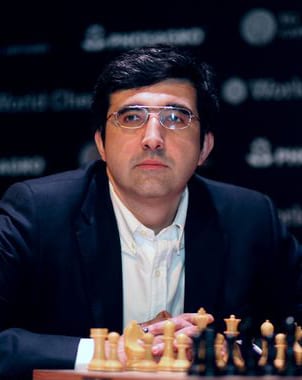
Photo: Vladimir Barskij / Wikimedia Commons (CC BY-SA 3.0)
Game 1 of the Gukesh and Sindarov match is on 24 November in Geneva. Before it starts, travel back to October 2000 and a different world title match. In London, Vladimir Kramnik, who was 25, played Garry Kasparov, who was 37 and had been world champion for 15 years. Kasparov was the heavy favourite. In Game 2 Kramnik grabbed a pawn with his rook and won in 40 moves.
The match and the first two games
Kramnik won the match without losing a game. It finished with two wins and 13 draws. The first game was a draw, so Game 2, played on 10 October, was the first time anyone in the match took the lead. Kasparov had Black and chose the Grünfeld Defence, an opening he knew very well. He did not play the Grünfeld again for the rest of the match.
You can read about the champion Kramnik beat in our story on Garry Kasparov.
The game: Kramnik vs. Kasparov, London 2000, Game 2
Vladimir Kramnik 1-0 Garry Kasparov
Kramnik had White. The Grünfeld starts like this: . White builds a big pawn centre on c3, d4 and e4. Black lets him do it, and plans to attack that centre from the side, with the bishop on g7 and a pawn push to c5.
Black followed the plan, . The queen on a5 attacks the pawn on c3 and the bishop on g4 attacks the knight on f3. White's rook went to the open b-file with . Black played .
After 10...a6, White to move. The rook on b1 attacks the pawn on b7, and no black piece protects it.
Look at the b-file. The rook on b1 sees the pawn on b7, and Black's c8 bishop has left, so nothing guards it. Kramnik took it, . The rook is safe there, because no black piece can capture it. Our engine, Stockfish 17.1 searching to depth 18, gives White a small edge of about a third of a pawn, so this is not a free win. It is a sensible risk. On the seventh rank the rook also eyes the pawn on e7.
Black took the knight on f3, . After the white pawns on f2 and f3 are doubled, which means two pawns on one file, a small weakness. White had an extra pawn. The game went , and Black won the pawn back. Count the material after and you will find it level. White still had the two bishops against a bishop and a knight.
. The rook took a second pawn, the one on e7, and Black offered a trade of rooks, . Then .
After 24...g5, White to move. Black has just attacked the pawn on f4 with the pawn on g5. White's queen is on f3, and the rook on f1 can go to e1.
White's pawn on f4 is attacked twice, by the queen and the pawn on g5. Many players would think about the pawn. Kramnik played a quiet rook move, . The engine puts this move first, with an edge of about two thirds of a pawn, ahead of 25.Kh1 and 25.Rb1. The rook joins the e-pawn, because the pawn is ready to run to e6.
Black took the pawn and the queens came off, . Then . The rook took another pawn, and White was a pawn up in a rook endgame with bishops of opposite colours. That means one bishop moves on light squares and the other on dark squares, which often makes it easy to draw. Here it did not. White's rook was active, and Black's pieces had less to do.
Slow pressure
The next ten moves look quiet. . The a-pawn walked to a5, and the engine's edge for White grew from about two thirds of a pawn to more than one and a half. The bishop on e4 guarded the pawn on f3, and the rook stayed active.
Then Kramnik gave a check, , and Black had five legal replies.
After 39.Rb6+, Black to move. The king can go to g7, f7, e7 or g5, or the bishop can block on d6. Our engine says only 39...Kg7 keeps the game close.
Our engine at depth 18 rates 39...Kg7 as a small edge for White, about four fifths of a pawn. Black played , and the same engine jumps to about five pawns for White. Why? Look at the king on e7 and the bishop on e5. They stand next to each other on the e-file.
After 39...Ke7, White to move. Black's rook on a2 is not protected, and the king and the bishop stand next to each other on the e-file. Find the move.
The answer is . The bishop attacks the rook on a2, and nothing protects it. If the rook runs, for example 40...Rxa5, then 41.Re6+ forks the king and the bishop, and the rook on e6 is protected by the bishop on d5. After 41...Kf7 42.Rxe5+ White wins the bishop. Our engine's three best replies for Black all leave White about five pawns ahead. The game ended with a win for Kramnik.
What Kramnik Can Teach You
What Vladimir Kramnik Can Teach You
- Check what your opponent leaves alone. After 10...a6 nothing guarded the pawn on b7, and the rook on b1 was already looking at it.
- A rook on the seventh rank is strong. It took pawns on b7 and e7 and kept Black busy.
- A quiet move can be the best move. 25.Re1 did not take anything, but it got the rook ready for e6.
- A small edge can grow in an endgame. An extra pawn, an active rook and a bishop that guards pawns were enough.
- Before you step your king, look for forks. 39...Ke7 put the king next to the bishop on the same file.
The match
After Game 2 Kramnik led by one and a half points to a half. Kasparov was the favourite and had the title, but he never won a game in the match. Kramnik finished with two wins and no losses, and took the title.
Update: the run-up series continues with Ding's win over Nepomniachtchi in 2023.