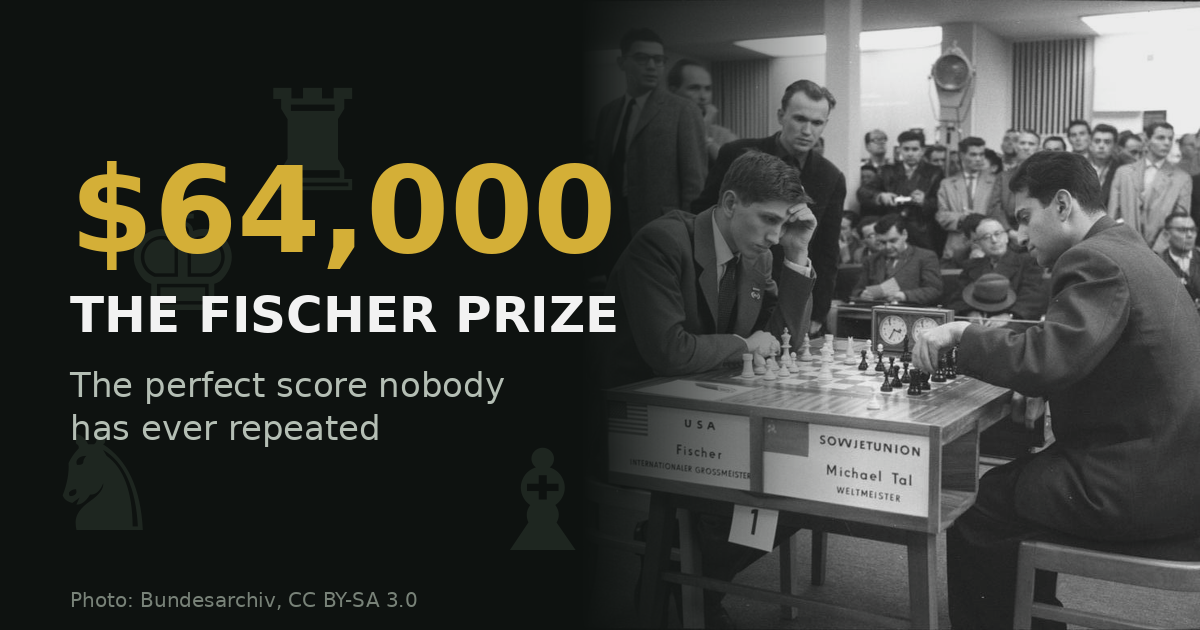
Photo: Bundesarchiv, Bild 183-76052-0335 / Wikimedia Commons (CC BY-SA 3.0 DE)
By the end of the third round of this year's U.S. Championship, a $64,000 prize had already vanished. Four players still had perfect scores after Round 2. One round later, all four had drawn or lost, and the prize simply became impossible, the way a lottery ticket becomes worthless after the draw.
The prize is called the Fischer Prize. It goes to any player who finishes the U.S. Championship with a perfect score: eleven wins, no draws, no losses. Smaller bonuses reward winning streaks of five to ten games, as long as the streak starts in Round 1. They double with each extra win, from $1,000 for five straight to $32,000 for ten. This year, after three rounds, no player in either section still had a perfect record, so all of it went back in the vault.
It is named for the only player who ever did it.
The 11-0
In the winter of 1963-64, a 20-year-old Bobby Fischer played the U.S. Championship in New York and won all eleven games. It remains the only perfect score in the history of the championship, which has been decided by a tournament since 1936, when Samuel Reshevsky won the first one.
The 11-0 was Fischer's sixth U.S. title. He played in eight U.S. Championships and won all eight. He won the first at age 14, still the youngest champion ever. The perfect score made him famous far beyond chess. Life magazine profiled him, and Sports Illustrated printed diagrams from all eleven games.
Larry Evans finished second with 7.5 points, three and a half behind. That gap led to a well-known joke: Evans was congratulated on winning the tournament, and Fischer on winning the exhibition.
The number 64
The prize was first offered in 2009, the year after Fischer died. Rex Sinquefield, the founder of the Saint Louis Chess Club, has offered it many times since, and in 2014 he extended it to the U.S. Women's Championship as well. The number is a good one for chess. There are 64 squares on the board, so $64,000 is one thousand dollars for every square. Fischer was also 64 when he died in 2008.
The brilliancy
The game that won the tournament's brilliancy prize lasted 21 moves. Robert Byrne, playing White, resigned against Fischer in a position so wild that two grandmasters explaining the game to spectators in another room believed Byrne was winning.
Fischer, with the black pieces, planted a knight on d3 with 14...Nd3, protected by the bishop on a6. Then he gave it up with 15...Nxf2, a real sacrifice that dragged the white king into the open. Byrne took the material, but the white king never found a safe square. After 21...Qd7, Byrne resigned.
 8
8
 7
7


 3
3 2
2
 1ad
1ad f
fFinal position of Byrne vs Fischer, U.S. Championship 1963-64, after 21...Qd7. White resigned here. Black is down material, but the white king is stranded.
For a beginner, this position teaches one of the most important lessons in chess: material only matters if your king is safe. Byrne was ahead on the board and lost the game.
Why nobody has claimed it
Many games at the top level end in draws. To win eleven in a row, a player must never have an off day, never let a worse position slip, and turn every small edge into a win. In 2013, Gata Kamsky won his first four games and was still in the running for the prize, until Joel Benjamin held him to a draw.
Think about what eleven straight wins demands. One tired afternoon, one missed tactic, one endgame where you relax, and the prize is gone. Since 2009 the money has been offered many times, and it has never been paid. Nobody has matched Fischer's 11-0 in more than sixty years.
Three lessons for beginners
Win with both colors. You do not get to choose your colors, and in a round robin half your games come with Black. Fischer's brilliancy against Byrne was a win with Black. If you only study attacking with White, half your tournament starts with a hole in your preparation.
Finish the job. In the final round of the 11-0, with the title already won, Fischer took a knight-against-bishop endgame that was close to level against Anthony Saidy and ground out a win. Winning a won position, or a slightly better one, is its own skill. Slow down, simplify, and give your opponent nothing to work with.
Play every round like the first. Fischer could have coasted through the last rounds. He played every game to win, and he won every game. The beginner version of this habit is simpler: fight in every position, even the boring ones, because boring positions are where many games are actually decided.
Back to 2026
The Fischer Prize is gone for this year, but the tournament goes on. After the rest day, Wesley So and Fabiano Caruana return tied on 3 points in the Open, and Alice Lee leads the Women's event on 3.5. None of them can win every game now. In more than sixty years, nobody else has.
Related Stories
Story • 2026-10-16
Alice Lee at 17: Defend First, Then Win
Story • 2026-10-16
Rachael Li at 16: The Record Breaker Who Stopped Alice Lee's Streak
tournaments • 2026-10-16
The King That Went the Wrong Way: So Beats Robson to Lead the U.S. Championship
Story • 2026-10-15