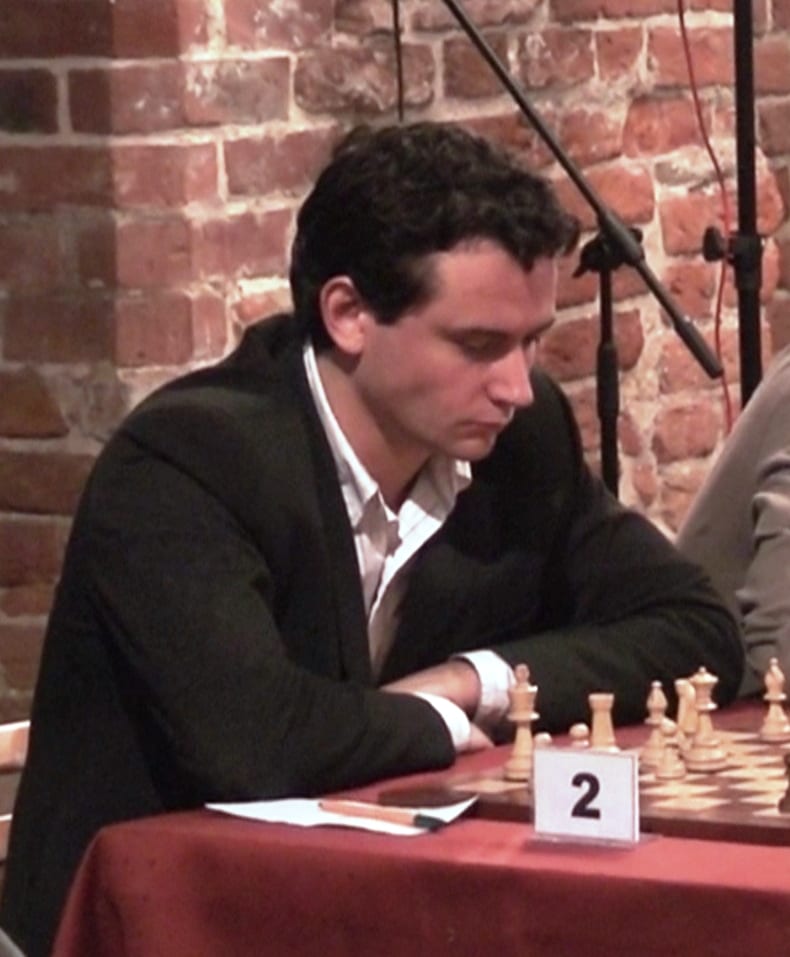
Photo: Aniaj / Wikimedia Commons (CC BY-SA 4.0)
At the end of the film Searching for Bobby Fischer, a boy called Jonathan Poe turns down a draw and then loses. The character was based on a real boy, Jeff Sarwer. In the real game, Jeff did turn down the draw. But he did not lose. The game ended in a draw anyway, with only the two kings left on the board.
Here is Jeff Sarwer's story, that real game move by move, and five more of his early games you can study.
A Young World Champion
Jeff Sarwer was born on May 14, 1978, in Kingston, Ontario, Canada, to a Finnish mother and a Canadian father. He grew up partly in New York, and his chess career made him a well-known face in newspapers, magazines and on television while he was still a small child.
In 1986, in San Juan, Puerto Rico, he won the World Under-10 Championship for boys, playing for Canada. His sister Julia won the girls' title at the same event.
The Game: Jeff Sarwer vs. Josh Waitzkin, 1986
Jeff Sarwer ½-½ Josh Waitzkin US Primary Championship, 1986 White: Jeff Sarwer, age 7 · Black: Josh Waitzkin, age 9
Josh Waitzkin had lost to Jeff at the same championship a year earlier. This time they tied for first place. Josh was placed first on tiebreak, a rule that looks at how strong each player's opponents were, and both were named co-champions.
1.d4 Nf6 2.c4 g6 3.Nc3 Bg7 4.e4 d6 5.f4 O-O 6.Nf3 Nbd7 7.e5 Ne8 8.Bd3 c5 9.dxc5 Nxc5 10.Bc2 a5 11.O-O b6 12.Be3 Bb7 13.Qd4 dxe5 14.Nxe5 Qxd4 15.Bxd4 Rd8 16.Bxc5 bxc5 17.Na4 Bxe5 18.fxe5 Rd2 19.Rf2 Rxf2 20.Kxf2 f6 21.e6 Nd6 22.Nxc5 Rc8
The queens came off early. Now each side has a rook, a bishop, a knight and a few pawns, and Jeff's pawn on e6 is deep in Black's half.
23.Nxb7 Nxb7 24.b3 Nc5 25.Re1 Rc6 26.Be4 Ra6 27.Bc2 Rxe6 28.Rxe6 Nxe6 29.Ke3
All the rooks are gone. It is Jeff's bishop against Josh's knight, with pawns on both sides. Our Stockfish 16 check rates White better here, by about two pawns.
29...Kf8 30.Ke4 Ke8 31.g3 Kd7 32.Kd5 f5 33.a3 h6 34.b4 axb4 35.axb4 Nc7+ 36.Kc5 e5 37.Ba4+ Kc8


 4
4
After 37...Kc8, White to move. White has two connected passed pawns on b4 and c4. Black's pawns on e5 and f5 are pushing on the other side. Our engine rates White about four pawns ahead.
White has two pawns side by side on b4 and c4 that no black pawn can stop. Black has pawns on e5 and f5, and they start running too.
38.Bc6 e4 39.b5 e3
After 39...e3, White to move. Both sides have passed pawns racing. White's bishop and king have to stop the e-pawn while pushing the b- and c-pawns.
The Chance That Slipped Away
40.Bf3 Ne6+ 41.Kd5 Ng5 42.Be2 Kc7 43.Ke5 Ne4 44.Kd4 Kd6 45.Kxe3 Kc5 46.g4 Nd6
Jeff has stopped the e-pawn and taken it. Now look closely at the next position. Our engine says White can win here with one precise move.
After 46...Nd6, White to move. Our engine's best move is 47.gxf5, taking the pawn, and it rates White close to five pawns ahead after that. Jeff played 47.Kf4.
47.Kf4
Jeff moved his king. Our engine's choice was 47.gxf5, taking the pawn. After 47.Kf4 our engine rates the position close to level, and Josh finds the way to hold.
47...g5+ 48.Ke5 fxg4 49.Kf6 g3 50.hxg3 Ne4+ 51.Kg6 Nxg3 52.Bd3 Nh1 53.Kxh6 g4 54.Kg5 g3 55.Be4 Nf2 56.Bd5 Nd1 57.Kf4 Nc3 58.Bc6 Ne2+ 59.Kf3 Nd4+ 60.Kxg3 Nxc6 61.bxc6
Josh's knight gave itself up for Jeff's bishop. Now White has two pawns and Black has none. That sounds like a win for White. But look where the black king is.
After 61.bxc6, Black to move. White has two pawns, on c6 and c4. The black king on c5 is right next to both of them, and the white king on g3 is too far away to help. Our engine rates this as a draw.
61...Kxc6 62.Kf3 Kc5 63.Ke3 Kxc4
The black king takes both pawns. Two kings alone cannot checkmate each other, so the game is a draw.
Final position after 63...Kxc4. Only the two kings are left. Neither side can ever give checkmate, so the game is drawn.
In the film, the story ends with a dramatic win. In real life, our engine preferred the seven-year-old's position for most of the game, and the ending was a lesson in how quickly an endgame can slip away.
Five More Sarwer Games to Study
Only a few of Jeff Sarwer's childhood games have been published. These five are from 1985 to 1988, when he was six to nine years old. Set each one up on a board, or play through it on your computer, and look for the idea in the note. The engine numbers come from our own Stockfish 16, searching to depth 16 to 20.
- Josh Waitzkin vs. Jeff Sarwer, US Primary Championship, 1985 (0-1). The first meeting of the two famous boys, a year before the drawn game above. Jeff, playing Black, is better from about move 21 by our engine. His f-pawn marches all the way to 39...f2, and in the final position it stands one step from becoming a queen.
- Jeff Sarwer vs. M. Granne, New York Open, 1986 (1-0). A 13-move checkmate, played when Jeff was seven. After 11...Nxg3 12.hxg3, the h-file opens, so the rook on h1 now guards h7. Then 13.Qxh7 is checkmate, with the rook protecting the queen.
- Jeff Sarwer vs. Sam Sloan, Manhattan, 1985 (0-1). A loss, and a useful one. Jeff attacks at once with 14.Qg5+ and 15.Qh6, but our engine rates 17.Bh5 as a mistake, and his adult opponent's pieces take over. Attacks have to be checked, not only played.
- Igor Ivanov vs. Jeff Sarwer, Saint John, 1988 (1-0). Ivanov was a strong grandmaster. At nine, Jeff held the game close to level for the first 15 moves by our engine, before Ivanov's pieces slowly took over in the endgame.
- Jeff Sarwer vs. Ilija Ilic, Saint John, 1988 (½-½). Another game where Jeff got a big advantage and did not keep it. After 24...Re7 our engine rates White more than three pawns ahead. 28.Ne5 let it slip, and the game was drawn.
 8
8
 7
7
 2
2 deh
dehSarwer vs. Granne, New York 1986, final position after 13.Qxh7, checkmate. The queen on h7 checks the king, and the rook on h1 protects the queen, so the king cannot take it.
A Different Life
Jeff's father took him away from tournament chess, and the family moved away from New York. For years he hardly played. As an adult, he has spoken openly about how hard his childhood was.
He later became a professional poker player. He also came back to chess from time to time, and in 2015 he earned an International Master norm, a result that counts toward that title, at a tournament in Finland.
What Jeff Sarwer Can Teach You
- In the endgame, take the pawn when you can. Against Waitzkin, 47.gxf5 was the winning move.
- Count the kings. Two extra pawns do not win if the enemy king can reach them first.
- Two kings alone is always a draw. Before you trade your last pieces, make sure you are not trading into one.
- Open files help rooks. Against Granne, one pawn capture let the rook on h1 join the mate.
- Learn from losses. Against Sloan, a fast attack was not enough.
- Winning a good position is a skill of its own. Practice finishing games, not only starting attacks.
A Habit to Practice
Set up the position after 46...Nd6 and play it as White against a friend or a computer. Try 47.gxf5 and see if you can win it. Then set up the position after 61.bxc6 and count how many moves each king needs to reach the pawns.