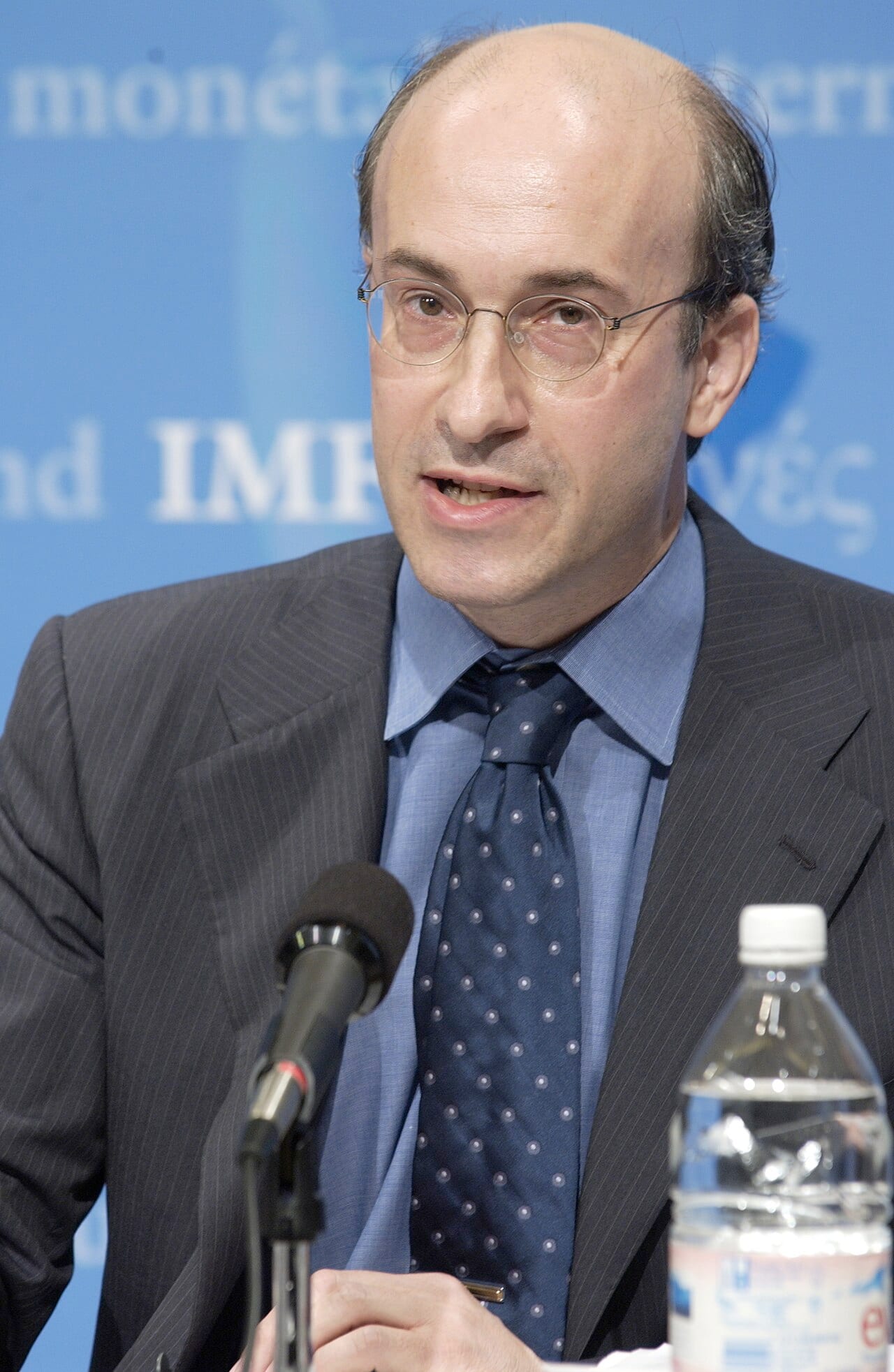
Photo: the International Monetary Fund / Wikimedia Commons (Public domain)
At 16, Kenneth Rogoff dropped out of high school to concentrate on chess. That same year he won the United States Junior Championship. Around that time he met Bobby Fischer, who was impressed, according to the grandmaster and author Andrew Soltis in What It Takes to Become a Chess Master, by Rogoff's "self-assured style and his knowing exactly what he wanted over the chessboard".
Two years later he made a surprising choice. He went to college to study economics. He still became a grandmaster, and later one of the best-known economists in the world. Here is his story, a short win from his championship year, and five more of his early games you can study.
Chess or College?
Kenneth Rogoff was born on March 22, 1953, in Rochester, New York. His father was a professor of radiology at the University of Rochester.
After his 1969 US Junior title, he spent several years living mostly in Europe and playing tournaments there. In 1971 he finished third at the World Junior Championship in Athens. But at 18 he decided he would not become a professional chess player. He studied at Yale, then earned a doctorate in economics from the Massachusetts Institute of Technology in 1980.
He kept playing and improving while he studied. He became an International Master in 1974 and a grandmaster in 1978. In 1975 he finished second in the US Championship, half a point behind Walter Browne, and qualified for the 1976 Interzonal in Biel.
The Game: Kenneth Rogoff vs. Steve Spencer, New York 1969
Kenneth Rogoff 1-0 Steve Spencer US Junior Invitational Championship, McAlpin Hotel, New York · June 1969 White: Kenneth Rogoff, age 16 · Black: Steve Spencer
A short game from the championship Rogoff won that year. It turns on one pawn: the one on f7, next to the black king.
1.e4 c6 2.d4 d5 3.Nc3 g6 4.Nf3 Bg7 5.h3 dxe4 6.Nxe4 Nd7 7.c3 Ngf6 8.Nxf6+ Nxf6 9.Bc4 O-O 10.O-O Qc7 11.Qe2 b6 12.Bg5 b5 13.Bb3 a5 14.a3 Ba6 15.Rfe1 e6 16.Qe5 Qxe5 17.Nxe5
Look at Rogoff's bishop on b3. It points straight down the diagonal at the black king, through the pawn on e6 and the pawn on f7. His knight on e5 also attacks f7.
17...Rfc8
This is the mistake. Our Stockfish 16 check preferred 17...Rfe8. Before this move, f7 was guarded twice, by the rook on f8 and by the king. Now the rook has left, and only the king guards it.
 8
8

 6
6 5
5

 3
3 1ae
1ae g
gAfter 17...Rfc8, White to move. The black rook has left f8, so only the king guards f7. The knight on e5 attacks f7, and the bishop on b3 points at it from far away. Our engine's best move gives up the knight.
18.Nxf7
Rogoff gives up his knight for a pawn. Our engine rates 18.Nxf7 as White's best move by a wide margin. Why give up a knight? Because of what comes next.
18...Kxf7 19.Rxe6
86531agAfter 19.Rxe6, Black to move. The black king is out in the open on f7. The rook on e6, the bishop on g5 and the bishop on b3 all work against it.
White has won a second pawn, and now the rook, the two bishops and the open lines around the black king do the work. The rook on e6 attacks the knight on f6, which the bishop on g5 also attacks.
19...Ne8
Black moves the knight away. But this lets White finish at once.
86531agAfter 19...Ne8, White to move. Our engine finds a forced checkmate. The rook can give check from f6, and the bishops cover the king's escape squares.
20.Rf6+
Black has only one legal move, 20...Ke7, because the bishop on b3 covers g8. After that, our engine finds checkmate in three more moves. The official game score ends here with White's win.
Five More Rogoff Games to Study
These five games are from 1968 to 1972, before he became an International Master. Set each one up on a board, or play through it on your computer, and look for the idea in the note. The engine numbers come from our own Stockfish 16, searching to depth 18.
- Bent Larsen vs. Kenneth Rogoff, Canadian Open, Toronto, August 27, 1968 (½-½). At 15, with Black, against one of the world's leading grandmasters. Our engine rates the game close to level for most of the way. It is a good example of simple, careful defence.
- Pal Benko vs. Kenneth Rogoff, Olot, February 27, 1971 (0-1). A win over a famous grandmaster. After 38.Qf1, our engine finds a forced win for Black. The finish is a trick every player should know: 40...Rd1+ gives up the rook so that the king must take it, because 41.Kxd1 is White's only legal move, and then 41...Qxf1+ takes White's queen.
- Kenneth Rogoff vs. Zoltán Ribli, World Junior Championship, Athens, August 4, 1971 (1-0). Ribli finished second in that championship and Rogoff third. It is a quiet game with queens traded early, level by our engine for a long time. Watch Rogoff's rook reach the seventh rank with 35.Rd7+ and take a pawn with 36.Rxh7.
- Kenneth Rogoff vs. Jan Timman, Costa del Sol, Málaga, 1971 (1-0). Timman later became one of the world's top players. Our engine rates Black slightly better around move 27. Then the pieces come off, and Rogoff's passed d-pawn decides the endgame, reaching 48.d6.
- Kenneth Rogoff vs. Vladimir Tukmakov, World Student Team Championship, Graz, July 27, 1972 (1-0). Look at 28.Ne6. The knight sits on e6, guarded by the pawn on f5, and no black pawn can ever attack that square. A square like that is called an outpost. From e6 the knight bothers Black for the rest of the game.
 de
de f
fBenko vs. Rogoff, Olot 1971, after 40...Rd1+, White to move. The rook gives check. White's only legal move is 41.Kxd1, and then 41...Qxf1+ takes the white queen.
Grandmaster and Economist
Rogoff became a grandmaster in 1978, while he was working on his economics degree. He went on to serve as chief economist of the International Monetary Fund from 2001 to 2003 and became a professor of economics at Harvard University. He has also drawn games with former world champions Mikhail Tal and Tigran Petrosian, and in 2012 he drew a blitz game, played with only a few minutes each, against Magnus Carlsen, then the world's highest-rated player.
What Rogoff Can Teach You
- Watch the f7 square (f2 for White). It is guarded only by the king at the start of the game, and it is a common target.
- Before you move a piece, ask what it was guarding. Against Rogoff, 17...Rfc8 left f7 alone.
- A sacrifice can be worth it if it opens the enemy king. Rogoff gave a knight, and two moves later he had a forced checkmate.
- Look for checks that force the king to take something, like 40...Rd1+ against Benko.
- Put your knights on outposts, squares that no enemy pawn can attack.
- You can be good at more than one thing. Rogoff became a grandmaster while training to be an economist.
A Habit to Practice
At the start of your next few games, look at your own f-pawn and your opponent's. Count how many pieces guard it and how many attack it. When the numbers change, stop and check whether a sacrifice there works.
Related Stories
legends • 2026-10-13
The $64,000 Prize Nobody Has Ever Won
legends • 2026-10-05
The Bishop in the Corner: How Anatoly Karpov Squeezed a Grandmaster
legends • 2026-10-05
Black's King Takes a Long Walk: Wei Yi's Famous Attack at 16
legends • 2026-10-04