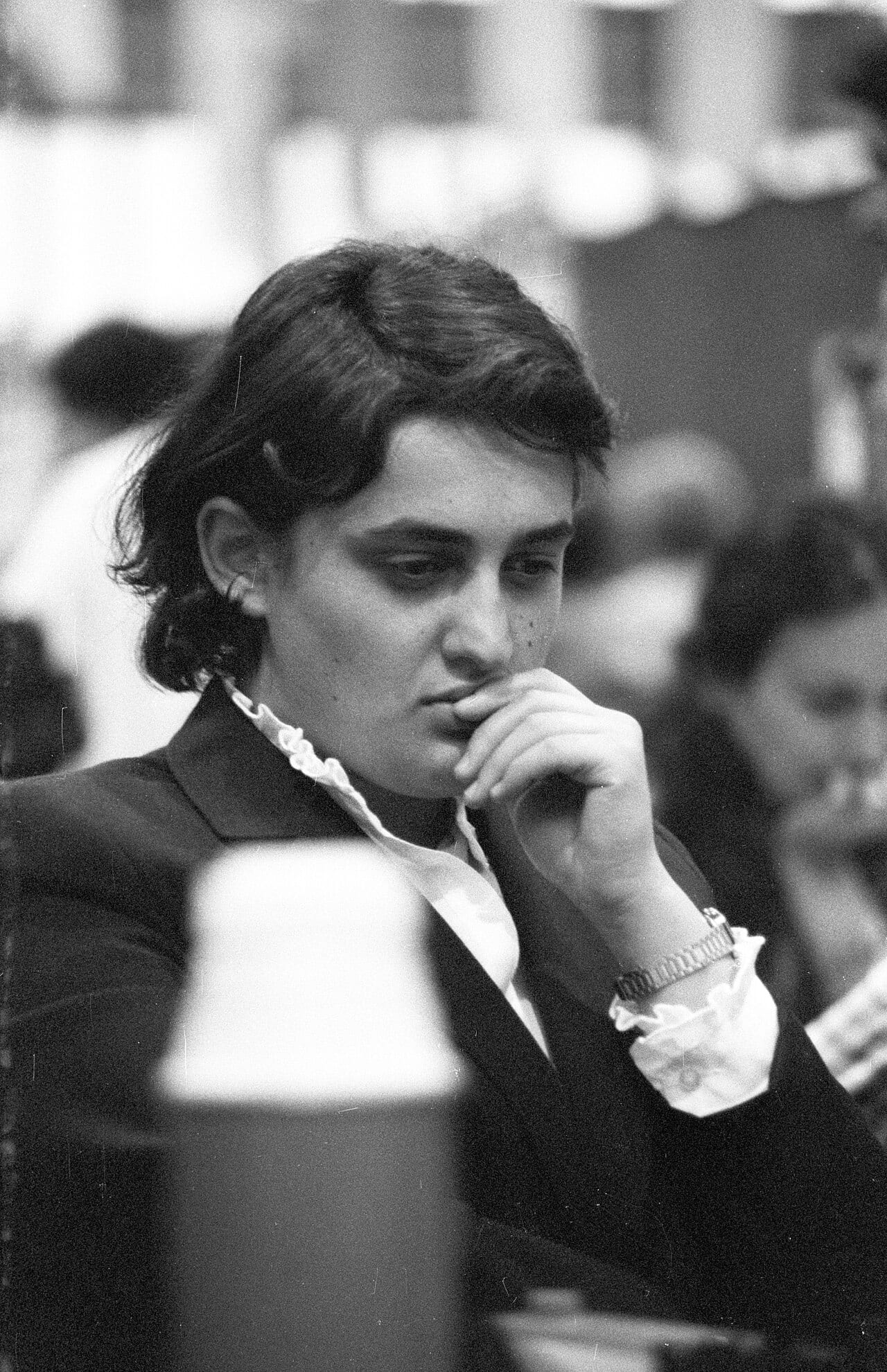
Photo: Krtschil / Wikimedia Commons (CC BY-SA 4.0)
In 1973 the women's world champion sat down to a game at the Soviet women's championship and lost. Her opponent was a girl of 12.
The champion was Nona Gaprindashvili, who had held the title for years. The girl was Maia Chiburdanidze. Five years later she took the title away, and she kept it for 13 years. Here is her story, a game in which she hunted the king of a future world title challenger, and three more of her games to study.
A Girl from Kutaisi
Maia Chiburdanidze was born on January 17, 1961, in Kutaisi, a city in Georgia. Georgia was part of the Soviet Union then. She started playing chess around the age of eight, and she improved very fast.
At 13 she played in her first big tournament, in Brașov in Romania, and she won it. In 1976 she became the girls' champion of the Soviet Union, for players under 18. Eduard Gufeld, a top Soviet trainer, helped her in those years. In 1977 she won the Soviet women's championship, and FIDE, the world chess federation, gave her the title of Woman Grandmaster. She was 16.
At 16 she was already the Soviet champion.
The Road to the Title
To play for the world title, a player had to climb a ladder. In late 1976 she played in an Interzonal, a big tournament in Tbilisi where the best players from many countries fought for a few places. She was 15. She finished second, half a point behind the winner, and she moved on to the Candidates matches.
The Candidates were a series of matches between eight players, and the winner of the last match would get to play the champion. In January 1978 Chiburdanidze won the final against Alla Kushnir by one point, 7½ to 6½. She was 17 years old now, and she had earned a match against Nona Gaprindashvili, the woman who had ruled women's chess for 16 years.
The title match had 15 games. Chiburdanidze won four, lost two and drew nine, so she won 8½ to 6½. The first three games were draws. Then she won game 4 with the black pieces and game 5 with white, and from game 4 until the end she was never behind. You can study game 4 below.
At 17 she was the youngest women's world champion in history. The record stood for 32 years, until Hou Yifan won the title in 2010 at 16. You can read about her in our story on Hou Yifan.
Thirteen Years on Top
Chiburdanidze defended her title four times. She played Nana Alexandria in 1981, Irina Levitina in 1984, Elena Akhmilovskaya in 1986 and Nana Ioseliani in 1988. Against Alexandria the match ended 8-8, and a draw was enough for the champion to keep the title.
In 1991 she lost the title to Xie Jun of China, 8½ to 6½. Her 13 years as champion are the third longest in the history of the women's title. Only Vera Menchik and Gaprindashvili held it for longer.
She did not only play against women. In 1984 FIDE made her a grandmaster, the top title in chess. She was the second woman ever to get it, after Gaprindashvili. She won tournaments that were open to men, in New Delhi in 1984 and in Banja Luka in 1985, and she came second in Brussels in 1987. For her country she won nine gold medals at the women's Chess Olympiad, the big team event: five for the Soviet Union and four for Georgia.
Did You Know?
Chiburdanidze has said she does not like the term "women's chess" and sees no reason to split chess into a men's game and a women's game. She played in many tournaments with men, and the next game shows why they took her seriously.
The Game: Chiburdanidze vs. Short, Dortmund 1983
It was round 5 of the Dortmund tournament in Germany. Chiburdanidze, 22, had White. Her opponent, Nigel Short, was 17. A year later he became a grandmaster, and in 1993 he played Garry Kasparov for the world title.
The opening was a Caro-Kann Defence, which starts with 1.e4 c6 and then ...d5. White's knight went to e4 and traded itself for Short's knight on f6, so Black had to recapture with the g-pawn.
After 6.Be2, Black to move. Black recaptured on f6 with the g-pawn, so the pawns on f6 and f7 stand in a row, doubled. That is a small weakness, but it also opens the g-file for Black's rook.
The game went , and then Chiburdanidze pushed her pawn with . Short castled to the queen's side with .
After 10...O-O-O, White to move. White has castled short, Black has castled long. When the kings live on opposite sides, each player can throw pawns and pieces at the other king. White's pawn on d5 is next to Black's pawn on e6 and can capture it.
She took on e6 with , and the game opened up. Our engine, Stockfish 17.1 searching to depth 22, thinks Short was a little better from here, and it only grew. After Short grabbed a pawn with . White played , which moved her bishop away from e2, and Short took a rook with . He had won a pawn and the exchange, which means a rook for a bishop.
After Black was ahead, 30 points to 28 if you count a pawn as 1, a knight or bishop as 3, a rook as 5 and a queen as 9. Now Short had to choose.
After 18.Be3, Black to move. White threatens Qa8+, which would check the king on c8 and force it to c7. Short took the knight on e4 with 18...Qxe4. Our engine prefers 18...Be7, which guards the square d8 and keeps Black almost three pawns ahead.
He took the knight with . It looks natural. He won a piece, and now Black was five points ahead. But it let White start an attack.
. Now stop and look. White is five points behind. What would you play?
White to move. White is five points behind (25 to 30). Look at the black rook on d8. The white queen on a8 attacks it, and only the black king guards it. Can you pull the king away?
The move is . It is a sacrifice, which means giving up material on purpose. The bishop checks the king, and the king can take it with . But then the king no longer guards the rook, and wins the rook with check. Chess players call this a deflection: you drag a defender away from the piece it protects. Our engine says that after this was White's only move to keep the balance.
After Short had a choice. He could have repeated the position with 21...Ka7 22.Qa5+ Kb8 23.Qd8+ and drawn by repeating moves, but he went for more. He walked his king forward with . Chiburdanidze answered .
After 22.b4+, Black to move. Short's king has walked from c8 all the way to c5, out in the open. Black is still three points ahead (25 to 22), but a king out in the open is in danger even when the army is bigger.
Short took the pawn with . Our engine says the position was equal. The best move for Black was 23...Qc4. Short played , and after he needed to find the best defence.
After 24.Rb1+, Black to move. The black king on b4 is in check from the rook on b1. Black has seven legal moves. Our engine says 24...Kc4 was the best defence. Short played 24...Nb2, putting the knight in the way.
Short played . Our engine, at depth 22, says that was the losing move. After the end was near.
After 28.Bd1, Black to move. The bishop on d1 looks along the diagonal d1-c2-b3-a4 at the king on a4. Only White's own rook on b3 stands in the way. If the rook moves, it uncovers a check, and Rd3 would be checkmate.
The game ended there with a win for Chiburdanidze. Look at what she did. She was worse for a long stretch, but she kept looking for checks. One of them, the bishop sacrifice on b6, dragged the black king out of his shelter, and White's attack kept going. Short was a rising star who slipped at the key moments, and she punished him.
More Games to Study
Chiburdanidze vs. Feustel, Tbilisi 1976
This game comes from the Interzonal that sent her to the Candidates. She was 15. Her opponent was Petra Feustel of East Germany, and Chiburdanidze had White.
The opening was a French Defence, 1.e4 e6 2.d4 d5 3.Nd2 c5 4.Ngf3 Nc6 5.exd5 exd5 6.Bb5 Bd6 7.dxc5 Bxc5. After the pawn trade Black's pawn on d5 stands alone, with no pawn beside it on the c-file or the e-file. This is an isolated pawn, and it is hard to defend. She played quietly until move 19.
 8


 6


 2
 1ae
 g
After 19...h6, White to move. Black's h-pawn has just attacked the knight on g5. But the same pawn used to guard Black's knight on g6, and now it does not.
She played 20.Ne6, a knight sacrifice.
8621aegAfter 20.Ne6, Black to move. The knight attacks the rook on f8 and the bishop on c7. Black took it with the f-pawn, which our engine says was best. But that pawn used to guard the knight on g6.
Feustel took with 20...fxe6, and 21.Qxg6 won the knight on g6, which the f-pawn no longer guarded. After 21...e5 22.Qxd6 Bxd6 23.Bxe5 the queens were off, and White was a pawn up.
What came next is a lesson in endgames. A strong plan in a rook endgame is to put your rooks on the seventh rank, the row second from your opponent's side. A rook there attacks the pawns and traps the king on the back rows. Chiburdanidze brought her rooks forward with 28.Re5 and slowly pushed on. By move 40 both rooks stood on the seventh rank.
62After 40.Rff7, Black to move. Both white rooks stand on the seventh rank. White is one pawn up, 15 points to 14. Black's king on g6 has little room.
Feustel's 42...Rc2 walked into a mating net. Our engine says 42...Rd1 or 42...Rd2 would have kept the game going. The finish was 43.Rg7+ Kf6 44.g5+ hxg5 45.Rgf7+ Kg6 46.f5+ Kh6. Your turn. White to move, and it is mate in one.
62White to move. Find checkmate in one. Hint: both rooks are on the seventh rank, and one of them can check from h7 with the other guarding it.
The move is 47.Rh7#. The rook on f7 slides to h7 and gives check, and the rook on e7 guards it. The pawn on f5 covers g6, and Black's own pawn on g5 blocks the king's other way out.
Gaprindashvili vs. Chiburdanidze, Game 4 of the 1978 Match
This is the game that made her the leader of the title match. She had Black. White opened with a quiet 1.Nf3 Nf6 2.g3 d5 3.c4 c6 4.Bg2 dxc4 5.a4, and Black had won a pawn on c4. By move 20 the position was equal. After 20.Nh4 Chiburdanidze played in the middle of the board with 20...Nb4 21.Bxb4 cxb4.
That pawn on b4 became the key. It guards the square c3, and once White played b3 on move 24, no white pawn could attack c3. A square like that is called an outpost, a safe home for a knight. By move 23 our engine saw Black ahead by more than two pawns.
Chiburdanidze sent her last knight on a long trip, 22...Nd7 23.Qc2 Nc5 24.b3 a6 25.Nf3 b5 26.axb5 axb5 27.Ne3 Na4. Then came 28.Qa2.
42deAfter 28.Qa2, Black to move. The knight on a4 can jump to c3. From c3 it attacks the queen on a2 and the rook on d1 at the same time, a fork. The pawn on b4 guards the knight, so no white pawn can chase it away.
She played 28...Nc3, and White had to save the queen. After 29.Qa5 Nxd1 30.Rxd1 Qxb3 Black had won the exchange, a rook for a knight, and a pawn. The game ended after 31.Qxb5 Rc3 32.Qb7 Rcxd3 33.Rxd3 Rxd3 34.Nd5 Rxf3. The lesson is simple. Before you move a piece, look at what the next square would attack.
Short vs. Chiburdanidze, Banja Luka 1985
Two years after Dortmund the two met again, in round 6 of the Banja Luka tournament in Yugoslavia, which she went on to win. Short was 19 and played White. Chiburdanidze had Black and chose the Sicilian Dragon, 1.e4 c5 2.Nf3 d6 3.d4 cxd4 4.Nxd4 Nf6 5.Nc3 g6 Bg7 7.O-O O-O. Short answered with 8.Kh1, a quiet king step into the corner.
The middle of the game swung back and forth. Our engine says Black slipped with 26...Qc8, and White could have kept a good edge with 27.Rc4, but Short played 27.Be5 and the balance came back. Then, after 30.Bf3, Chiburdanidze played her queen to b5.
4hAfter 30...Qb5, White to move. Black threatens 31...Qf1, checkmate. White's king on h1 has no escape square, because its own pawns stand on g2 and h2, and a queen on f1 would cover g1.
Many moves stopped the mate in one, such as 31.Qf2 or 31.Be2. Short played 31.b4, and Black played 31...Qf1#.
4fhAfter 31...Qf1, checkmate. The king on h1 is in check from the queen on f1. It cannot go to g1, g2 or h2, and nothing can block or capture.
This is a back-rank mate. The king hides behind its own pawns, and one check on the first row finishes it. The cure is a pawn move that makes an escape square, which chess players call luft, German for "air". Notice where Short's king stood since move 8.
What You Can Take From Maia Chiburdanidze
At 12 she beat the champion, at 17 she became the champion, and at 22 she beat a young player who would later play for the world title. In the game against Short she was worse for a long time and still won, by asking one question again and again: where is the king, and what can I check?
Try it in your next game. Before you defend, look at every check you have. One of them may drag a defender away from something valuable.