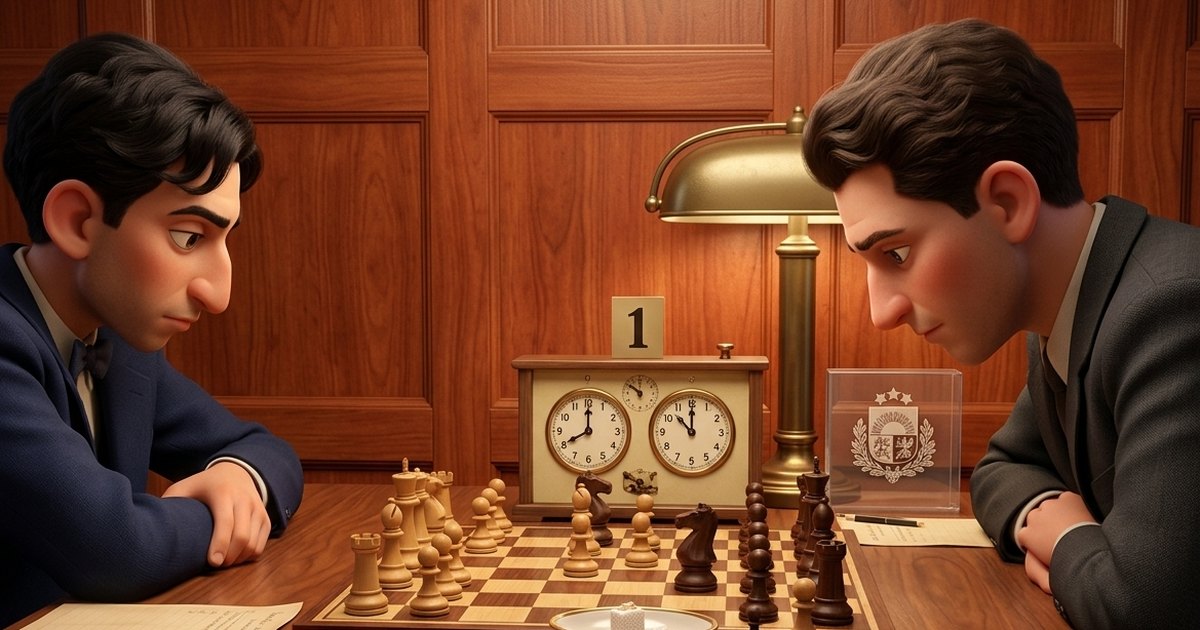
Illustration: a young Mikhail Tal (left) at the chessboard. This is not a real picture of him, and the board shown is not a position from a real game.
Let us start with a puzzle. Black to move. White has just taken Black's queen. Only one move is good for Black. Keep it in mind: you will meet this position again in the game below.


 7
7

 2
2


 c
cBlack to move. White has just taken Black's queen. The black pawn on f3 attacks the white queen on e2. Find the only good move.
The player with Black was Mikhail Tal. Chess fans called him "The Magician from Riga". At 23 he became the youngest world champion there had ever been.
A Boy from Riga
Tal was born on 9 November 1936 in Riga, the capital of Latvia. As a child he joined the chess club at the Riga Palace of Young Pioneers, a club for children.
In 1949 a young master named Ratmir Kholmov gave a simultaneous exhibition, or "simul", where one strong player walks from board to board and plays many people at once. In his autobiography, Tal describes beating Kholmov that day with a clever combination, when he was about 13.
Climbing to the Top
- In 1956 Tal played in the championship of the Soviet Union, one of the strongest national championships in the world, and shared fifth place.
- In 1957, at 20, he won it. He was the youngest Soviet champion ever. He had not played enough international events to earn the grandmaster title the normal way, so FIDE, the world chess federation, gave it to him that year because of the win.
- In 1958 he won the Soviet championship again, and then won the Interzonal tournament in Portorož, a step on the road to the world title.
- In 1959 he won the Candidates Tournament, the event that decides who gets to challenge the world champion, in Yugoslavia with 20 points out of 28, ahead of Paul Keres. He won all four of his games against a teenage Bobby Fischer.
- In 1960 he played Mikhail Botvinnik for the world title in Moscow, from March to May. Tal won 12½-8½, with six wins, two losses and thirteen draws. He was 23.
Botvinnik won the title back in a return match in 1961. Tal kept playing at the top for many years. In 1973 and 1974 he played 95 games in a row without losing, a record that stood until 2018. He died in Moscow on 28 June 1992.
The Game: Mikhail Botvinnik vs. Mikhail Tal, World Championship 1960, Game 6
Mikhail Botvinnik 0-1 Mikhail Tal World Championship match, Moscow, 1960 · Game 6 White: Mikhail Botvinnik, world champion · Black: Mikhail Tal, age 23
Botvinnik was known for deep, careful strategy. Tal was known for attacks and sacrifices. This game shows what happened when those two styles met.
1.c4 Nf6 2.Nf3 g6 3.g3 Bg7 4.Bg2 O-O 5.d4 d6 6.Nc3 Nbd7 7.O-O e5 8.e4 c6 9.h3 Qb6 10.d5 cxd5 11.cxd5 Nc5 12.Ne1 Bd7 13.Nd3 Nxd3 14.Qxd3 Rfc8 15.Rb1 Nh5 16.Be3 Qb4 17.Qe2 Rc4 18.Rfc1 Rac8 19.Kh2 f5 20.exf5 Bxf5 21.Ra1
This opening is the King's Indian Defence: Black puts the bishop on g7 and castles early, then fights for the center with pawns. Both kings are safe. Each side has traded one knight, and every other piece is still on the board.
7
 21ac
21acAfter 21.Ra1, Black to move. The black knight on h5 can jump to f4. There, both the pawn on g3 and the bishop on e3 can take it.
21...Nf4
Tal put his knight on a square where two white pieces could take it. This is a sacrifice: giving away material on purpose to get something else, like an attack or open lines.
Here is the honest part. Our own Stockfish 17.1 check at depth 20 does not think 21...Nf4 was Black's best move. It prefers 21...Nf6, and it rates White slightly better after either move, a little more so after the sacrifice. So the sacrifice was not perfect. What it did was make the position very hard to handle, even for a world champion, as the next moves show.
22.gxf4 exf4
721acAfter 22...exf4, White to move. Black has given a knight for one pawn. The pawn on f4 attacks the bishop on e3, and the bishop on g7 now aims straight at the knight on c3.
Count the material. White is ahead by a knight for a pawn. But look at what changed. The pawn on f4 attacks White's bishop. The long diagonal from g7 is open, and the bishop there now hits the knight on c3. White's king on h2 has fewer pawns around it.
23.Bd2 Qxb2 24.Rab1 f3
72bcAfter 24...f3, White to move. Both queens are attacked. The rook on b1 attacks the black queen on b2. The pawn on f3 attacks the white queen on e2.
Now both queens are under attack. White's rook on b1 hits the black queen, and Tal's pawn on f3 hits the white queen. White has to choose.
Our engine's choice was 25.Bxf3, taking the pawn with the bishop and keeping White better. Botvinnik took the queen instead:
25.Rxb2
This is the puzzle from the start of the article. Did you find it?
25...fxe2
The pawn takes the white queen. Queen for queen, the trade is even. But now look at the pawn.
72cAfter 25...fxe2, White to move. The black pawn on e2 is one step from becoming a new queen on e1. It also attacks the squares d1 and f1.
The black pawn is one step from the last row, where it would turn into a new queen. White has to spend time and pieces stopping it. Every other move would have been a mistake: our engine rates Black well ahead after 25...fxe2 and White far ahead after any other move. That is why it was the only good move.
26.Rb3 Rd4 27.Be1 Be5+ 28.Kg1 Bf4 29.Nxe2 Rxc1 30.Nxd4 Rxe1+
72egAfter 30...Rxe1+, White to move. The trades are over. Each side has three pieces, and Black has one more pawn, plus two bishops working together.
After all the trades, Tal has won back the piece he gave on move 21. Each side has three pieces, and Black has an extra pawn and two active bishops.
31.Bf1 Be4 32.Ne2 Be5 33.f4 Bf6 34.Rxb7 Bxd5 35.Rc7 Bxa2 36.Rxa7 Bc4 37.Ra8+ Kf7 38.Ra7+ Ke6 39.Ra3 d5 40.Kf2 Bh4+ 41.Kg2 Kd6 42.Ng3 Bxg3 43.Bxc4 dxc4 44.Kxg3 Kd5 45.Ra7 c3 46.Rc7 Kd4
In the endgame Tal's king walked forward to help his c-pawn. Botvinnik soon resigned.
What to Learn from This Game
- A sacrifice can work even when it is not perfect. 21...Nf4 was not the engine's first choice, but it gave White hard problems on every move.
- Count what you get, not only what you give. For the knight, Tal got open lines, an active bishop and a pawn close to White's king.
- When two pieces are attacked, look at all the captures. Botvinnik took the queen, and after 25...fxe2 the black pawn became the most dangerous piece on the board.
Five More Games to Study
- Mikhail Tal vs. David Bronstein, Soviet Championship, 1957 (1-0). From the event where Tal became the youngest Soviet champion. After Bronstein takes a knight with 45...Kxf8, which our engine marks as the losing mistake, 46.Qe7+ leaves the black king only one square, g8. Our engine then finds White completely winning.
- Mikhail Tal vs. Vasily Smyslov, Candidates Tournament, 1959 (1-0). Smyslov was a former world champion. Watch 19.Qxf7: Tal puts his queen where the rook can take it. After 19...Qa1+ 20.Kd2 Rxf7 21.Nxf7+ Kg8 22.Rxa1, the queens are gone and Tal is ahead in material. Our engine says the real mistake came one move earlier, with 18...Nf6.
- Mikhail Tal vs. Bobby Fischer, Candidates Tournament, 1959 (1-0). One of Tal's four wins over Fischer that year. Fischer grabs a knight with 23...Qxc3, and our engine calls it a big mistake. Tal answers 24.Bxf5+, a bishop sacrifice with check that opens the f-file. After 25.Qxf5+, Fischer's other king move, 25...Kg7, would have run into a forced checkmate.
- Mikhail Tal vs. Mikhail Botvinnik, World Championship, 1960, Game 1 (1-0). The first game of the match. Tal's queen takes two pawns on Black's kingside, 9.Qxg7 and 10.Qxh7, and then his own king walks to d1 with 11.Kd1. It looks risky, but our engine rates the position slightly better for White. Tal won after 31.Bxg8, taking a rook.
- Mikhail Tal vs. László Szabó, Chess Olympiad, Leipzig, 1960 (1-0). Played as world champion, and a quieter win. Watch Tal's queen collect two pawns with 39.Qxa5 and 40.Qxb4. Tal could attack like a magician, and he could also win slowly.
Related Stories
tournaments • 2026-09-27
The Last-Day Win: Madaminov Beats Dehtiarov as Uzbekistan Win the Samarkand Olympiad
tournaments • 2026-09-24
The Bishop Move That Opened the Door: Svane Beats Vokhidov at the Samarkand Olympiad
legends • 2026-09-22
The Endgame Genius: José Raúl Capablanca
legends • 2026-09-22