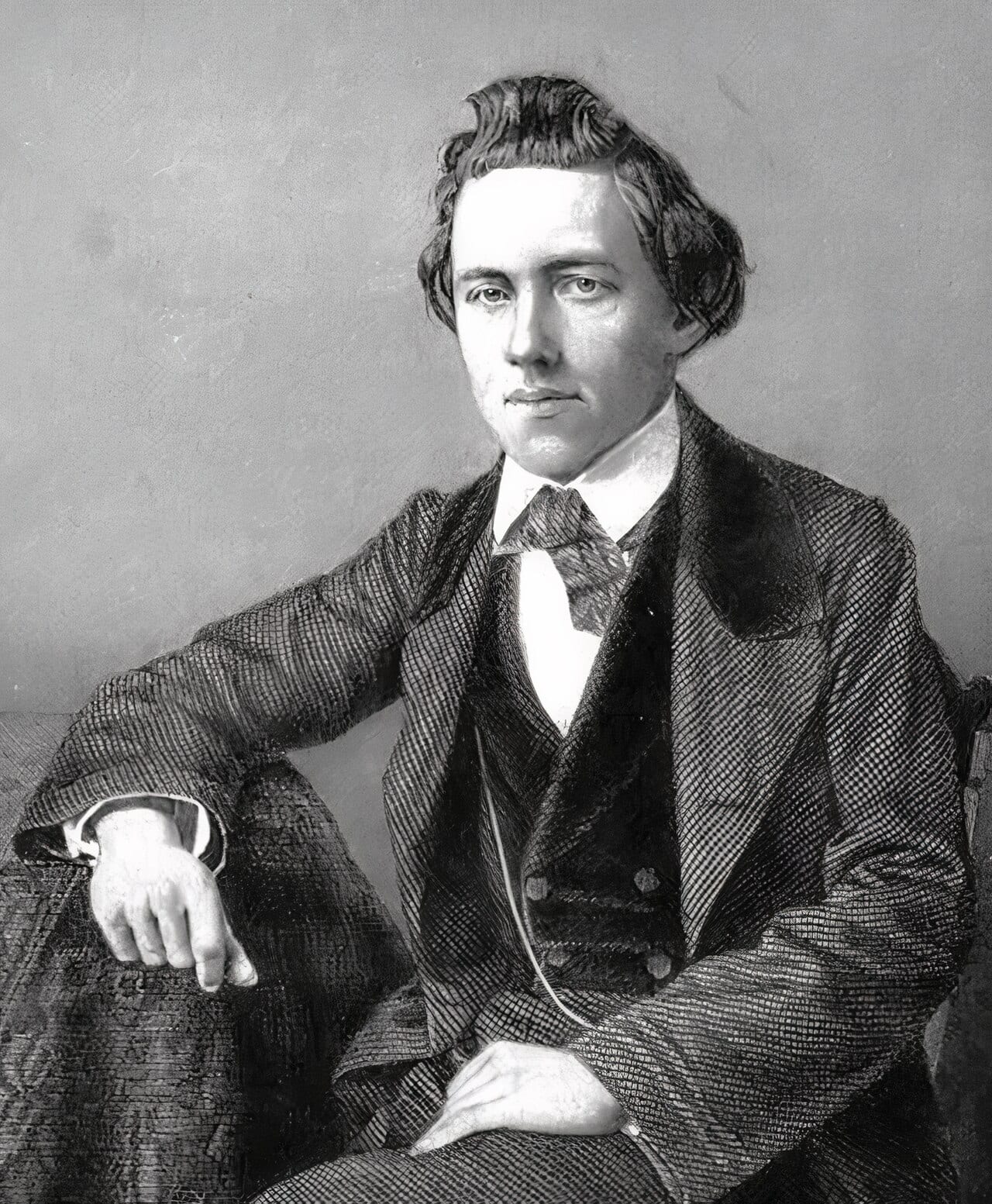
Photo: Wikimedia Commons contributor / Wikimedia Commons (Public domain)
In the autumn of 1858, a young American sat in a private box at the Italian opera house in Paris. He loved music, but he had his back to the stage. Facing him were two noblemen, the Duke of Brunswick and Count Isouard, and between them was a chessboard. The Duke loved chess so much that he played it even at the opera. Morphy's friend Frederick Edge wrote that on one of their visits, the two noblemen argued about their moves through most of the show, and a singer on stage kept glancing up at the box to see what the fuss was about.
The young American was Paul Morphy. He was 21 years old, and he was beating the best players in Europe one after another. On one of those opera nights he played a game against the Duke and the Count that lasted only 17 moves. More than 160 years later, chess teachers still use it to show beginners how to play.
Here is how a boy from New Orleans got there, why he stopped, the famous game from the opera, and five more of his games you can study.
A Boy in New Orleans
Paul Morphy was born on June 22, 1837, in New Orleans, Louisiana. His father, Alonzo Morphy, was a lawyer who later became a judge on the Louisiana Supreme Court. His mother came from a French Creole family and was a gifted musician. At their Sunday gatherings, the family played music and chess.
How did Paul learn the game? There is a famous story. His uncle, Ernest Morphy, said that nobody ever taught Paul the rules. The boy watched his father and uncle play, and one day, after they gave up on a long game as a draw, Paul spoke up. He said his uncle should have won, and then he set up the pieces and showed how.
It is a great story, and it may not be true. In Morphy's lifetime a similar tale went around the chess clubs: that he learned just by watching and was soon a match for his uncle. His friend Frederick Edge, who travelled with him in Europe and wrote a book about him in 1859, said that Morphy himself called that story "a humbug and an impossibility." A humbug means nonsense. So we do not know exactly how Paul learned. We do know he learned fast.
Beating a General at Nine
In 1846, General Winfield Scott, the head of the United States Army, stopped in New Orleans on his way to the war with Mexico. He liked chess and asked for a strong local player to play against after dinner. According to Morphy's biographer, David Lawson, the general felt insulted when the opponent turned out to be a nine-year-old boy. He thought people were making fun of him. His hosts told him the boy really was that good, so he sat down to play.
Paul won both games. In the second, he announced a checkmate in six moves. That means he said out loud, before it happened, that he would checkmate the general in six moves. Then he did it.
The Twelve-Year-Old and the Master
By 1848 and 1849, Paul was playing the best players in New Orleans. The strongest was Eugène Rousseau. Lawson counts at least 50 games between them, and Paul lost at most five.
In 1850, a real chess master came to town. Johann Löwenthal was a strong player from Hungary who was travelling around America beating the best local players. He was invited to the Morphy family home to play Paul, who was 12.
Paul's uncle Ernest later described what happened to Löwenthal's face. Every time the boy played a good move, the master's eyebrows shot up. Ernest said it looked "comique," which is French for funny.
They played three games. Edge wrote that Paul won two and drew one. Some other old sources say he won all three. Either way, the master did not win a single game against the 12-year-old. You can study one of those games in the list at the end of this article.
School Before Chess
Then Paul mostly stopped playing and put school first. He studied at Spring Hill College in Mobile, Alabama, and finished his first degree in 1854. He stayed one more year and earned a master's degree in 1855. Then he studied law in New Orleans and finished on April 7, 1857.
There was one problem. He was 19, and he was too young to work as a lawyer. So he had some free time.
Champion of America
That year, the first American Chess Congress was held in New York, from October 6 to November 10, 1857. It was a knockout event for 16 players. Each round was a short match, and the loser went home.
Paul first said no to the invitation, then changed his mind. He beat James Thompson, then his family friend Alexander Meek, then Theodor Lichtenhein. In the final he met Louis Paulsen, a strong German master, and beat him with 5 wins, 1 loss and 2 draws.
Games had no clocks in those days, so a player could think as long as he liked. According to Lawson, in the second game of the final Paulsen took about eleven hours for his moves. Morphy usually played quickly.
Across the Ocean
Next, Paul wanted to play the best players in Europe. In 1858 he sailed to England. He hoped to play a match against Howard Staunton of England, who was seen as the champion of Europe, but the match never happened.
He played many of the other top players instead, and he beat them. In London he won a match against Löwenthal, the same master he had beaten as a boy, with 9 wins, 3 losses and 2 draws. In Paris he beat Daniel Harrwitz, the professional at the famous Café de la Régence. He also gave blindfold shows, playing eight opponents at the same time without looking at any of the boards.
Then came the biggest test: Adolf Anderssen of Germany, thought by many to be the best player in Europe. Just before the match, in December 1858, Paul got sick with a stomach illness. The doctors of that time treated him with leeches, which suck blood, and he was so weak that he had to be helped into the room for the first game. He lost that game after seven hours. Then he won the match with 7 wins, 2 losses and 2 draws. He was 21.
Anderssen took it with good humor. After the ninth game, which Morphy won in 17 moves, and the tenth, which Anderssen won in 77, he told Edge: "Mr. Morphy wins his games in Seventeen moves, and I in Seventy. But that is only natural."
Did You Know?
One of the most popular openings in chess is named after Paul Morphy. In the Spanish Opening (1.e4 e5 2.Nf3 Nc6 3.Bb5), the reply 3...a6, which asks White's bishop what it wants to do, is called the Morphy Defense.
Why He Walked Away
When Paul came home in 1859, people cheered him in New York and Boston as the chess champion of the world. There was even a Morphy hat and a Morphy cigar.
But Paul did not see chess as a job. At a dinner in New York he said: "Chess never has been and never can be aught but a recreation." A recreation is a hobby, something you do for fun.
He tried to become a lawyer, but his law office never succeeded. After he came home, he would not play another serious match unless he gave his opponent a head start. Morphy would begin the game without one of his own pawns or knights. In his later years his health, including his mental health, grew worse. He died in New Orleans on July 10, 1884, at the age of 47.
Chess players call him "the pride and sorrow of chess." The pride is how brilliant he was. The sorrow is how short his career was. Wilhelm Steinitz, the first official world champion, used the phrase in 1885, but nobody knows for sure who said it first.
The Game: Morphy vs. the Duke and the Count, Paris 1858
This is the game from the opera. Morphy had White. The Duke of Brunswick and Count Isouard played Black together, choosing each move as a team. That is called a consultation game. The two noblemen were keen players, but they were not masters. What makes the game famous is how clearly Morphy shows three ideas: bring out your pieces fast, open lines toward the enemy king, and keep making threats. In 1932 the American champion Frank Marshall called it "the most famous game of all time."
It started 1.e4 e5 2.Nf3 d6 3.d4 Bg4 4.dxe5 Bxf3 5.Qxf3 dxe5 6.Bc4 Nf6. Black has already traded away a bishop, and White's queen and bishop are both out and pointing at Black's side of the board.
Then Morphy played 7.Qb3.
 8
8


 7
7

 2
2 1a
1a bc
bc eh
ehAfter 7.Qb3, Black to move. The queen attacks the pawn on b7, and nothing guards it. The queen also stands behind the bishop on c4, and both aim at f7, which only Black's king guards.
This is a double attack: one move that makes two threats. If Black guards the wrong thing, for example with 7...Nc6, then 8.Bxf7+ Ke7 9.Qe6 is checkmate. The Duke and the Count found the best defense, 7...Qe7, which guards f7.
Now Morphy could win the b7 pawn with 8.Qxb7. Our engine, Stockfish 17.1 searching to depth 22, rates that as White's best move by a small margin. Morphy did something else. He played 8.Nc3, bringing out one more piece. Black played 8...c6, and Morphy brought out another piece with 9.Bg5.
Black tried to chase the bishop away with 9...b5. Morphy did not move it. He gave up a knight instead: 10.Nxb5 cxb5 11.Bxb5+ Nbd7.
8721aehAfter 11...Nbd7, White to move. Morphy has given a knight for two pawns. Now look at Black's knights. Each one is stuck in a pin.
A pin is when a piece is stuck because a more valuable piece stands behind it. Either it is not allowed to move, or moving it would lose something bigger. Here there are two:
- The knight on d7 is pinned by the bishop on b5. Behind the knight is Black's king, so the knight is not allowed to move at all.
- The knight on f6 is pinned by the bishop on g5. Behind it is Black's queen. The knight may move, but then White takes the queen.
Morphy was one point behind in material, but two of Black's pieces were tied up. He castled on the queenside, 12.O-O-O, which put his rook straight onto the d-file, aiming at d7. A file is a column of squares, like d1 to d8. This one was open, meaning no pawns stood on it. Black answered 12...Rd8, and Morphy took with 13.Rxd7 Rxd7 14.Rd1.
72cdAfter 14.Rd1, Black to move. Two white pieces attack the rook on d7: the rook on d1 and the bishop on b5. The rook on d7 is pinned to the king, so it cannot run away.
Black is still guarding d7 three times, with the knight, the queen and the king. But the rook cannot move, and the knight on f6 is still pinned to the queen. Black played 14...Qe6. It offers a queen trade, and it takes the queen off the line of White's bishop on g5, so the knight on f6 is no longer pinned.
Morphy took on d7 anyway: 15.Bxd7+ Nxd7.
72cdAfter 15...Nxd7, White to move. White can force checkmate in two moves. Try to find it before you read on.
Here is a puzzle. White has a queen, a rook and a bishop left. White can force checkmate in two moves, and we checked every possible move: there is only one way.
The answer is 16.Qb8+. Morphy gives up his queen. Black's only legal reply is to take it, 16...Nxb8, and that takes the knight away from d7. Now 17.Rd8 is checkmate.
72cFinal position after 17.Rd8 checkmate. The rook gives check. The bishop on g5 guards the rook and the e7 square. Black's own bishop on f8 and pawn on f7 block the king's other squares.
Count the material at the end. White has 15 points, a rook, a bishop and seven pawns. Black has 25 points, including a queen. Morphy was 10 points behind, and he won.
Now look at where Black's pieces are. The bishop on f8 and the rook on h8 never moved in the whole game. The king never moved either. Every one of White's pieces moved, and most of them joined the attack. That is the lesson of the Opera Game. A piece that stays at home does not help.
Five More Morphy Games to Study
Set up each game on a board, or play through it on your computer, and look for the idea in the note. The engine numbers in these notes come from our Stockfish 17.1, searching to depth 20 or 22.
- Morphy vs. Johann Löwenthal, New Orleans, May 25, 1850 (1-0). The 12-year-old against the master. Watch Morphy's f-pawn. It moves 2.f4, then 17.f5, then 19.f6, and then takes a pawn with 20.fxg7. The pawns in front of Black's king are torn open. Later, after 26...Re8, Morphy finds 27.Nf6, the move our engine also picked first, and goes on to win.
- Louis Paulsen vs. Morphy, American Chess Congress final, New York, 1857 (0-1). Morphy gives up his queen with 17...Qxf3. After 18.gxf3 Rg6+ 19.Kh1 Bh3, Morphy is six points behind, and our engine rates Black more than three pawns ahead. The threat is Bg2+ and then Bxf3, which is checkmate. Paulsen's reply, 20.Rd1, did not stop the attack, and he gave up the game eight moves later.
- Henry Bird vs. Morphy, London, 1858 (0-1). Morphy gives up a rook with 17...Rxf2 18.Bxf2, and then puts his queen where a pawn can take it: 18...Qa3. Look at the diagram below and work out why Bird did not take it.
- Morphy vs. Adolf Anderssen, match game 9, Paris, 1858 (1-0). The game that took only 17 moves. Morphy's knights jump in with 8.N1c3 and 9.Nd5. Then watch Anderssen's king walk out: 10...Kf7, 14...Kg6, 15...Kxf6. Our engine says 14...Ke7 kept the game level. After 14...Kg6, White was winning. The game ended after 17.Ke2.
- Anderssen vs. Morphy, match game 4, Paris, 1858 (0-1). Proof that Morphy could win slowly, too. With Black, he wins a pawn with 26...Bxb2 and another with 28...Qxf2. The queens come off on move 33. Then his c-pawn marches: 35...c6, 47...c5, 48...c4, 50...c3. The game ends with 51...Rxg4+. If White takes the rook with 52.Kxg4, the pawn goes to c2, one step from becoming a queen, and our engine rates Black far ahead.
732cdhBird vs. Morphy, after 18...Qa3, White to move. The pawn on b2 can take the queen. But after 19.bxa3, the bishop takes back with 19...Bxa3, and that is checkmate. Bird played 19.c3 instead.
Why Morphy Still Matters
Garry Kasparov, a world champion, wrote that Morphy understood three ideas long before anyone wrote them down as rules: develop your pieces quickly, control the center, and open lines for your pieces. You saw all three in the Opera Game.
Bobby Fischer, another world champion, admired him too. At a press conference in 1992, Fischer said: "Morphy, I think everyone agrees, was probably the greatest genius of them all."
What Paul Morphy Can Teach You
- Get your pieces out early. In the Opera Game, every white piece moved, and Black's bishop on f8 and rook on h8 never did.
- A free pawn is not the only good idea. On move 8, Morphy brought out a knight instead of grabbing the pawn on b7.
- Look for pins. A pinned piece is stuck, so attack it again and again.
- Open lines toward the enemy king. Morphy's rooks used the open d-file to finish the game.
- Count material, but do not stop there. Morphy was 10 points behind when he gave checkmate.
- Check the stories you hear. Even a famous tale about how Morphy learned chess was one he called "a humbug."
A Habit to Practice
Play through the Opera Game on a real board, one move at a time. After each of White's moves, ask: which piece moved, and what is it attacking now? Then do the same for Black and notice which pieces never join in.
Next time you play, count your moves in the opening. Try to move each piece once before you move any piece twice. That is the habit behind the Opera Game.
Related Stories
legends • 2026-10-13
The $64,000 Prize Nobody Has Ever Won
legends • 2026-10-05
The Bishop in the Corner: How Anatoly Karpov Squeezed a Grandmaster
legends • 2026-10-05
Black's King Takes a Long Walk: Wei Yi's Famous Attack at 16
legends • 2026-10-04