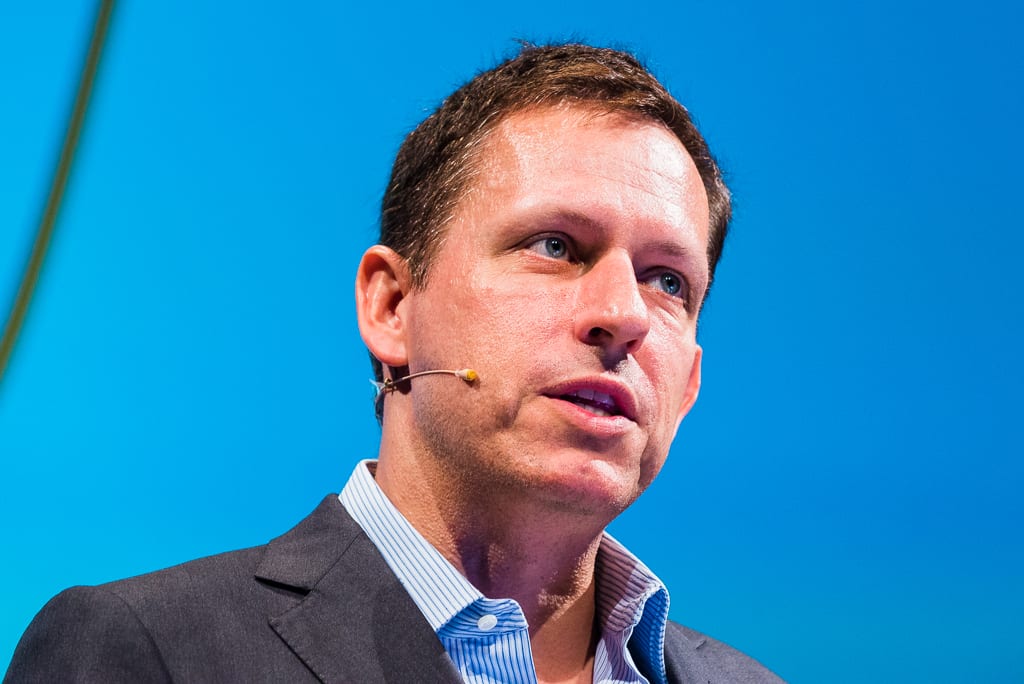
Photo: Dan Taylor / Wikimedia Commons (CC BY 2.0)
In August 2000, at the US Open in Saint Paul, Minnesota, Peter Thiel sat down with the black pieces. He was 32, and two years earlier he had co-founded the company that became PayPal. By move 27 he had chased the white king out of its castled corner and all the way up to g4.
Here is his story, that game, and five more of his games you can study.
A Boy Who Moved a Lot
Peter Thiel was born on October 11, 1967, in Frankfurt, West Germany. His family moved to the United States when he was one. They later lived in South Africa and in what is now Namibia, before settling in Foster City, California, in 1977. He changed elementary schools seven times.
He started playing chess at six, and at one time he was one of the top junior players in the United States. He was also strong at mathematics. In middle school he placed first in a California-wide math competition, and in 1985 he was the top student of his graduating class at San Mateo High School.
- He holds the US Chess Federation title of Life Master.
- He has not played in a tournament since 2003.
- He studied philosophy at Stanford University and later earned a law degree there, in 1992.
No games from his junior years have been published. The games below are from 1993 to 2003, when he was 25 to 35.
The Game: Carter B. Gibson vs. Peter Thiel, US Open 2000
Carter B. Gibson 0-1 Peter Thiel 101st US Open, Saint Paul, Minnesota · Round 7 · August 11, 2000 White: Carter B. Gibson · Black: Peter Thiel, age 32
1.e4 c5 2.Nf3 d6 3.d4 cxd4 4.Nxd4 Nf6 5.Nc3 a6 6.Bd3 Nbd7 7.O-O b5 8.a3 Bb7 9.Nde2 g6 10.f4 Bg7 11.Ng3 h5
The opening is a Sicilian Defence, Najdorf Variation. White has castled on the kingside, and Black has not castled yet. That means Black can throw his h-pawn at the white king without worrying about his own.
12.f5 Qb6+ 13.Kh1 h4 14.Nge2 h3
 8
8


 6
6
 3
3

 1ac
1ac df
df h
hAfter 14...h3, White to move. Black's h-pawn has marched from h7 to h3, right next to the white king on h1. Our engine rates Black more than two and a half pawns ahead.
15.fxg6 O-O-O 16.Nf4 hxg2+ 17.Kxg2 d5 18.Ncxd5 Nxd5
Black castles on the other side, and then the h-pawn takes on g2 with check. Now the white king has no pawn cover on the kingside.
19.Nxd5
Our engine preferred 19.exd5. After 19.Nxd5, the king hunt begins.
631acdfAfter 19.Nxd5, Black to move. The black queen can take the pawn on g6 with check. Our engine rates Black more than eight pawns ahead after that.
The King Hunt
19...Qxg6+ 20.Kf3 Rh3+ 21.Ke2 Bxd5 22.exd5 Rxh2+ 23.Ke3 Bh6+ 24.Kd4
Every Black move is a check or a capture, and the white king keeps walking. Look where it is now: on d4, in the middle of the board.
631acdfAfter 24.Kd4, Black to move. The white king has walked from g1 to d4. Our engine finds a forced checkmate for Black.
24...Qg7+ 25.Ke4 Nc5+ 26.Kf5
631acdfAfter 26.Kf5, Black to move. Our engine points out that 26...Rxd5 is checkmate at once. Can you see why? Thiel played 26...Qf6+, which also mates soon.
Can you find the fastest finish? The rook on d8 can take the pawn on d5. That checks the king on f5 along the fifth rank, and every square around the king is covered. Thiel chose another route.
26...Qf6+ 27.Kg4 Rg8+
The official game score ends here with Black's win. White has only two legal moves, 28.Bg6 and 28.Bg5, and our engine finds checkmate within two more moves either way.
631acdfFinal position after 27...Rg8+, White to move. The white king has walked from g1 to g4. White can only block with a bishop, and checkmate follows.
Five More Thiel Games to Study
These five games are from 1993 to 2003. Set each one up on a board, or play through it on your computer, and look for the idea in the note. The engine numbers come from our own Stockfish 16, searching to depth 16.
- Peter Yu vs. Peter Thiel, Labor Day Festival Open, California, 1993 (0-1). Against a player rated 2315. Thiel is better for much of the middlegame, then the game becomes level in an ending with queens, a bishop and a knight. After 51.Qe7+ and 52.Qf6, both rated as mistakes by our engine, 52...Qc2+ and 53...Bxe4 win a pawn, and Black's g-pawn later becomes a new passed pawn with 57...gxf3. A good lesson in patience.
- Peter Thiel vs. Thomas Feeney, US Open, Saint Paul, August 6, 2000 (1-0). Our engine rates White better from about move 11. Black tries 19...Nxe5, giving a knight for two pawns, but White keeps the extra piece, and 24.Bxg7 takes another pawn.
- Peter Thiel vs. Rodolfo Hernandez, BCC Goodwin Open, San Mateo, 2000 (1-0). Against a player rated 2162. 29.Nf4 attacks the black queen on d5. Black plays 29...d3 instead of moving it, and 30.Nxd5 wins the queen. Always ask what your opponent's last move attacks.
- Peter Thiel vs. Igor Margulis, San Francisco March Masters, March 26, 2003 (1-0). Against a player rated 2227. A long game where White is slightly better for many moves. After 42...Rxg3+, which our engine rates as a mistake, White's c-pawn and e-pawn run forward together with 50.c6 and 53.e5.
- Peter Thiel vs. Mark Pinto, San Francisco March Masters, March 31, 2003 (1-0). A kingside pawn storm with 8.g4, 10.g5 and 12.h4, and then the rook reaches the seventh rank with 21.Rh7. Our engine rates White better from about move 16 to the end.
861agThiel vs. Hernandez, San Mateo 2000, after 29...d3, White to move. The knight on f4 attacks the black queen on d5. Nothing defends the queen, so 30.Nxd5 wins it.
Chess and Business
After law school, Thiel worked as a lawyer and a trader. In 1998 he co-founded the company that became PayPal, and in 2004 he became the first outside investor in Facebook.
In his book Zero to One, he quotes the world champion José Raúl Capablanca: to succeed, "you must study the endgame before everything else." In 2016 he made the ceremonial first move of a tiebreak game in the World Championship match between Magnus Carlsen and Sergey Karjakin.
What Peter Thiel Can Teach You
- If your king is safe and your opponent's is not, push pawns at the enemy king, like the h-pawn against Gibson.
- Checks keep the initiative. Against Gibson, almost every move from move 19 was a check.
- Always look for the fastest checkmate. Against Gibson, 26...Rxd5 was mate in one.
- Ask what your opponent's last move attacks. Against Thiel, Hernandez left his queen to be taken.
- Level endgames still need care. Against Yu, patience won a pawn and then the game.
- Study the endgame, as Capablanca said, and as Thiel quoted in his book.
A Habit to Practice
Set up the position after 26.Kf5 and find 26...Rxd5. Then list every square around the white king and name the black piece that covers it. In your own games, when you are giving checks, stop each move and look for a mate in one.
Related Stories
legends • 2026-10-13
The $64,000 Prize Nobody Has Ever Won
legends • 2026-10-05
The Bishop in the Corner: How Anatoly Karpov Squeezed a Grandmaster
legends • 2026-10-05
Black's King Takes a Long Walk: Wei Yi's Famous Attack at 16
legends • 2026-10-04