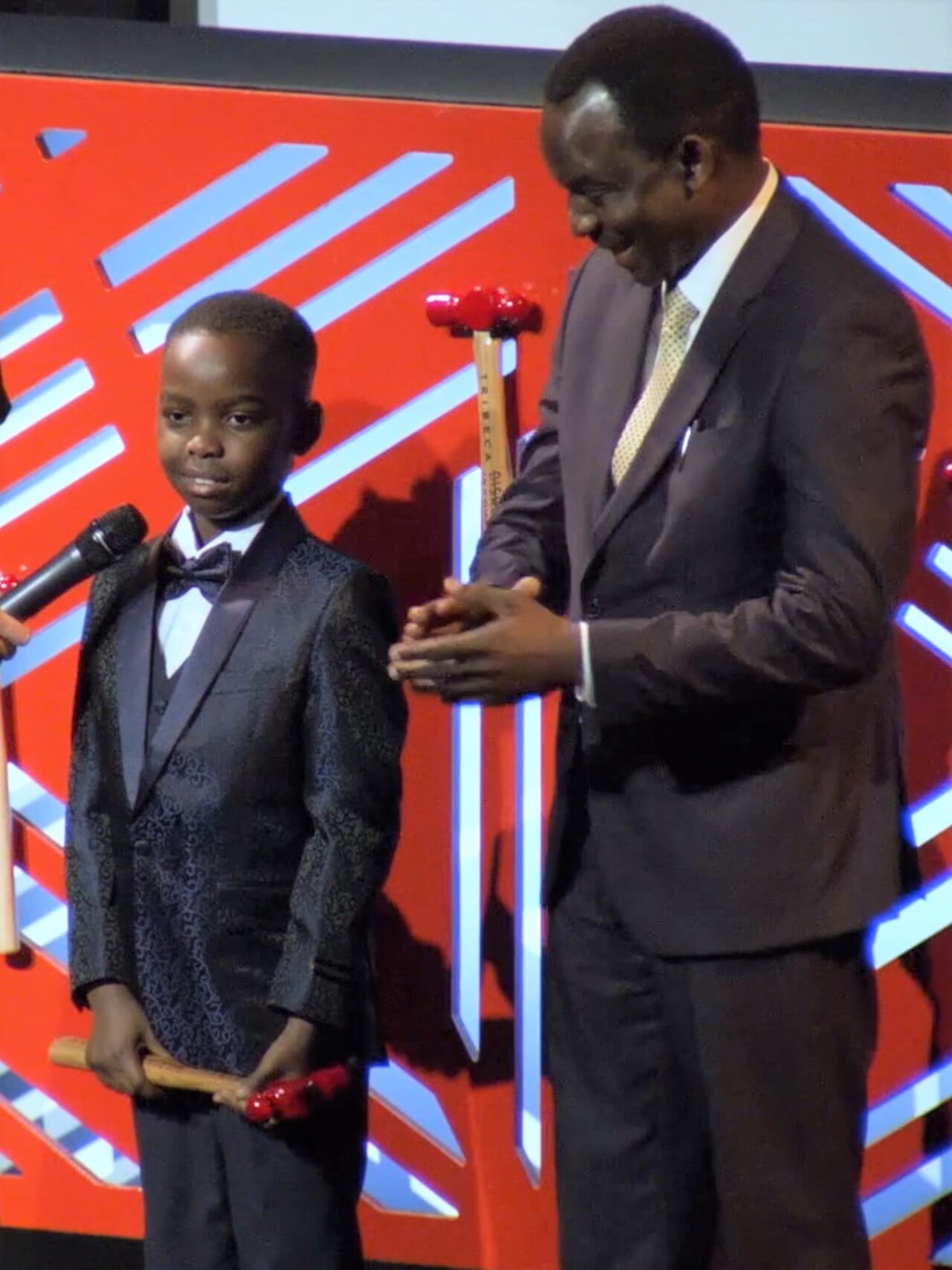
Photo: Tribeca Disruptive Innovation / Wikimedia Commons (CC BY-SA 3.0)
In January 2022, at a tournament in Charlotte, North Carolina, an 11-year-old sat down with the white pieces against Bach Ngo, who was rated almost 200 points higher. The game was level for 32 moves. Then one pawn walked from d5 to d8 and became a queen, and a queen trade turned into a winning pawn endgame.
His name was Tanitoluwa "Tani" Adewumi. Here is his story, that game, and five more of his games you can study.
From Nigeria to a New York Shelter
Tani Adewumi was born on September 3, 2010, in Nigeria. His family is devoutly Christian and had been threatened by the terrorist group Boko Haram. In June 2017 they left Nigeria for the United States and asked for asylum. In New York, they were given a place in a homeless shelter in Manhattan. His father worked as a dishwasher and an Uber driver, and his mother as a cleaner.
At his school, P.S. 116, the chess coach Shawn Martinez introduced the students to the game, and Tani took to it at once. He wanted to join a chess club run by the coach Russell Makofsky, but the fee was $330. When Makofsky heard about the family's situation, he waived it.
- In early 2018 he played his first tournament, with the lowest starting rating, 105.
- In March 2019, at eight, he won the kindergarten to third grade division of the New York State Scholastic Championship. He was seeded eighth of 74 players and scored 5½ out of 6, with no losses.
- In May 2021, at 10, he became a US Chess National Master.
- In November 2021 he became a FIDE Master.
The Game: Tani Adewumi vs. Bach Ngo, Charlotte 2022
Tani Adewumi 1-0 Bach Ngo CCCSA Winter IM Norm Tournament, Charlotte, North Carolina · Round 2 · January 14, 2022 White: Tani Adewumi, age 11, rated 2136 · Black: Bach Ngo, rated 2327
1.d4 Nf6 2.c4 e6 3.Nf3 b6 4.g3 Bb7 5.Bg2 Bb4+ 6.Bd2 c5 7.Bxb4 cxb4 8.O-O O-O 9.Qd3 d6 10.Nbd2 a5 11.a3 Na6 12.e4 e5 13.Rfe1 Qc7 14.Rac1 Rfe8 15.Re2 Bc6 16.Ne1 b5 17.Nb3 Qb6 18.c5 dxc5 19.Nxc5 Rad8 20.Nxa6 Rxd4 21.Nxb4 Rxd3 22.Rxc6 Qb7 23.Nexd3 axb4 24.Nxb4 Rc8 25.Rec2 Rxc6 26.Rxc6 Qd7 27.Nd5 Nxd5 28.exd5 f5
Lots of pieces came off. For the first 32 moves our Stockfish 16 check rates the game close to level. Now look at White's pawn on d5. No black pawn on the c-, d- or e-file stands in front of it, so it is a passed pawn.
29.d6


 3
3
 g
gAfter 29.d6, Black to move. The white pawn on d6 is passed. The black queen on d7 has to keep an eye on it. Our engine rates the position close to level.
29...e4 30.Rb6 g6 31.Bf1 e3 32.Bxb5 Qa7 33.Rc6 Qb7
Both sides now have a dangerous pawn: White's on d6 and Black's on e3. Our engine says 33...Qb7 is a mistake. It preferred 33...exf2+ or 33...Qd4, which keep the game level.
3gAfter 33...Qb7, White to move. The black queen attacks the bishop on b5. Our engine's best move is 34.fxe3, removing Black's dangerous pawn first. It rates White about two pawns ahead after that.
The Pawn Becomes a Queen
34.fxe3 Qxb5 35.d7
White gives up the bishop and takes Black's e-pawn. Now the d-pawn is one step from d8.
3gAfter 35.d7, Black to move. The pawn on d7 is about to become a queen. The black queen can take the rook on c6, but then 36.d8=Q+ makes a new queen with check.
35...Qxc6 36.d8=Q+
Black took the rook, and the pawn became a queen with check. Now each side has a queen, and White has two extra pawns.
Trading Into a Winning Endgame
36...Kg7 37.Qd4+ Kh6 38.Qd2 Qe4 39.Qc1 Kg5 40.b4 h5 41.h4+ Kg4 42.Qd2 Kxg3 43.Qh2+ Kf3 44.Qf2+ Kg4 45.Qg2+ Kxh4
The black king has gone hunting for pawns on the kingside. But look at the queens.
3 g
gAfter 45...Kxh4, White to move. The white queen can take the black queen on e4 with check. After the trade, only kings and pawns are left, and the black king is far from White's queenside pawns.
46.Qxe4+ fxe4 47.b5
White trades queens. Now only kings and pawns are left. White's b-pawn and a-pawn are far away from the black king on h4, and Black's pawn on e4 is blocked by the white pawn on e3. The official game score ends here with White's win.
3gFinal position after 47.b5, Black to move. The black king on h4 is too far away to stop White's queenside pawns. Our engine rates White as winning easily.
Five More Adewumi Games to Study
These five games are from 2022 to 2024, when he was 11 to 14, before he became an International Master in 2025. Set each one up on a board, or play through it on your computer, and look for the idea in the note. The engine numbers come from our own Stockfish 16, searching to depth 16.
- Brewington Hardaway vs. Tani Adewumi, New York Summer IM Norm Tournament, July 10, 2022 (½-½). From the event where he earned his second International Master norm, at 11. After 30.Nc5+ Qxc5 31.Rxd4 Qxd4 32.Qxf6, only queens and pawns are left. Our engine rates the ending level, and it ends in a draw after White's queen gives check after check.
- Bach Ngo vs. Tani Adewumi, US Cadet Championship, Lisle, Illinois, June 20, 2024 (0-1). A rematch two years later, with Black. The game is close to level for most of the first 36 moves. After 37.bxc5, which our engine rates as a mistake, Black is better for the rest of a long ending where Black's queen faces White's rook and knight. It finishes with 71...Qd5, checkmate.
- Akshat Chandra vs. Tani Adewumi, Washington International, Rockville, Maryland, August 14, 2024 (0-1). A win over the grandmaster Akshat Chandra, rated 2481. After 43.Bf2, which our engine rates as a mistake, Black takes over. Watch Black's pawn reach c2 with 47...dxc2, one step from becoming a queen.
- Tani Adewumi vs. Alice Lee, Saint Louis Masters, December 4, 2024 (1-0). Against a player rated 2398. White wins a pawn with 13.Bxh7+, then pushes pawns at the black king with 18.f4, 19.h5, 21.e4 and 22.e5. The black king runs toward the centre, but White's pieces follow. Our engine rates White better from about move 18.
- Tani Adewumi vs. Aleksandar Indjic, World Rapid Championship, New York, December 26, 2024 (1-0). A rapid game, played with less time, against a player rated 2647. Black is better around move 25, but the game becomes level again. After 32...Nc7, which our engine rates as a mistake, 33.Qg6 threatens 34.Qh7, checkmate, because the bishop on e4 guards h7.


 43f
43fAdewumi vs. Indjic, New York 2024, final position after 33.Qg6, Black to move. White threatens Qh7, checkmate. The bishop on e4 would guard the queen on h7.
International Master
In 2022 Adewumi earned three International Master norms in New York tournaments, and in October 2022 his family was granted asylum in the United States, which let him travel to play abroad. He earned a fourth norm in 2024 and became an International Master in 2025. In March 2026 he scored 6 out of 9 at the Saint Louis Masters and earned his first grandmaster norm.
His story was first told in 2019 by Nicholas Kristof in The New York Times. A crowdfunding page raised $254,000 for the family, and they put most of it into a foundation to help other children in similar situations. A book about him, My Name Is Tani ... and I Believe in Miracles, came out in 2020.
What Tani Adewumi Can Teach You
- Passed pawns must be pushed. Against Ngo in 2022, the d-pawn walked from d5 to d8.
- Remove your opponent's most dangerous pawn first, like 34.fxe3.
- When you are ahead, trading queens can make winning easier. After 46.Qxe4+, only pawns were left.
- In a pawn endgame, count how far each king is from the pawns.
- Look for queen and bishop teamwork against the enemy king, as against Indjic.
- Help can come from many people. A coach waived a fee, and Tani made the most of it.
A Habit to Practice
Set up the position after 45...Kxh4 and play it from White's side against a friend or a computer. Take the queen with 46.Qxe4+, and then try to win the pawn endgame. Count the moves the black king needs to catch your b-pawn.