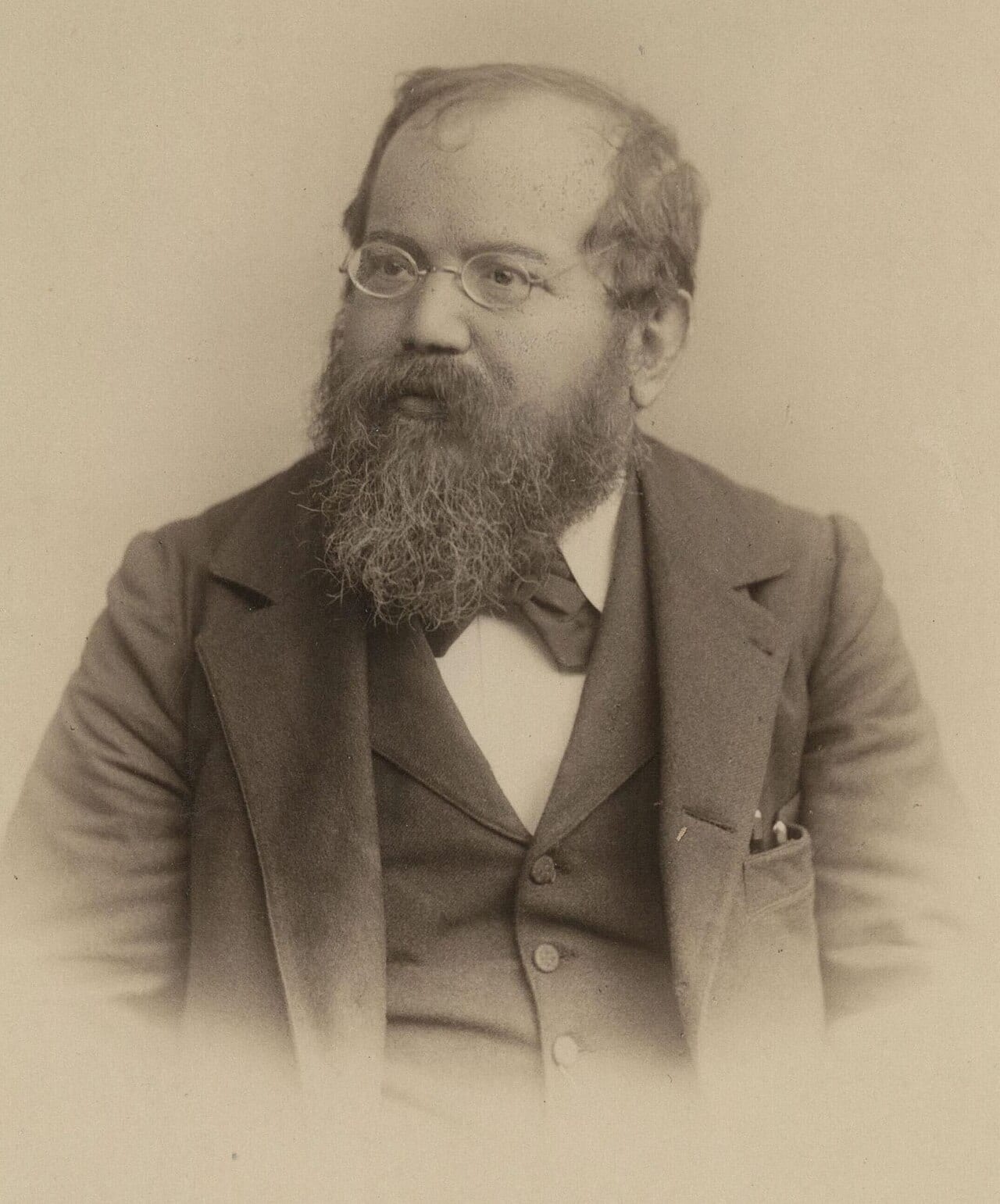
Photo: Schumann, Fritz / Wikimedia Commons (Public domain)
On August 17, 1895, in the English seaside town of Hastings, a 59-year-old man put his rook on a square where Black could take it. Next move he did it again. Then again, and once more. Four times in a row the rook stood where a black king or queen could capture it, and nobody took it.
That man was Wilhelm Steinitz, the first official world chess champion. He was born with a club foot, learned chess at 12 and spent his life showing that chess has rules you can learn. Here is his story, the game of the rook nobody took, and five more of his games to study.
A Small Boy in Old Prague
Wilhelm Steinitz was born in May 1836 in the old Jewish quarter of Prague, which was then part of the Austrian Empire. His father was a tailor, and Wilhelm was one of 13 children in a family with little money.
He was born with a club foot, a foot that turns inward, and it made walking hard for his whole life. He also stayed small, about 1.50 meters tall, which is just under five feet. None of that slowed down his mind.
He learned chess at the age of 12. Historians do not agree on who taught him, a friend of his father or a school friend, so nobody can say for sure.
In the late 1850s he left Prague for Vienna to study mathematics. He later tried to treat chess like a science, with rules you can test. But he stopped his studies, and chess took over.
The Austrian Morphy
In Vienna he improved quickly. He won the Vienna city championship in 1861, and people began to call him "the Austrian Morphy." Paul Morphy was the American star who had beaten Europe's best players a few years earlier, and you can read about him in our story on Paul Morphy. Like Morphy, the young Steinitz attacked, and he loved to sacrifice pieces.
Austria sent him to the big international tournament in London in 1862. He finished sixth, but his win over Augustus Mongredien was given the brilliancy prize, an award for the most beautiful game. You can study it in the list at the end of this article.
He decided to stay in London and make chess his job. He began to beat the best English players in matches, which are contests of many games between two players.
Number One in the World
In 1866 he played a match in London against Adolf Anderssen. Many people thought Anderssen was the strongest active player, because Morphy had stopped playing. Steinitz won 8 to 6, and there was not one draw. After that, most people called Steinitz the best player in the world.
In tournaments, though, he often finished second or third. At Baden-Baden in 1870 he came second behind Anderssen, and that result made him look hard at his own chess. In 1873 he won the big Vienna tournament, and he played in a new, calmer way.
What was new? Steinitz decided that a game is won by collecting small advantages. A small advantage can be more space, a better pawn structure, two bishops against two knights, or a strong knight on a safe square. He believed that you earn the right to attack only after you have an edge, and that when you do have one, you should attack.
Did You Know?
Steinitz gave chess the word "hole." A hole is a square in your camp that none of your pawns can protect any more, so an enemy piece can settle there. When you play, look for holes in your opponent's camp, and try not to leave any in yours.
The First World Champion
By 1886 many people argued about who was the best player in the world, Steinitz or Johannes Zukertort. Zukertort had won the London tournament of 1883, ahead of Steinitz. So the two men played a match for the world championship in the United States, first in New York and then in St. Louis and New Orleans. The first player to win ten games would be champion.
After five games Zukertort led 4 wins to 1. Steinitz then won game after game. By game 9, played in St. Louis, the wins were level at four each. Steinitz won the match 12½ to 7½, with ten wins, five draws and five losses, and became the first official world champion. You can study game 9 below.
He moved to New York in 1883 and lived there for the rest of his life. He kept his title for eight years, and he won title matches against Isidor Gunsberg in New York and against Mikhail Chigorin in Havana, Cuba, in 1892. You can study two of his wins against Chigorin below.
Losing the Title and the Last Great Game
In 1894 Steinitz lost his title to Emanuel Lasker, a German who was 32 years younger. Steinitz was 58. Lasker won ten games, Steinitz five, and four were drawn. They played again in 1896 and 1897, and Lasker won again. You can read about the winner in our story on Emanuel Lasker.
Steinitz kept playing. At Hastings in 1895 he was 59 years old. He finished fifth, but one of his games won the first brilliancy prize of the tournament. He died in New York in 1900. He had never been good with money, and he died poor. But he had changed the way people think about chess.
The Game: Steinitz vs. von Bardeleben, Hastings 1895
It was round 10 of the Hastings tournament, on August 17, 1895. Steinitz had White. His opponent, Curt von Bardeleben, was a strong German master.
The opening was an Italian Game: 1.e4 e5 2.Nf3 Nc6 3.Bc4 Bc5 4.c3 Nf6 5.d4 exd4 6.cxd4 Bb4+. With 4.c3 and 5.d4, Steinitz built a big pawn center.
 8


 7


 2
 1abc
 d
 eh
After 6.cxd4, Black to move. White has pawns on d4 and e4, side by side in the middle. Black's bishop on c5 can give check on b4.
Steinitz blocked the check with 7.Nc3, and Black hit the center back with 7...d5. Then a lot of pieces came off: 8.exd5 Nxd5 9.O-O Be6 10.Bg5 Be7 11.Bxd5 Bxd5 12.Nxd5 Qxd5 13.Bxe7 Nxe7.
Chess players count their pieces in points: a pawn is 1, a knight or bishop 3, a rook 5 and a queen 9. After move 13 both sides had 28 points. Our engine, Stockfish 17.1 searching to depth 20, thought White was a little better, by about one pawn. Now look at the kings. White had castled on move 9. Black's king was still on e8, in the middle of the board.
14.Re1 put a rook on the e-file, the column of squares that runs from e1 to e8.
8721adegAfter 14.Re1, Black to move. White's rook looks up the e-file at the knight on e7. The knight cannot move, because the king stands behind it on e8.
That is a pin. A pinned piece is stuck, because if it moved, the piece behind it would be attacked. Here the piece behind is the king, so the knight has no legal moves at all. Black defended it with 14...f6.
Then came 15.Qe2 Qd7 16.Rac1 c6. Our engine says 16.Rac1 let Black get close to equal, and that Black could have held the balance with 16...Kf7. After 16...c6 White was clearly better, by about two pawns.
Steinitz now opened the position with 17.d5, which attacked the pawn on c6. 17...cxd5 18.Nd4 Kf7 19.Ne6 followed. The knight jumped to a square where Black could not safely take it.
872cegAfter 19.Ne6, Black to move. Black's rooks are still on a8 and h8, where they started. All of White's pieces are in the game.
Look at the two armies. White's queen, both rooks and the knight are all in the fight. Black's rooks have not moved from the corners. Black is even a pawn ahead, 28 points to 27, but it does not help. The knight cannot be taken. If Black plays 19...Qxe6, then 20.Qxe6+ wins the black queen for a knight, because the white rook on e1 guards e6 and Black has no way to recapture.
Bardeleben played 19...Rhc8 20.Qg4 g6 21.Ng5+ Ke8. Now stop and look at this position. White to move. What would you play?
872cegWhite to move. Find the winning move. Hint: look at the knight on e7, and at what guards it.
Our engine finds only one move that keeps a big edge. Every other White move gives about one pawn or less. The move is 22.Rxe7+.
872cgAfter 22.Rxe7+, Black to move. Black can take the rook with the king or the queen, or step away with the king to f8 or d8.
The white rook captures the knight with check, and now Black has four legal moves: king takes the rook, queen takes the rook, 22...Kf8, or 22...Kd8. The last one loses at once to 23.Qxd7, which is checkmate.
What about taking the rook? If the queen takes, White's other rook captures on c8 with check, and the white queen follows. If the king takes, the king is dragged into the open, and the white queen and rook chase it. Our engine, searching to depth 18, says that after either capture White is more than five pawns ahead.
Bardeleben played 22...Kf8. Then 23.Rf7+ Kg8 24.Rg7+ Kh8 25.Rxh7+. Count the rook's moves. On e7, f7, g7 and h7 the white rook stood where Black could take it, and the same engine check says every capture leaves White more than five pawns ahead. That is why the rook was safe. The rook was a bait, and every bite lost.
872cgAfter 25.Rxh7+, Black to move. Black has only two legal moves: 25...Kg8 or 25...Qxh7.
Black has two legal moves, and Bardeleben played neither. He stood up and left the playing hall without resigning, and his clock ran out. He told Steinitz that he was protesting the long applause that followed games. The tournament committee then put up a notice asking visitors to keep quiet.
Steinitz showed the crowd how the attack would have finished: 25...Kg8 26.Rg7+ Kh8 27.Qh4+ Kxg7 28.Qh7+ Kf8 29.Qh8+ Ke7 30.Qg7+ Ke8 31.Qg8+ Ke7 32.Qf7+ Kd8 33.Qf8+ Qe8 34.Nf7+ Kd7 35.Qd6#. That is a checkmate in ten moves. Black could avoid that mate only by giving up a lot of material, and even the best try, 26...Qxg7, leaves our engine with White about seven pawns ahead.
Capablanca, who later became world champion, called this game "one of the last masterpieces handed to us by the Grand Old Man."
Five More Steinitz Games to Study
Set up each game on a board, or play through it on your computer, and look for the idea in the note. The engine numbers in these notes come from our Stockfish 17.1, searching to depths between 18 and 30.
- Steinitz vs. Augustus Mongredien, London 1862 (1-0). The brilliancy prize game, played at the international tournament in London. Steinitz plays the young attacker. Watch the rook: 13.Rf3 and 14.Rh3 swing it across to the h-file, which chess players call a rook lift. On move 16 he plays 16.Rxh7 and gives the rook away. After 17...Kxh7 White is 5 points behind, 26 to 31, yet our engine has White more than three pawns ahead, because Black's king is wide open. The game ends with 29.Qxe8#.
8721agSteinitz vs. Mongredien, London 1862, after 17...Kxh7. White to move. White has given up a rook and is 5 points behind, but look at Black's king and queen.
- Steinitz vs. Adolf Anderssen, Vienna 1873 (1-0). The tournament where his new style showed. Steinitz builds up pressure. He puts rooks on the c-file and the d-file, and the black knight on d7 ends up attacked twice, by the queen on a4 and the rook on d1, with only Black's queen guarding it. After 14...Bxg5 15.Nxg5 Qxg5 nothing guards it at all, and 16.Rxd7 wins it. Count attackers and defenders on one square, and you can see it coming.
8742cdgSteinitz vs. Anderssen, Vienna 1873, after 15...Qxg5. White to move. Black has won a knight, so White is 3 points behind. The knight on d7 has two attackers and no guard.
- Johannes Zukertort vs. Steinitz, World Championship match, Game 9, St. Louis 1886 (0-1). The game that made the wins level. With 22.c4 White's pawns stand on c4 and d4, side by side. Chess players call two pawns like this hanging pawns, because there is no pawn on the b-file or the e-file to guard them. They can be strong or weak. Black's pieces press on them, and our engine has Black a little better here, by about a fifth of a pawn. Our engine marks 31.Rg6 as the move that gave Black a big advantage, and by the end Black is far ahead.
72cegZukertort vs. Steinitz, 1886, after 22.c4. Black to move. White's pawns on c4 and d4 are hanging pawns. Black's rook on c8 already looks down the c-file at c4.
- Steinitz vs. Mikhail Chigorin, World Championship match, Game 4, Havana 1892 (1-0). A Ruy Lopez with a pawn storm. Watch the h-pawn: 11.h4 and 12.h5, and after 13.hxg6 it leaves the board and opens the h-file. White castles queenside with 19.O-O-O, so a rook stands on h1. After 23...Nxd4 Black has won a rook, but it is a mistake. Our engine sees a forced checkmate in seven moves, starting with 24.Rxh7+. The score stops after 28.Qxd4+. Black's only move is 28...Kf5, and then 29.Qf4 is checkmate.
52cfhSteinitz vs. Chigorin, 1892, Game 4, after 23...Nxd4. White to move. White is 5 points behind, and Black's king on h8 has only the pawn on h7 for cover. Find the rook sacrifice.
- Steinitz vs. Mikhail Chigorin, World Championship match, Game 16, Havana 1892 (1-0). A quiet game with a sharp finish. Steinitz pushes his queenside pawns with 28.b5, 33.b6 and 37.b7. After 38.Rd8 the points are level, 17 each, yet our engine has White more than five pawns ahead. The reason is the pawn on b7. It is a passed pawn, which means no black pawn can stop it, and the bishop on c6 guards it.
7dgSteinitz vs. Chigorin, 1892, Game 16, after 38.Rd8. Black to move. The pawn on b7 is guarded by the bishop on c6, and the rook on d8 attacks Black's rook on b8.
What Steinitz Can Teach You
What Wilhelm Steinitz Can Teach You
- Do not leave your king in the middle. Bardeleben's king was still on e8 when the attack came.
- Bring every piece into the game. For the first 18 moves Black's rooks stayed on a8 and h8, and White's pieces were all in the game.
- Collect small advantages first. Attack when you have an edge, as Steinitz taught.
- Before you sacrifice, check every reply. Steinitz's rook was safe because each capture lost.
- Use pins. A pinned piece cannot move, and that gives you time.
- Count the attackers and defenders on a square. It showed how the knight on d7 was lost against Anderssen.
A Habit to Practice
Before you play a move, look at every capture your opponent can make in reply. Ask: if he takes this, what happens next? Steinitz's rook on e7, f7, g7 and h7 was safe because he had checked each capture.
Try it with the puzzle position above. Set it up on a board, play 22.Rxe7+, and then try every black reply, one at a time. Find what White plays after each. Then pick one of the five games in the list and play through it slowly, covering the next move and guessing it.
Related Stories
tournaments • 2026-10-29
Sindarov Wins Clutch Chess After a Dramatic Last Round
tournaments • 2026-10-28
Clutch Chess Day 2: Praggnanandhaa Jumps From Last to First
tournaments • 2026-10-27
Clutch Chess Day 1: Nakamura Leads as a Pawn Strikes
tournaments • 2026-10-26