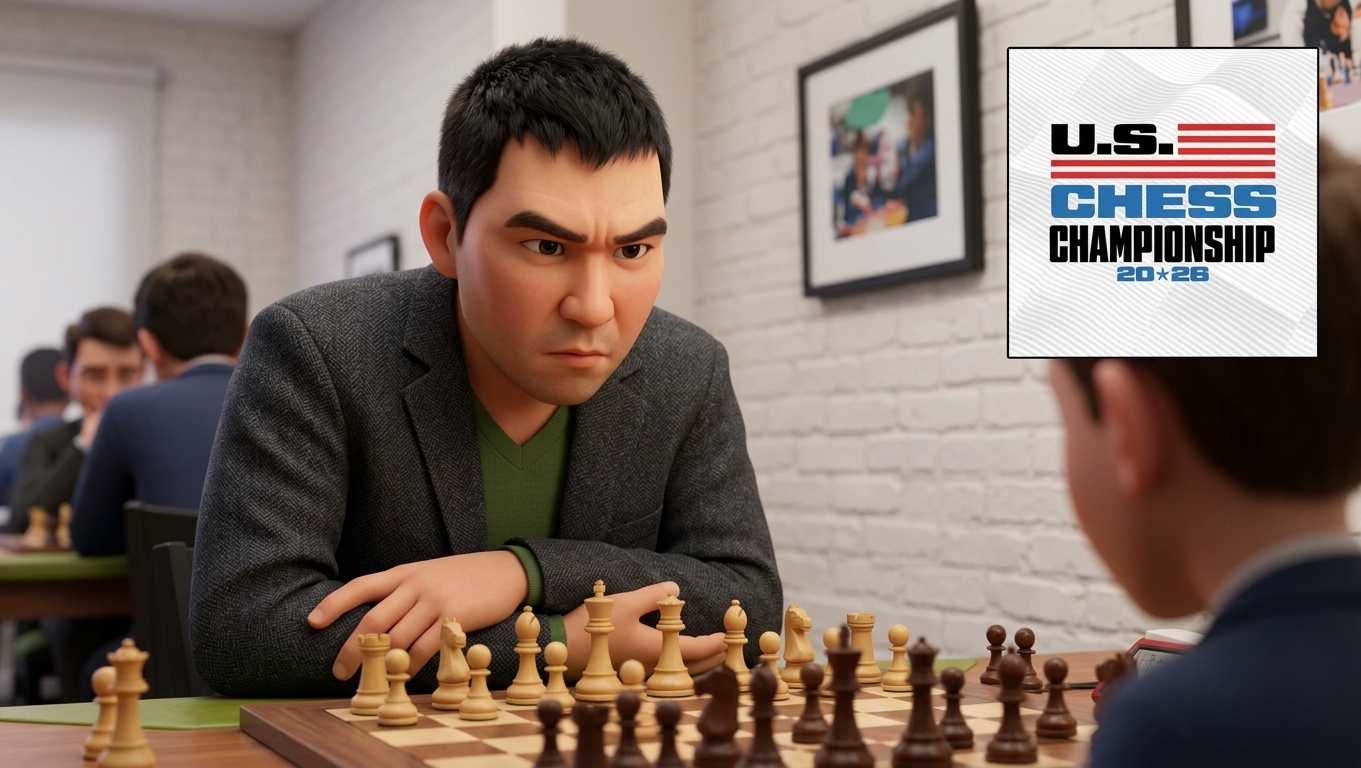
Illustration of Wesley So at the chessboard. This is not a real picture of Wesley So, and the pieces shown are not from this game.
Let us start with a puzzle from the game. It is Black to move. Black has a shot here that turns the whole game upside down. Can you find it? The answer is at the end.


 5
5 4
4


 d
dBlack to move, after 38.Ng3. Find the shot that turns the game upside down.
Wesley So 1-0 Sam Shankland 2026 U.S. Chess Championship, Saint Louis · Round 1 · 9 October 2026 White: GM Wesley So (2774) · Black: GM Sam Shankland (2646)
A birthday gift, nearly returned
Wesley So turned 33 on the day this game was played. He gave himself a win to celebrate, but it was nearly a disaster. So, a three-time U.S. champion, made a big mistake on move 38. Shankland missed the punishment. Then So kept pressing in a rook endgame that was a draw for a long time, until one king move by Shankland on move 64 decided everything. The game lasted 80 moves, the longest of the round.
This game is a perfect endgame lesson. The ending was not simple, but it shows three rules that decide rook endgames: keep your rook active, keep your king near the danger, and push your passed pawns. A passed pawn is a pawn that no enemy pawn can stop on its way to the last rank.
The Game: So v Shankland
A quiet Italian, then a pawn grab
1.e4 e5 2.Nf3 Nc6 3.Bc4 Bc5 4.O-O Nf6 5.d3 d6 6.c3 a5 7.Re1 Ba7 8.a4 O-O 9.h3 Be6 10.Bxe6 fxe6
This is the Italian Game. Both players chose the slow setup with d3 and d6, the kind of position where nothing happens fast and both sides move their pieces around, looking for a better square.
11.Be3 Bxe3 12.Rxe3 d5 13.Nbd2 d4 14.Re1 dxc3 15.bxc3 Qxd3
The first sharp moment came on move 15. Black's queen took a pawn deep in White's half of the board. Taking pawns with your queen in the middlegame always raises a question: is it greedy, or is it good? Here it was good. Our Stockfish 17.1 check at depth 20 picks 15...Qxd3 as Black's best move.
8541adegAfter 15...Qxd3. The black queen has taken the d3 pawn. Black is one pawn ahead for now. Look at the black pawn on e6: nothing guards it.
16.Qb3 Rab8 17.Qxe6+
White won the pawn straight back, with check. The pawn on e6 had no defender. Material was level again, and our engine gave White a small edge, about a third of a pawn.
So pushes his kingside pawns
17...Kh8 18.Qb3 Nh5 19.Re3 Qd7 20.Nc4 Nf4 21.Ncxe5 Nxe5 22.Nxe5 Qe7 23.Nf3 Rf6 24.Kh2 Rbf8 25.e5
White won a pawn on move 21 when the knights traded on e5, and the e-pawn moved up to e5.
25...Rb6 26.Qc2 Rg6 27.Rg1 Nd5 28.Re4 Nf4 29.Re3 Nd5 30.Re4 Nf4 31.Nd4 Qh4 32.Re3 c5 33.Nf5 Qg5 34.g4 Re6 35.Qb3 g6 36.h4 Qd8 37.Rd1 Qc8
So then did what strong players do with an edge: he pushed his kingside pawns. Moves like 34.g4 and 36.h4 sent them up the board toward Black's king. Our engine agreed with him and rated White about a pawn better.
The mistake nobody punished
38.Ng3
Then came 38.Ng3, and the evaluation fell off a cliff. So had a little over three minutes left. Before this move our engine rated White better by 1.18 pawns. After it, the engine rated Black better by 4.82. This is the puzzle position from the start of the article.
Black now had a way to break open the position around White's king, starting with a capture on e5. The answer, with the full line, is at the end.
38...c4
Shankland did not find it. He played 38...c4, and our engine rated the position as level again, 0.00. At the board, with six minutes on his clock, even a grandmaster can miss a shot like 38...Rxe5.
So had dodged a bullet on his birthday.
Into the endgame
39.Qb5 Nd3 40.f3 Qd8 41.g5 Rf4 42.Re4 Rxf3 43.Qxc4 Rc6 44.Qd4 Qxd4 45.cxd4 Nf4 46.Rd2 Rcc3 47.d5 Nxd5 48.Rxd5 Rxg3 49.e6
The queens came off on move 45. Then both knights left the board: Black's knight took a pawn on d5 and was taken by the rook, and a black rook took White's knight on g3. What remained was a rook endgame. White's best asset was the e-pawn, which marched to e6 on move 49 and sat deep in Black's half of the board.
54After 49.e6. Two rooks each and four pawns each. The white pawn on e6 is two steps from the last rank, but our engine already rates this position as a draw.
Here is a rule worth learning: in rook endgames, an active rook matters more than almost anything else, even more than a small material edge. Both players understood this.
49...Rge3 50.Rde5 Rc2+ 51.Kg1 Rxe4 52.Rxe4 Rc8 53.Rd4 Re8 54.Rd6 Kg8 55.Kf2 Kf8 56.Rb6 Ke7 57.Ke3 Rc8 58.Kd4 Rc1 59.Kd5 Rd1+ 60.Kc5 Rh1 61.Rxb7+ Kxe6 62.Rxh7
One pair of rooks came off on moves 51 and 52. Black kept his last rook busy, checking and harassing, while the black king won the e6 pawn. After 62.Rxh7, White had three pawns against two.
62...Rb1
That did not make White winning. Our engine rated the position at 0.00, a dead draw, after almost every move from move 48 to move 63. And 62...Rb1 was the only move that kept it that way. The rook on b1 cut the white king off from the b5 square. Every other black move our engine checked was rated about four pawns better for White.
The king goes the wrong way
63.Rg7 Kf5 64.Ra7
White's rook went to a7 to attack the pawn on a5.
754bAfter 64.Ra7, Black to move. The white rook attacks the a5 pawn. The black king stands on f5, close to White's g5 and h4 pawns, and far from the a-pawns.
Black could still hold. Our engine rates 64...Rb4, keeping the rook active and next to the queenside, at a draw.
64...Kg4
Instead Shankland played 64...Kg4, marching his king toward White's kingside pawns. It looks natural: kings should be active in the endgame. But active means active in the right place. The danger was on the queenside, where White's a-pawn was about to become a passed pawn. Black's king walked to the wrong side of the board, and our engine's rating jumped from 0.00 to more than three pawns for White in a single move.
65.Rxa5 Kxh4
This is the most important moment of the game. In rook endgames, your king belongs near the passed pawn that matters most. Shankland took the h4 pawn, a pawn that did not matter, while White's a-pawn decided the game on the other side of the board.
54bAfter 65...Kxh4. White's a4 pawn is now a passed pawn: no black pawn can stop it. The black king on h4 is seven files away from it.
Textbook conversion
66.Rb5 Ra1 67.Kb4 Rb1+ 68.Ka5 Ra1 69.Rc5 Rb1 70.Ka6 Kg4 71.a5
What followed shows how to win these endings. The white rook went to b5 and then c5, out of the way of its own pawn. The white king walked up next to the pawn: Kb4, Ka5, Ka6. Then So played 71.a5. Passed pawns must be pushed.
71...Kf4 72.Rb5 Re1 73.Rc5 Rb1 74.Rd5 Rb2 75.Rb5 Re2 76.Kb6 Re6+ 77.Kc7 Kg4 78.Rc5 Kf4 79.Kb7 Re7+ 80.Kb6
Black's rook checked and checked, 76...Re6+ and 79...Re7+, but checks without a plan only slow the game down. The game ended after 80.Kb6. Our engine rated White more than four pawns better in the final position.
5The final position, after 80.Kb6. The white king stands next to its a-pawn, and the white rook on c5 keeps the black king away from the queenside.
What to Learn: three lessons to take home
First, tactics do not stop when the middlegame gets quiet. The shot 38...Rxe5 was there in a position where both players had been quietly moving pieces around for many moves. Always ask what your opponent's last move left unguarded.
Second, in rook endgames, rook activity is everything. Shankland held a drawn ending for 16 moves by keeping his rook busy, and on move 62 he found the only move. The moment his king went hunting a kingside pawn, the game was lost.
Third, and most important: your king must be near the danger. The king is a fighting piece in the endgame, and a king on the wrong side of the board only watches. Shankland's 64...Kg4 is a move every club player should study, because it looks so natural.
Puzzle answer
The winning shot was 38...Rxe5. Black gives up a rook for the e5 pawn, to get a strong attack. If White takes back with 39.Rxe5, then 39...Qxg4 brings the queen next to White's king. One line our engine gives is 40.Qxb7 Qxh4+ 41.Kg1 Nh3+ 42.Kf1 Rxf2+, and Black's queen, knight and rook close in on the white king.
White had no good answer. Our engine checked all 46 legal White replies to 38...Rxe5, and every one left Black more than three pawns better. So was lost in the puzzle position, and only Shankland's miss kept the birthday celebration on track.
Related Stories
tournaments • 2026-10-11
A Pawn on e6 and a Rook on the Seventh: Abrahamyan Beats Yip in Round 3
tournaments • 2026-10-11
Three Pawns for a Knight: Shankland Opens Up Xiong's King in Round 3
tournaments • 2026-10-10
One Knight, Two Rooks: Wesley So Beats Jeffery Xiong in Round 2
tournaments • 2026-10-10